Saturday, August 31, 2019
Last week on Art With a Needle
For 33 years we have lived in a house set back quite a way from the street near the bottom of a cul-de-sac. When we first moved in I nailed some house numbers to a piece of scrap treated lumber, stuck it to a piece of scrap metal and set it at the corner of the driveway. Felt very proud of myself. But over the years shrubbery grew into the corner and overran the sign; meanwhile the sign itself rotted away. I have been wanting a new sign for a long time and finally got my wish this week. Don't you love the bright orange aluminum numbers?
More hemming of quilts this week, but mostly I worked on revising the member handbook for PYRO Gallery. This is the kind of fussy writing task that I love to do, but it sure is time-consuming, and at the end of the week, when you realize how much time you have NOT spent in the studio.
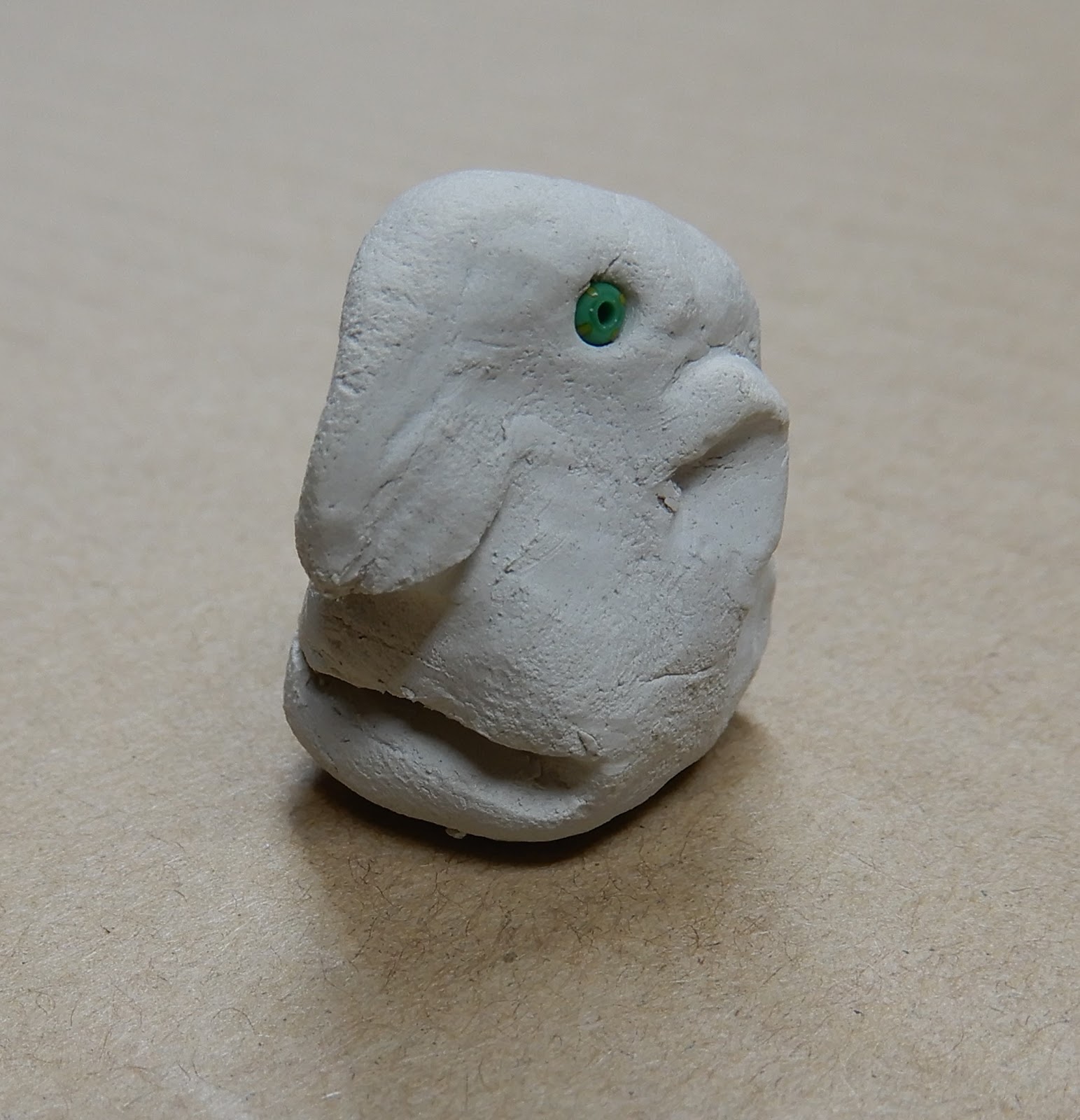
Walking up and down the aisles of the art supply store, I discovered air-drying modeling clay and bought a two-pound hunk. I've been thinking that it would be fun to make some little clay sculptures for my daily miniatures, but didn't want to use Sculpey or Premo because they have to be baked in the oven. My rule for daily miniatures is that they have to be finished by midnight and never touched again except to photograph and store them. Sometimes I will leave a miniature out by itself overnight for paint or ink or Fray Check to dry, but no further making is allowed. So self-drying clay will follow the rules.
Here's my first little guy from the bag of clay, and my favorite of the week:
Wednesday, August 28, 2019
Fiberart International 3 -- more holes
Seen at Fiberart International, which has unfortunately just closed in Pittsburgh.
Marie Fornaro, It is Bread We Fight for, but We Fight for Roses, Too (details below)
It's sort of a quilt, since it contains batting and is layered in some places, but it's more deconstructed than not. Apparently after the large hanging was sewed together, the artist went at it madly with a scissors, slashing and snipping lots of holes and letting the cut-off bits pool attractively on the floor.
I liked the use of old garments, towels and sheets; the touches of red that suggest both roses (as in the title) and blood; the nod to traditional quilt patterns; and the audacity of the crude construction and of course, the slashing,
Susan Avishai, No Place to Hide a Dark Heart (detail below)
It's four layers of an old shirt, hand-cut with scissors into a lacy pattern and suspended about an inch apart, close enough to the wall that the lace casts intricate shadows. I like the way the untouched pocket and collar stand out from the filigree of the cut shirt.
Leigh Suggs, Untitled (Mondrian's City) (detail below)
This is a construction of Mylar on Tyvek, and I'm not sure how it qualifies as fiber art except that it vaguely resembles weaving. What's special about it is the red shadow on the wall, cast that way because the back surface is red. Clever and intriguing.
Six very different takes on holes, transparency and visual weight; I liked the contrasts.
Monday, August 26, 2019
Fiberart International 2 -- lots of holes
Putting holes in previously unbroken materials turned out to be a theme at this year's Fiberart International show, which has been on display in Pittsburgh this summer but just closed two days ago.
My favorite in this category is this pixelated photo treatment made of holes burned into buckram. There are actually three layers of buckram, hanging about an inch apart, and I think the photo is slightly different on each layer. (It may even be two different people, morphing from one to the other.)
Xia Gao, Passing (details below)
Having worked briefly with burning fabric several years ago, I can appreciate the immense control it takes to burn a regular grid of holes without setting the whole thing on fire, and beyond that, to get exactly enough charred fabric around the edge of each hole to produce value gradations to make the image appear. An altogether beautiful piece!
Each of the two venues had its own big, black, hulking suspended sculpture --apparently the jurors really wanted to have something big, black, hulking and suspended, but couldn't make up their minds which one to choose.
Jozef Bajus, Toccata and Fugue (detail below)
This one is made out of shiny black leather, cut into smooth-edged cascades of loops and shapes and hung against the wall.
Zlatko Cvetkovic, Wave (detail below)
The second one is made of video and audio tapes, removed from their cassettes and looped into an airy curtain in mid-room. (Apologies for the out-of-focus photos on both these pieces -- cellphone cameras are pretty capable but apparently don't do well with shiny black stuff.)
But wait, there's more! More holes in the next post...
Saturday, August 24, 2019
Last week on Art With a Needle
A reader left a comment the other day about a very old blog post in which I was complaining about my fancy new washing machine that uses very little water and never gives me the feeling that the clothes are squeaky clean. At the time, that post got more than a dozen comments from people who also hate their washing machines. And apparently people are still stumbling over it, and it still strikes a chord. This week's visitor wrote: "My big problem is the water level. After the wash cycle finishes and before the spin cycle starts I have actually found dry spots of clothing sticking up out of the water that had never gotten wet. How could they get clean if they never got wet?" Amen, sister!
Coincidentally, the same day that she left that comment, I had a washing machine experience that I'd never had before. The two-year-old threw up in the car as it was pulling into our street, so we began the day with a bath and two loads of wash, one devoted to the covers from the car seat plus a couple of towels for ballast. I thought the heavy seat covers would perplex the washing machine, which doesn't just wash things to order but has to think about it first. In the past it has not been happy with large items that get off balance as they spin. But these covers definitely had to be washed, now.
I chose the "Bulky / bedding" cycle, called for extra water, and kept my fingers crossed. When I went into the laundry room some time later, it was nearing the end of the wash cycle and to my amazement, I saw the tub full of water! (The door is glass -- lots of fun for little ones to watch the machine at work.) The water actually came to within four inches of the top of the tub and the seat covers were happily sloshing away underneath.
I have never seen more than an inch of water visible in the tub, so this was a breakthrough. I am now wondering whether I could replicate this in the future, such as when I want to dye, or soak after dyeing.
Out of the laundry room and into the studio.... I decided to sew narrow black bindings onto at least two of my four new quilts, and am now stitching them down. I usually think quilts look more like art and less like bedcoverings when they are finished with facings, not bindings, but for these pieces I think the binding will be unobtrusive, the quilt will be flatter, and it's certainly easier.
Here's my favorite miniature of the week:
Thursday, August 22, 2019
State Fair prizewinners 2 -- the overachievers
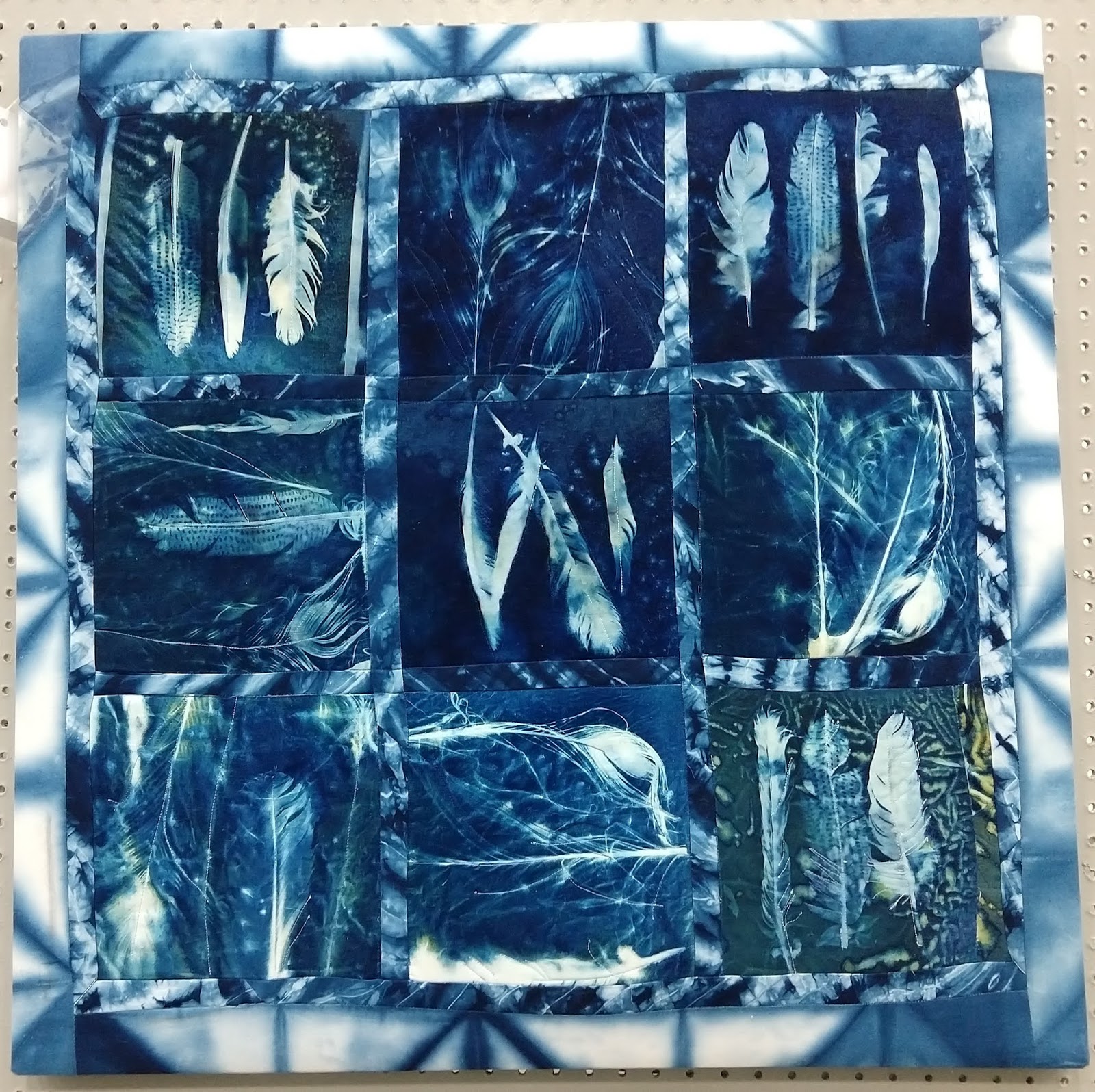
Two of my fiber friends just love to enter the State Fair, and have been regulars in the textile categories for many years. Trish Korte and Kevin Schultz, who both were teachers, spend much of their vacations making art, often working together. For instance, this year you can tell that they had cyanotype play days.
Kevin Schultz, first place, surface design (pretty big -- the dress is adult-size)
Trish Korte, third place, surface design
Trish Korte, first place, stitched fabric construction
But they work in other techniques as well.
Kevin Schultz, second place, stitched fabric construction (an ecoprint of leaves)
Trish Korte, third place, manipulated fiber construction (felting)
Lots of ribbons between the two of them, and lots of beautiful work. Well done!
Tuesday, August 20, 2019
State Fair prizewinners 1 -- best in show
Last week I had the privilege of judging the textile categories in the Fine Arts and Crafts department of the Kentucky State Fair. Here's the big winner, awarded the Best in Show award from Louisville Area Fiber and Textile Artists:
It's a hooked rug by Kaye D. Miller, showing scenes from the life of her father. It has a folk-art flavor but is anything but naive in its masterly handling of color and technique. The little scene vignettes are fit into every spare inch of the composition; the landscapes are realistic; the people are nicely depicted with no facial features. I kept coming back to it, finding new little things to admire each time.
Subscribe to:
Posts (Atom)