Showing posts with label weaving. Show all posts

Monday, September 14, 2020

Inspirational reading for the day


If you're feeling depressed and discouraged today (as who isn't?), here's a five-minute read that will cheer you up.  The New York Times visited a tiny village in Ecuador where the finest Panama hats are made, and gives us a two-page spread of photos and text that will certainly put a smile on your face.  How nice to be reminded that master craftsmanship still exists and is respected.

New York Times photo

(Don't ask me why it took six weeks from the time this story was posted online to get it into the print newspaper.  I guess we dinosaurs who still love paper have to have our noses rubbed into it every now and then.) 

Friday, July 24, 2020

NYTimes strikes again


I love the New York Times.  We've subscribed to home delivery for decades and I couldn't live without its news coverage.  Not to mention its art and music coverage and its editorial columnists and its wonderful photography and its puzzles.  So it really pains me when they drop the ball, over and over, to the extent that I have to make fun of them in this blog.

Such as this spring and summer, when the editors have been desperately reaching for ideas to help people occupy themselves during pandemic quarantine.  I loved to hate their series on Designer D.I.Y.  and so did a lot of you.  Earlier this week, when I snarked a recent NYT article on how to mend jeans with sashiko stitching, one of you commented: "The real mending is called boro."

Gail commented: "In my long experience mending jeans, it's NOT the patch that needs strengthening, it's the thinning jeans fabric around the hole.  I'm going to guess this guy "mends" his jeans not out of need, but rather to make fashiony statements.  As one whose family wore out (still does!) many pair of jeans doing real physical work, the fake wear and repairs just hits me all the wrong way.  Is this where I put in a Harumph! and Get off my lawn!?"

Our running feud with Designer D.I.Y. got passed along to Susan Lenz Dingman, an artist in South Carolina who is one of my online acquaintances from way back.  She wrote me to tell about her recent run-in with the Times' do-it-yourself obsession.  You should know that Susan has made a lot of "vessels" consisting of some cord and a bazillion machine stitches to sculpt and hold everything in place. She writes:

"Last week I received an email from a photo editor at The New York Times.  She found my fiber vessels on the Philadelphia Museum of Art Craft Show's website featuring last year's accepted artists.  She thought they were woven and would make a great DIY "basket" project for the Sunday 'At Home' print edition.  This series of articles is apparently about using actual pages of the newspaper and ordinary things found around an average household.  Her message included links to past projects, including instructions for folding a spread of the newspaper into an envelope and another for coiling strips of the newspaper into decorative paper beads.

"I knew at once that there were problems.

"First, my fiber vessels aren't woven.  I don't weave, never have.  Second, the process is rather laborious.  Third, even though I have written a free online tutorial for making my fiber vessels, the instructions can't be simplified into a neat, four or five step process.  Yet... this was an email from THE NEW YORK TIMES.  I was personally floored that anyone from such a prestigious publication would have found me.  I didn't want to write back with a simple NO.

"Immediately my husband Steve went to our local grocery store and came back with two copies of last Wednesday's edition.  Within twenty-four hours, I managed to create a fiber vessel.  I blogged about it HERE.  My response to the photo editor's message included images and a nicely phrased suggestion that my work is available should the newspaper ever want to feature work by artists who have incorporated their newspaper.  She was impressed but asked if I couldn't figure out a simple woven basket using strips of the newspaper. Politely, I declined, citing my inability in weaving as an excuse.  Yet, in the back of my mind I thought to myself, 'Susan, so you really want to have your name in The New York Times for a silly, simple DIY project that looks like an elementary school craft project?'  My answer to myself was another NO.

Susan Lenz Dingman, "Black & White and Read All Over: The New York Times"
"I am writing today mostly to say THANK YOU!  Your blog posts confirmed my suspicious regarding this odd opportunity.  I'm glad I didn't attempt to figure out something appropriate!"

Meanwhile, at today's breakfast table my husband pointed out a NYT feature for kids, in which they're supposed to get points for doing various virtual activities with their best friend, such as writing a letter, reading a book together or watching the same movie together/apart.  They're supposed to check off when they do an activity, and keep a running total in the corner.

Let's hope there's a white gel pen at hand to do that checking.

Friday, January 12, 2018

Tension headaches


Our fiber art group just scored two huge garbage bags full of old doilies and tablecloths in a variety of techniques -- crochet, tatting, hairpin lace, cutwork, bobbin lace, embroidery and who knows what else.  As we sorted through, contemplating what we'll do with them, I noted how some were obviously made at less-than-expert level craft.

And I thought, as I have so often in the past, that in every single fiber art, the key to mastery is control of tension.

Check out this cute little crocheted doily, made in granny squares.  The white is tighter than the pink, hence the 3-D effect.

When I first learned to crochet, taught by my mother-in-law, I made a fairly large afghan.  I was proud of how neatly it was done, flat and even -- until I finished and tried to fold it up.  Oops -- one end was a good six inches longer than the other!

What had happened, of course, was that as I got more comfortable with the yarn and the stitch, I eased up on the tension and the finished fabric got more expansive.

I have taught many beginners how to crochet, sew and embroider, and have watched myself try to learn knitting, weaving, felting, macrame and many other techniques.  In 99% of the cases beginners' work is too tight.  We clench up on the needle or hook or whatever tool we're using, we pull too hard on the thread or the yarn, we hang on too tight to the underlying material.  We grab that quilt in a death grip and resist the pull of the sewing machine; we wrap the french knot so firmly that we can barely pull the needle through; we tug the weft through the weaving so hard that the selvages bow inward. 

(Weavers may correct me on that last remark -- I think some beginners err in the other direction, leaving the weft too loose so the selvages are uneven and loopy.  But that's the other 1% of tension headaches.)

The problem usually disappears with practice; we relax, we learn to let the yarn flow easily, we develop muscle memory so all the stitches have the same tightness throughout the whole work.  In knitting parlance, we automatically maintain the right gauge without having to stop and measure all the time. 

That's not to say we can stitch in oblivion.  It's still good to stop every now and then, lay the work out flat, check how it's coming along.  Note whether your afghan is still the same width as when you started.  Check that the second sock is the same size as the first one.  Make sure your seams are smooth, not drawn up in a ruffle.  Look at the back of your work and see that the threads are well-behaved, not forming tangles and knots. 

It's not just the sewist that can have tension problems -- the machine can too.  In my experience, Bernina sewing machines, which I love, adore and have used exclusively for almost 30 years, have one achilles heel, and that's tension control.  I have had to learn tricks to keep them from spoiling my work: avoiding threads that the machine doesn't like, making sure the bobbin thread matches the top thread so if it's pulled up too far, it will be less visible. 

All these issues are part of mastering the craft of our art.


Sunday, August 20, 2017

My favorite things 34


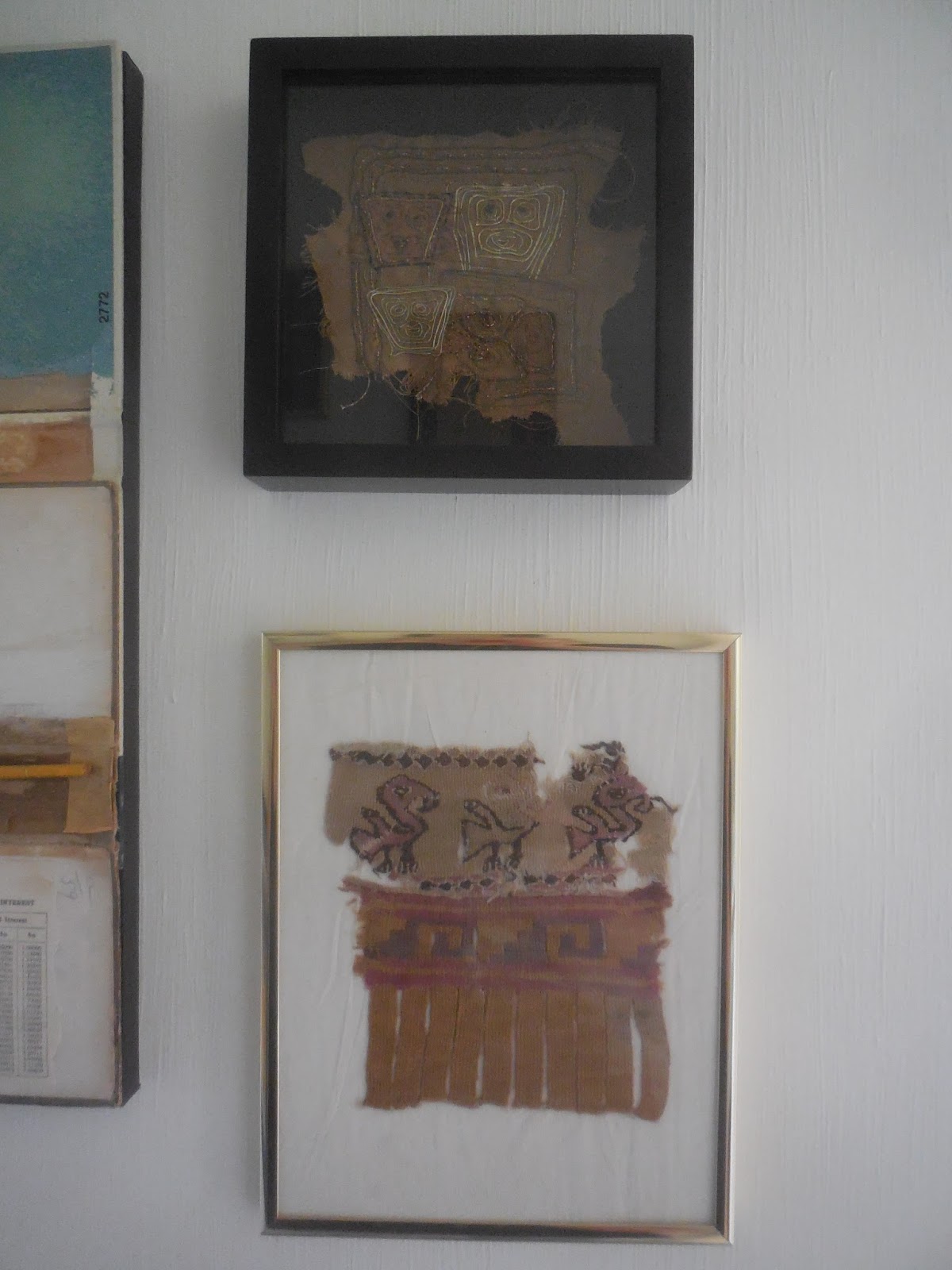
My parents traveled frequently to South America and brought home various souvenirs that my siblings and I now own.  One of my favorites is this fragment of weaving from Peru, made by the Nasca people in about 1500 A.D.

It's not the oldest thing I own, but is by far the oldest textile, and is well preserved; the dry climate of the coastal deserts west of the Andes has kept lots of cloth in excellent condition over many centuries.  It has the traditional birds, steps and spirals of ancient Peruvian textiles, and its red and gold colors are still relatively bright.

After I'd owned this for many years, I bought a contemporary piece of embroidery that shares the pre-Columbian sensibility, a small piece by my very good friend Bette Levy.  It has four mask/faces painstakingly executed in couched metallic threads, onto a frayed linen background that looks a whole lot like the real antique.

(My apologies for the reflections and glare in all the images, because both textiles are framed under glass.  I know that glass protects fragile art, both from dust and flying objects and from UV light, but I always wish that textiles would be open so they can be better seen and appreciated.)

Of course the two pieces had to be hung together, and that's how they have been for a decade, keeping one another company across the centuries.


Thursday, March 3, 2016

More weaving from Wendy Weiss


I wrote yesterday about Wendy Weiss, a fiber artists whose show is on display at the Patio Gallery in Louisville through March 29.  I always love to attend gallery talks with artists, because you never know what you might learn, and this time was no exception.

What I learned from Weiss, who likes to dye her materials with plants from her own garden, is that nylon monofilament (aka fishing line) loves to be dyed!  It's a manmade fiber that was engineered to replace silk, and thus was given many of its qualities, including its affinity for acid dyes.  Weiss likes to use the fishing line as a weft.

You can see this most clearly by inspecting the selvages of her flat pieces.  I was pleasantly surprised to see that Weiss violates the classic rule that a perfectly firm selvage is the mark of the master weaver.  Instead, she lets her selvages loop out into space, making an airy edge that shows off the dyed nylon and casts jaunty little shadows on the wall behind.


Wednesday, March 2, 2016

Wendy Weiss -- ikat artist


This month's show at the Patio Gallery in Louisville features work by Wendy Weiss, a fiber artist who specializes in natural dyeing and ikat weaving.  She has twice had Fulbright fellowships to visit India, learn traditional ikat techniques and work with the local artisans to develop new marketable designs.

She gave a gallery talk at the opening reception last week and I am left with new awe for the traditional artisans who mastered this complex method of weaving.  In ikat, the design for the cloth is dyed separately into the warp and weft threads, then they are put together on the loom and if you're very good at it, the chosen pattern will emerge perfectly.

If you have thought of ikat as "painted warp," you are seeing only the tip of the iceberg, and as Weiss said in her talk, "I've always thought of that as cheating."  True ikat starts long before you get near a loom.  The threads are stretched onto an armature and then tied in small groups -- in some traditions, as few as four threads at a time -- following a graph paper design.  In her own work, Weiss has emulated the method in which the threads are doubled over in the center, with top and bottom parts of the warp tied together to create a mirror image when it's unfolded and woven.


Weiss also explained how to tell whether an ikat is single or double -- that is, whether it's patterned on both warp and weft, or just one.  Look at the places where colors abut.  In the checkerboard piece below, just the warp (horizontal in this photo) is patterned.  Thus you get ghost lines crossing the warp where the black and white warp patterns don't align perfectly, but sharp lines where the weft threads have no pattern to worry about.

Weiss has been experimenting with text as her ikat design.  Here's a detail of her piece titled "Resist," an appropriate double entendre for a dyer.

She has a huge wall-sized text piece in the prestigious 2016 Lodz Tapestry Triennale, which opens in May.  The actual tapestry has been shipped to Poland already, but a photo by Weiss's husband Jay Kreiner is in the exhibit.

It's based on one of Kreiner's photos of the commemorative sign at the site of the Lodz ghetto, taken on an earlier visit.  Each of the letters is woven into its own panel.

The show continues through March 29.