Showing posts with label International Honor Quilt. Show all posts
Monday, February 22, 2016
IHQ on display
I've been working for more than a year as a volunteer to catalog the International Honor Quilt, a project undertaken in the 1970s and 80s as a companion piece to Judy Chicago's great feminist work, "The Dinner Party." It consists of more than 500 24-inch panels made by women around the world to honor other women. Many of the panels honor famous women, but most are less well-known -- perhaps the maker's mother, grandmother, aunt, third-grade teacher or stitch-and-bitch sewing club buddies.
The collection was donated to the University of Louisville and it is now on display at the Hite Art Gallery of the School of Art. I visited the exhibit this weekend with several members of the Surface Design Association.
The panels had been hung once before, for a short period of time right after U of L acquired them, just so people could see the whole collection. There was no attempt to make an aesthetically appealing display, just to get everything up on the wall and have all the panels right side up (some are upward facing, others are downward facing). Here's what it looked like as we were putting them up:
Now. a year later, there's a formal exhibit up (through March 19) and the people who hung it decided to go for fancier visual effects. Which I think came off pretty well! Some of the groupings were thematic, such as this bunch of panels honoring the same woman in Quebec (I think she was the grandmother and great-grandmother of the various makers).
Other groupings were geometric, although in some cases like shapes or images were put together.
I think the new arrangement is a good idea. It's difficult to display hundreds of small units of anything, especially when they're all identical in size and individual bits, no matter how attractive, tend to blend into an allover effect. With these geometric arrangements, the individual panels still are hard to differentiate from one another, but the smaller groupings draw your eye and make you want to come closer and look.
Friday, December 4, 2015
Brits to the rescue
I am always amazed at how you can ask an obscure question on the internet and within a few hours come up with an answer!
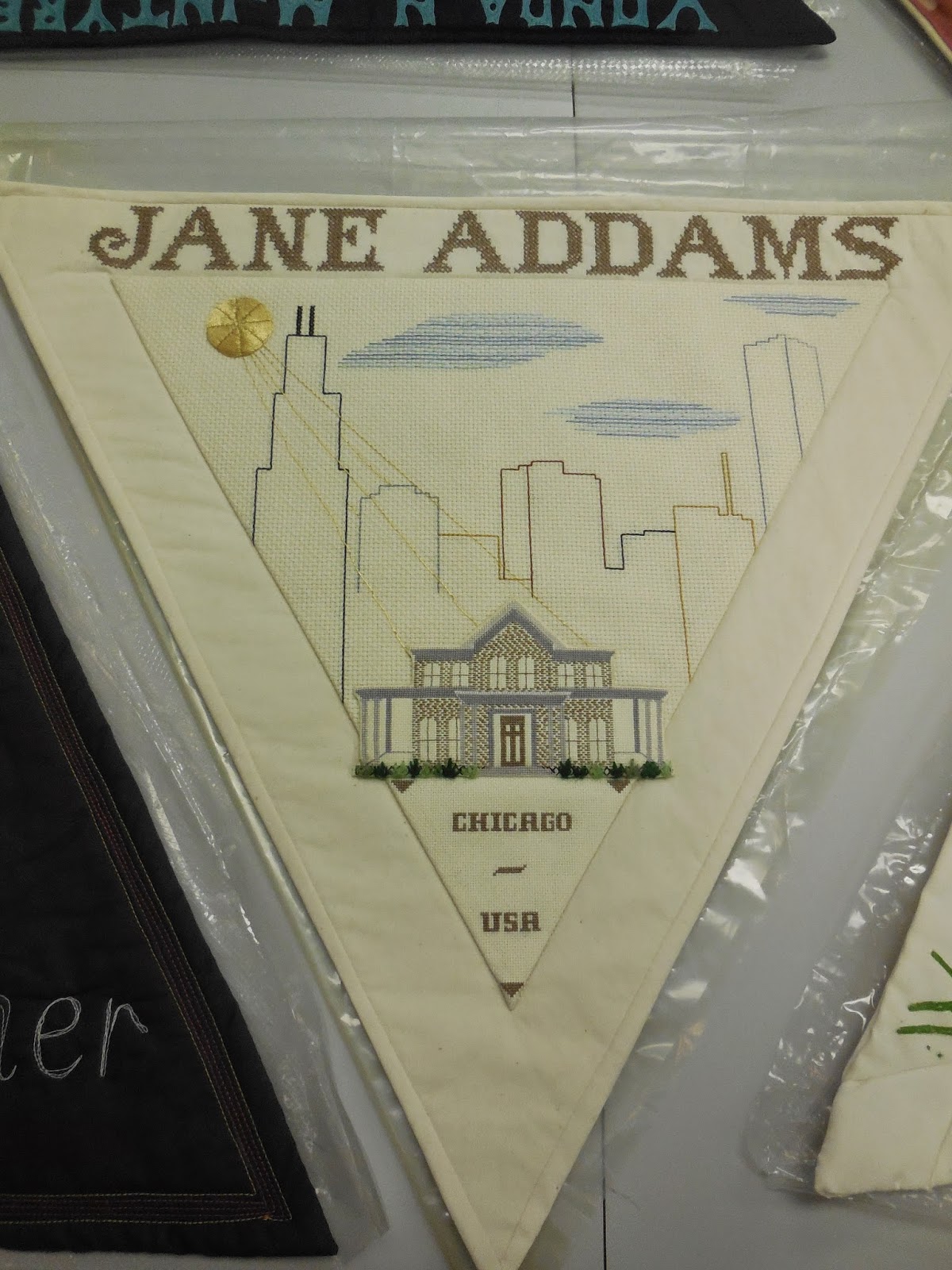
The question was what this fancy food concoction is, pictured on a needlepoint panel in the International Honor Quilt project.
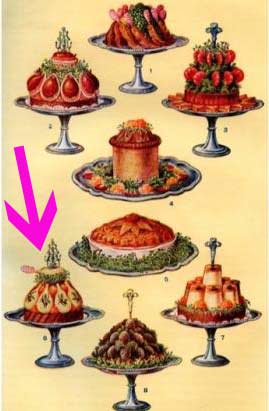
Four readers directed me to a page from Mrs. Beeton's cookbook that has to be the model for this panel.
But what is it? You find it on a page called "cold collations" and this one is entitled "lamb cutlets." What's a cold collation?
Apparently we would call it a buffet -- a bunch of cold foods arrayed on a bountiful table with an eye to visual as well as culinary appeal. (And some writers suggested the visual could greatly outdo the culinary.)
So I think I can see the lamb chop shapes in the needlepoint panel; the one on the top seems to have a little paper frill on the tip of its bone (it looked like a puff of steam to me at first). But I still have no idea what else we're looking at.
How come the lamb chops are white? Are they propped or mayonnaised into position around a round loaf of rye bread or a pudding, or is it a thin food shell over a plain upended bowl? What makes up the green and red decorations? What's the braid effect at the bottom?
Way more questions than I had to begin with.
But a huge thank you to the readers who again stepped up to help allay my ignorance. You're wonderful!
Wednesday, December 2, 2015
Calling all Brits
Several weeks ago I had a fabulous success after asking for help from my faithful readers on a problem that arose while I was cataloguing the panels in the International Honor Quilt project. That cry for help was for translating or transliterating some Inuit words embroidered on a panel made in northern Quebec, and amazingly, within a couple of hours I had more than one volunteer!
Now I have another cry for help, but this one on the other side of the ocean. I need someone more familiar with British culinary customs than I am.
This panel -- executed in beautiful needlepoint -- was made to honor Isabella Beeton, the famous early cookbook writer, and its centerpiece is this elaborate food fantasia. The person who catalogued the panels 20 years ago thought it was a roast, but I don't, despite the lethally sharp knife in the background. Is it some kind of Christmas pudding? And what's the little white cloud of steam being emitted at top right?
I'll be wildly grateful for any help you can provide!
Monday, October 5, 2015
I can't believe what the Internet can do for you
Last week I posted a panel in the International Honor Quilt project, made in northern Quebec, that celebrated Inuit culture. I asked whether anybody knew anybody who could help me type in and/or translate the writing.
To my utter amazement, I got four responses from people who said they could help! Thank you so much to all of you -- I am so appreciative that you responded and offered.
First to write me was Judy Martin, my longtime internet friend whose work and blog I love. She volunteered her brother, who has worked with Canadian aboriginal languages, and in a couple of hours he wrote me back with the text typed in:
ᒣᓇᕿᓗᑭ mainiqiluki
ᐳᕕᕐᓂᑐ puvirnitu
ᑯᐯ kupai
Apparently "Mainiqiluki" is the woman being honored in the panel, "Puvirnitu" is a variant of Puvirnituq, the town where the panel was made, and "Kupai" is the abbreviation for Quebec. And the name of the language is not "Inuit" but "Inuktitut."
Here's where Puvirnituq is:
As it turns out, there's a second bunch of Inuktitut that we may want to have translated, a piece of paper that presumably explains more of who made the panel (we know it was a sewing class) and who Mainiqiluki is. But that would require higher-level translation that Judy's brother can provide. If the project director wants to go that far, I may be calling on the other three comment posters for their help after all.
Meanwhile, let's take a minute to contemplate how impossible such a transaction would have been in the days before the Internet. What took less than a day to accomplish would have taken weeks, maybe months. And I marvel at how I've had the privilege, through the Internet, to build such a wonderful network of friends and connections.
Wednesday, September 30, 2015
Need help from Canada!
I've written before about my ongoing volunteer work to help catalog the International Honor Quilt project, organized by artist Judy Chicago, in which hundreds of panels were made to commemorate women and women's organizations. Part of my job is to document what the panels look like, and to accurately transcribe any lettering.
I've had to learn how to type characters with diacritical marks (ä, ç, ê, etc.) and in non-Roman alphabets (θ Σ Δ Ω π). It took me four emails back and forth with my Hebrew advisor to get this one right -- הדסה -- because the type-Hebrew keyboard I found on the internet didn't have names on the letters and I had to find something that looked like the one on the panel, except in a different font so the letters didn't look exactly alike.
Today I need help! Here's a panel, made in Povuknituk, Québec, (aren't you impressed by that accent mark?) depicting Inuit culture with Inuit words around the edges. I don't even know which way is up with the characters.
Who knows somebody who could help me (a) translate and (b) type in this lettering for our database? Many thanks, much glory and maybe even a bit of loot if you can solve my problem du jour.
And while we're here, check out the beautiful embroidery on the central figure!
Monday, March 2, 2015
Is it a quilt? 2
I wrote last week about the definition of quilt for purposes of acceptance into quilt shows, but the subject came up again in a very different context -- the so-called International Honor Quilt project, which I am working on as a volunteer. (click here to read my past postings on the IHQ) The University of Louisville has acquired the IHQ, organized 35 years ago by the famous feminist artist Judy Chicago, and is now trying to get all the panels catalogued and posted online for research.
Recently we spent the better part of an afternoon discussing what should be put on the website to tie the IHQ to the traditions of quilting. Because I had the strongest opinions I got to write the first draft:
The project was originally called the International Quilting Bee, later changed to the International Honor Quilt, so it must have something to do with quilts, but the word "quilt" has different meanings to different people.
Traditional quilters, who make quilts to go on beds, and artists who use the quilt form, would probably define "quilt" by its functional attributes: two or three layers of fabric, held together with stitches that go through all the layers. By this definition, most of the panels in the IHQ are not quilts.
But the general public probably thinks of a "quilt" as some kind of flat fabric that has been worked on by hand. To this audience, the word has powerful emotional overtones, conjuring thoughts of their own grandmothers, of textiles that comfort and protect, and old-time rural women gathered around a quilting frame at a quilting bee to socialize and stitch. These connotations of women working together using traditional craft techniques were a critical element in the art of Judy Chicago and other feminist artists as they sought to reclaim and elevate the historically devalued female skills of needlework and other domestic crafts.
Interestingly, the term "quilt" was also used in this context to describe the AIDS Quilt, a project on which Chicago was also involved. The word is a metaphor for personal connections, the comfort and protection of textiles, and the use of fabric and handwork to make memorials to loved ones, although quiltmakers would think that few of the AIDS panels are technically quilts.
![]() |
| 40,000 panels of the AIDS quilt on the Mall, Washington DC, 1996 |
So does this description make sense? What do you think?
Wednesday, February 11, 2015
IHQ 3 -- Happy Valentine's Day!
Just in time for Valentine's Day, I found two panels in the International Honor Quilt box yesterday that are perfect for the holiday.
Here's a piece made by a group of quilters in Evanston IL in 1982. The maker of the concentric hearts with the crochet medallion was Kay Burlingham; the maker of the brown appliqued hearts was Marissa Zwick. Each of the makers left a threaded needle in the panel, ready to take up for more stitching.
Here's a piece made by Sally Jane Nelson in honor of her mother. She found an old linen handkerchief or tablecloth, so finely woven and well used that it is almost translucent. At the right, elaborate floral embroidery from its first life; on the wrist, a bit of cutwork embroidery.
She put the heart and hand onto the panel with beautiful shadow applique, putting pink and red shapes underneath the handkerchief and outlining them with hand quilting. What beautiful work!
Thursday, January 15, 2015
IHQ 2 -- really sloppy work
What I'm finding as I go through the "International Honor Quilt" boxes is fascinating, so I'll share some of it with you as I work. My first observation is that much of the handwork is truly bad.
I wasn't aware of the IHQ project in the 1980s but I would have imagined it to be a magnet for accomplished needlewomen to show off their skills while honoring somebody they admire. And there were obviously many people like that; I'll show you lots of examples if you stay tuned. But there were also a lot of women whose desire to participate far outran their sewing skills -- and that didn't stop them.
Which I find admirable, in a way.
So often needlework is judged solely on its technical quality -- look at all those dull, boring and artistically empty works that win blue ribbons at the state fair because they were quilted at 24 stitches per inch or knitted on size 0 needles -- and many people think their goal is simply to get better at the stitches, rather than getting better at the aesthetics. Many people, for instance, have been sewing or knitting or whatever for decades and it has never crossed their minds to work without using somebody else's patterns.
So I might have imagined that women without excellent sewing skills would have shied away from the project, embarrassed to submit work that wasn't up to Quilt Police standards. But clearly I was wrong.
If I were feeling pessimistic I might take this as bad news, another nail in the coffin of needlework as fine art; if needlework displayed in a museum or gallery looks like amateur hour doesn't it make it harder for us serious artists to be taken seriously?
If I were feeling cynical I might make comparisons to the postmodern practice of sloppy craft, in which Famous Artists are free to do slapdash work, but I don't believe that these panels are in the same ballpark. The Famous Artists are trying mightily to Make Art, whereas these ladies were just trying to make a statement about somebody they admire.
I've always been a snob about craftsmanship, practicing it myself and admiring it when I see it on others' work. So I'm conflicted about the occasional lousy craft I'm finding in the IHQ panels. And the fact that these panels are so obviously earnest and sincere somehow makes it worse (apparently my thinking has been corrupted by the pervasive irony that hadn't quite taken hold when the IHQ was made).
I hashed this out at great length last week during a road trip with my art buddy Marti Plager (we've done a lot of good art thinking on more than a decade of road trips). After much back and forth, Marti said, "Well, Kathy, this is just something you're going to have to come to terms with." And she is so right.
What do you think?
Monday, January 12, 2015
IHQ 1 -- Ana Lupas
I've written about my new volunteer gig, helping to catalog the "International Honor Quilt" collection of panels that were made to accompany Judy Chicago's Dinner Party installation. What I'm finding as I go through the boxes is fascinating, so I'll share some of it with you as I work.
My favorite piece in the first 200 panels I've catalogued is this one, by Ana Lupas:
Yes, at first glance it looks pretty awful, a mess of raggedy interfacing and loose thread ends. But as you look more closely, you notice the intricate machine-stitched gridwork in the center:
Why did this piece call out to me so loudly? I love grids, and I love dense machine stitching, and I love old-fashioned typewriters like the one used to type Lupas' name and address on the interfacing. But what I really admire is the supreme confidence of an artist who can put such humble materials together -- the edges are secured with staples! -- and make them stand up straight and proud.
The panel stood out from the others -- not pretty, not earnest, not awkward or amateurish, despite its seemingly haphazard construction. It's the only one I've seen so far that strikes me as art rather than as decoration.
I had never heard of Ana Lupas, but some research reveals her to be 75 years old, living in Cluj, Romania, where she was born. She started her art career as a tapestry weaver and was exhibited in all the major shows, including several times at the the Lodz Triennial, where she won Gold and Silver medals in 1979.
She expanded her work to installations and happenings, especially outdoors where she was among the earliest Land Art practitioners and strongly influenced many of her fellow artists in Eastern Europe. She would enlist people from villages to construct wreaths, towers and other forms from straw, then leave them outside for years to weather and disintegrate. Predating Christo's Running Fence, she had 100 women help her cover an entire hill with clotheslines of wet linens.
Ana Lupas, Humid Installation, 1970
I'm afraid she will remain a mystery to me; her work calls out to me across the years but leaves me hungry for more.
This is cross-posted to Ragged Cloth Cafe, a blog about art.
Wednesday, December 10, 2014
My new "day job" 3
The 600+ panels in the International Honor Quilt collection were supposedly catalogued in 1994, but don't try to take that to the bank. The database is supposed to include information on the panel, the woman or group honored in the panel, the maker of the panel and biographical information about her, the maker's statement (about why she chose the honoree, how she made the panel, or whatever else she wanted to say), technical information on the panel's condition, measurements, materials and techniques, and a detailed description of the panel.
Materials, techniques and description are my responsibility, while the other fields are being checked and corrected by others on the project staff. In my three fields, we're finding that some panels have no information at all, while others have been incorrectly described.
For instance, 18 of the first 54 we've gone through had no information on materials, techniques and description! That's a lot of blank spaces in the data base.
But even the ones that have been filled in by past cataloguers need to be carefully checked for accuracy. The previous cataloguers sometimes confuse hand and machine stitching and use catchall terms such as "hand sewn" instead of distinguishing between hand piecing, hand applique and hand embroidery. Considering that this project is officially about "quilts," it's discouraging that they have not carefully distinguished between quilting and other forms of stitching.
One of the cataloguers seemed enamored of the term "partial machine construction," which means nothing to me. "Top stitching" is frequently used as a descriptor, except sometimes it means machine applique, other times it means quilting, still other times it means embroidery.
the cataloguer thought this beautiful padded satin stitch was machine embroidered
The previous cataloguers also didn't pay much attention to how the edges of the panels were finished -- traditional quilt binding, facing, knife-edge finish, fabric from the front or back of the panel folded over the edge and stitched down on the other side, or whatever. In many cases there was no description at all of the edge, and in others it wasn't accurate.
In addition, we've decided that consistency in the descriptions is a virtue, so I'm rewriting them to always begin with the "border," which almost always contains the name and location of the honoree, then describe the interior triangle, then the edge finish, finally the reverse.
So I inspect each panel, compare it to what the cataloguer wrote, poke and prod the work to determine what techniques were used, occasionally feel the goods with my ungloved hand to identify the material, and write my own notes. Then at home I type it all into the database; it usually takes me a bit longer to type up the notes than it did to inspect the panels.
The curators had acquired several pairs of those baggy, limp white cotton gloves to protect the quilts, but I said we needed Machingers to make it easier to work, so as of yesterday we're the proud owners of four pairs! I have a long embroidery needle that I use to poke at the work and lift an edge or pull a seam open to see how it was stitched, a ruler to measure the borders and a magnifying loupe to get a better look at the stitches if necessary. And we had to get a metric tape measure to do all the dimensions in centimeters (we argued for quite a while about whether to stick with inches, but couldn't agree on whether to say 1.125 or 1 1/8 and whether those three decimal places were misleadingly "accurate").
I had to gingerly poke at this one to determine that the tiny orange stitches are made with a punch needle, not french knots
But enough about research methods; more in subsequent posts about what I'm finding as I inspect the panels.
Labels:
feminism,
fiber art,
International Honor Quilt
Tuesday, December 9, 2014
My new "day job" 2
When I learned last summer that the University of Louisville School of Art had acquired the panels made by hundreds of volunteers to accompany Judy Chicago's The Dinner Party, my heart sank. I had two major concerns.
First, I was afraid that the panels would be portrayed as works of art, even though I suspected that many of them would have that loving-hands-at-home air -- exhibiting neither excellent craft nor compelling visual imagery -- that is the antithesis of serious fiber art. I was afraid that such an endorsement would taint the air, at least locally, and make it easier for people to lump all fiber art into the same shallow bucket, awash in earnest sentimentality.
Second, I was annoyed that the collection was officially named the International Honor Quilt, even though many of the pieces in my first viewing were not quilts. It's the same quarrel I have with the "AIDS Quilt;" it chops me that the "most famous quilt in the world" is not a quilt, because that disrespects the many works that truly are quilts and encourages people to be haphazard in how they talk about all fiber art and textile techniques. (Chicago was also involved in the genesis of the AIDS Quilt, so perhaps her cavalier attitude toward nomenclature affected both projects.)
not a quilt
When my fiber and textile art group met with the curators in August and got to see some of the panels, I raised this issue of nomenclature. It didn't get much response from the curators, none of whom had much experience with fiber art, until I said, "I know that you must be really annoyed when people refer to your work incorrectly, using the terms 'painting' and 'print' interchangeably." (Winces from the other side of the table; laughter from the assembly.) "Well, that's the same way I feel when people don't use the term 'quilt' correctly -- it's like fingernails on the blackboard."
But I left the meeting with a feeling that the best -- perhaps the only -- way to be sure my concerns didn't become unpleasant realities was to get involved myself. I was reassured that the curators had backed away from the earliest PR-release language touting the collection as "an artistic treasure" and were viewing it more as a sociological event, a remarkable outpouring of response from women around the world, embodying the ardent feminism that today seems quaint.
not a quilt
And I was determined to honor the work of these women by describing it correctly. The curators said at the meeting that they hoped to get volunteer help from our textile group in the cataloguing, and I immodestly thought that I probably had as wide a knowledge of textile techniques as anybody else in the group. So I told the professor in charge of the project to count me in.
Labels:
feminism,
fiber art,
International Honor Quilt,
quilts
Monday, December 8, 2014
My new "day job" 1
I'm about to tell you several posts worth about my new volunteer project at the School of Art at the University of Louisville. Today, the back story.
It starts with Judy Chicago's magnum opus, The Dinner Party, made in 1975-6, first exhibited in 1979 and now on permanent display at the Brooklyn Museum of Art. Widely regarded as one of the high points in feminist art, it is a huge three-sided table with 39 place settings, each one commemorating a famous woman in history with an individualized plate and placemat. An additional 999 women were memorialized on floormats on which the table rested.
The exhibit toured the world for nine years, drawing huge crowds, and many of the women who saw it were moved to wish that their own favorite women could be included in the show. At some point Chicago invited submissions from anybody who wanted to make a panel. Hundreds of panels came in, and on later stops in the tour they were displayed as part of the Dinner Party installation.
The panels covered famous and not-famous women; many people honored their mothers, grandmothers, next-door neighbors and teachers. Others chose women's organizations such as the League of Women Voters, the American Association of University Women or La Leche League. Some depicted fictional, mythological or Biblical characters, groups such as farm women or pioneers, or universal themes such as menstruation.
There were only two rules: each panel should be an equilateral triangle, 24 inches on a side, and around the edges of the triangle should be written the name of the honoree and her city and country. Beyond that, the format, materials and techniques were up to the makers.
After the world tour, both The Dinner Party itself and the more than 600 volunteer-made panels went into storage. Last year, Chicago's foundation donated the panels to the University of Louisville, and the school is now grappling with the task of properly documenting them.
In a moment of some kind of mental aberration, I decided that I needed to be involved with this project, so I'm spending several hours a week with the panels and a spreadsheet, helping the curators with the technical details of textile techniques and materials. I'll tell you more about the project and my role in it in subsequent posts.
Labels:
feminism,
fiber art,
International Honor Quilt
Subscribe to:
Comments (Atom)