
Friday, June 17, 2011


Thursday, June 16, 2011
Home again
In the olden days of wind-up wristwatches, I used to jinx my timepieces. Whatever the cause, every watch I ever wore ran slow. Was it magnetism, personal or extraterrestrial? (Perhaps I should have worn an aluminum foil hat.) Or were my appliances simply reflecting my life? (I generally ran slow, too.)
Fortunately they invented battery-powered watches and I've been on time ever since, or at least my watch has. But I wonder whether my personal magnetism has transferred its mischief to my digital cameras.
My first Olympus lasted for three years, until it started to eat batteries. It hit its death throes in the middle of a Nancy Crow workshop, when I realized it had taken all of three photos on a new set of batteries. I went out to Best Buy that evening and bought a new Olympus, which was smaller, fancier, with a larger display screen, and cheaper than my old one -- technological progress at its best.
That one lasted four years, but started to get crabby, sometimes refusing to focus. Last year I decided to upgrade to a third Olympus, which I loved for five days until it lost a vital part. I took it back and switched to a Nikon, which I also loved, until one day the metal eyelids that protect the lens refused to retract. Three weeks in the shop, and it came back, just in time for me to take it on vacation, and I was so happy.
Until I noticed that my photos had spots on them..


Well, you get the idea. At first I thought the spots were crud on the outside of the lens, but they were uncleanable. One of the professional photographers on my cruise thought they were specks of dust on the sensor, which would have to be fixed by taking the camera apart.
Eight thousand miles and three thousand photos later, I had gotten pretty good at framing my shots so that the largest spot would sit on top of something dark and busy rather than on top of empty sky. It wasn't like dropping your camera overboard on the first day of the cruise, but it was a pain.
So back to the shop, the minute we got home from the far ends of the earth. And Tuesday afternoon it came home again, just one week past its first birthday, with a new lens yet! Had it gotten marred by the faulty eyelid, or maybe suffered collateral damage while the eyelid was being repaired? Was there dust on the sensor? Who knows. Fortunately this camera has a two-year warranty. How many more adventures will it have in its lifetime? I hope not many.
PS -- my second Olympus, still crabby and sometimes reluctant to focus, has been a trooper, doing its best on days when the Nikon is in the shop. Just as I think no serious sewist should have only one sewing machine, I think it's a really good idea to have a backup camera.

Wednesday, June 15, 2011
Rest in peace
Bad news in the mail yesterday -- the summer issue of Fiberarts magazine came with its own death notice. The editor's note said, "...the support for Fiberarts has not been strong enough over the past several years to continue keeping it in circulation." So after 35 years, this was the last issue.
 I'm sad. As a former newspaper journalist myself, I'm always sad to see good print media bite the dust. But more important, as a fiber artist I think its demise will leave a big hole in our field, and that our community will suffer as a result.
I'm not just talking about the articles, or the photos, or the fiber art news, or the listing of calls for entry. Those are great, and we'll miss them, but we can get these things from other sources. What I fear will not be replaced is critical writing about the art produced in this field.
Forgive me if I beat my favorite dead horse for a bit, but if we want to be taken seriously in the larger world of mainstream art instead of just the small pond of fiber art, we need more rigorous standards. Specifically, we need people who will apply public judgments to the work we produce -- not just by jurying work into shows and awarding prizes, but by pointing out work that does not achieve the best.
I like to read books and magazines about mainstream art, and I love the reviews. Those critics don't hesitate to comment when an artist has phoned it in, or has gotten stuck in a rut of doing the same work over and over again, or is doing derivative work, or has taken a step backward from previous levels of achievement, or hasn't yet mastered a new approach or concept. Even when these remarks are about somebody whose work I don't know very well, I learn something, and often am able to apply it to my own work.
It's like taking a workshop from a good teacher. Some students want to finish a specified project; success means skillfully replicating the pattern or prototype. What they want from the teacher is technical guidance and, at the end of the day, warm-and-fuzzies about how well they executed somebody else's idea. More advanced students may want to be challenged by assignments to do original work, and appreciate help from the teacher in developing their own designs. But the most serious students want criticism from the teacher; they want to be pushed to do better and that doesn't occur if the teacher provides only praise. That's what critical writing does, except in a more public arena. And only serious artists want and can take it.
Most of what you read in magazines devoted to fiber art or quilting is cheerleading, not criticism. Everybody's work is wonderful; everyone's work is ART. Every show is great. Every technique is worth learning. I've always seen a relationship between this sunny view of life and the fact that fiber art is an overwhelmingly female occupation. No matter how bitchy we might be when talking amongst ourselves, we have to be NICE in public.
Recently I inherited a huge pile of old magazines from an older artist friend, and have been enjoying reading them. I was impressed by the degree to which Surface Design, the publication of the Surface Design Association, used to support criticism. Not only did it run reviews of shows and individual artists' work, it gave an annual prize for critical writing in the arts. It even printed master's theses from MFA candidates in many mediums, not just fiber.
Sometimes I was put off by these articles; the writing was impenetrable, the concepts arcane and snobbish. But I was always impressed by the very fact of their being there. In the last few years, the magazine has largely abandoned this commitment to criticism. Arguably it's more reader-friendly now, especially with its better layout and production values that allow us to better see the art being discussed. But I do miss the criticism.
Fiberarts was never a tough critic, but it did print actual reviews that did occasionally make non-cheerleading observations. On occasion it printed unfavorable reviews and failed to stand behind its writers when the protests came in. But at least it did allow the idea of critical comment. It generally featured work that was substantive and worthwhile, not just flashy and easy. And it was intelligently written.
Fiberarts subscribers won't get refunds, but will receive Quilting Arts magazine instead for the duration of their subscriptions. I hope that this sudden influx of new readers with broader interests may nudge Quilting Arts toward the more serious end of the spectrum. QA has generally been a little too NICE for my taste, featuring ever-more-trivial projects, contests and "artworks" that too often are product- and technique-based rather than art-driven, but maybe it will change a bit for the better.
And maybe Surface Design and SAQA Journal will be encouraged to print tougher reviews now that they're the only games in town. Sure, mid-level artists won't want this kind of attention, but serious artists will. If SDA and SAQA really want to represent and serve the high end of the professional spectrum, they will step into the breach and provide the kind of criticism that the mainstream art world enjoys all the time.

Tuesday, June 14, 2011
Flags flying
In April I saw a delightful exhibit of American flag paintings by David Morsman at the Kentucky Museum of Art + Craft in Louisville. For one reason or another I didn't get the post up in a timely fashion, and decided to hold it till Flag Day.
The imagery of his paintings is intriguing and the technique is mesmerizing; everything is covered in a thick layer of resin that makes the work glow.
 American Flag Abstraction
 American Flag over French Flag
 American Flag over French Flag -- detail
 American Flag Abstraction
You might think that Jasper Johns holds the current patent on the American flag as art, but these paintings take a different tack and don't seem at all derivative. Where Johns' flag paintings grapple with existential questions of art -- "is it a flag, or is it a painting?" -- Morsman seems to just enjoy the familiar colors and shapes of the flag.
And perhaps this is my message for Flag Day. Let's take a day off from grappling with the political questions of whether elected representatives or wannabe presidential candidates must wear flag pins in their lapels to prove their patriotism, or whether the flag somehow is aligned with the military. Let's just enjoy the flag today as an innocent and joyful symbol of the things that are right with this wonderful country.
The imagery of his paintings is intriguing and the technique is mesmerizing; everything is covered in a thick layer of resin that makes the work glow.
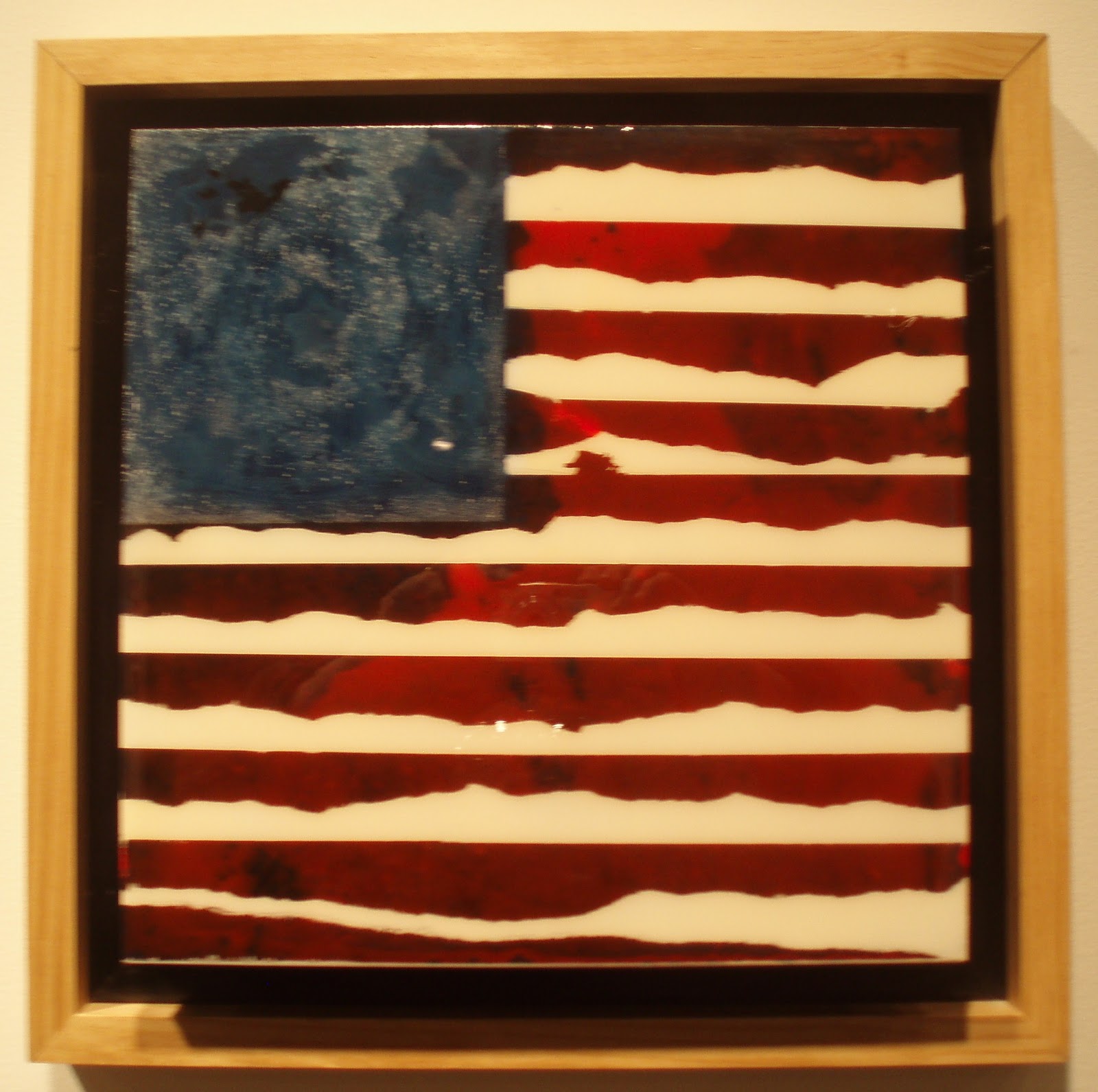


You might think that Jasper Johns holds the current patent on the American flag as art, but these paintings take a different tack and don't seem at all derivative. Where Johns' flag paintings grapple with existential questions of art -- "is it a flag, or is it a painting?" -- Morsman seems to just enjoy the familiar colors and shapes of the flag.
And perhaps this is my message for Flag Day. Let's take a day off from grappling with the political questions of whether elected representatives or wannabe presidential candidates must wear flag pins in their lapels to prove their patriotism, or whether the flag somehow is aligned with the military. Let's just enjoy the flag today as an innocent and joyful symbol of the things that are right with this wonderful country.
Subscribe to:
Posts (Atom)