
Showing posts with label Germany. Show all posts
Showing posts with label Germany. Show all posts
Sunday, November 20, 2011


Saturday, July 30, 2011

Tuesday, May 3, 2011
Collaboration project 3 -- sharing national culture
Uta and I have each lived in one another's country for long enough to feel somewhat familiar; I spent three years in Germany in the 1970s while my husband worked for the U.S. military, and Uta had lived in the U.S. for four years in several different extended stays. But we both were eager to fill in the other on some of the stranger aspects of our culture.
Uta sent me a batch of photos of ways to commemorate Germany's strong showing in the World Cup last summer. (Here, patriotic toilet brushes.)
 I sent her photos of blow-up Halloween figures.
 She sent photos of silly revelers at Carnival parades.
 I sent photos of lawn animals.
 We also sent lots of photos of less frivolous aspects of culture. I was particularly enchanted with the medieval-style shop signs, illustrated with the goods on sale, that Uta found in her home town.

 Everyday sights in one country became cultural exchange in the other. We learned a lot about each other's lives in the course of our mail project.
Uta sent me a batch of photos of ways to commemorate Germany's strong showing in the World Cup last summer. (Here, patriotic toilet brushes.)


Friday, February 4, 2011
Textiles -- the old-fashioned way
On our trip to Germany last summer we visited more museums than I can count without a cheat sheet, and I have written about most of them on the blog last year. But one I never got around to telling you about. It is in Bramsche, near Osnabruck in northern Germany, and we found it quite by accident because the tourist office, where we needed to stop to find a hotel room, happened to be located in its lobby. When my husband came back to the car he said "there's a museum in this building we might want to go to, but I don't know what it is about." The sign over the door said Tuchmachermuseum; I'm embarrassed to say I had to look it up in my little dictionary.
When I translated it as "clothmaking," I let out a whoop of joy!
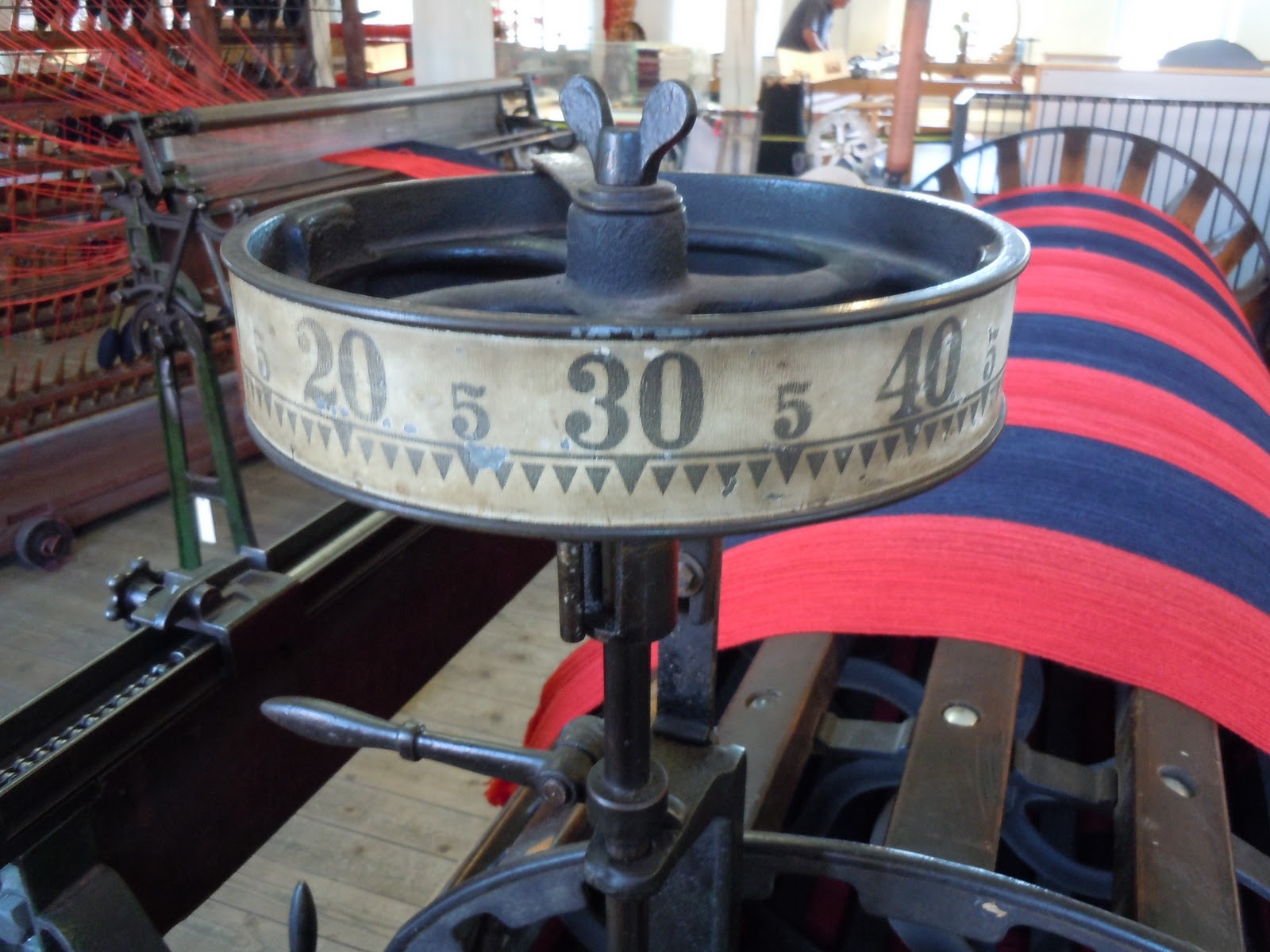
Sure enough, the building itself was an old woolen mill, in operation on this river for 400 years. Its specialty was heavy fabric in a special shade of red, used primarily for British army uniforms. It operated as a factory until 1972. Most of the equipment was about a hundred years old, and some machines, acquired by the museum from the old East Germany after reunification were in use in that technologically challenged country until late in the 20th century. The museum depicts all the steps in the traditional carding, spinning, weaving and finishing of cloth.
We found one brochure in English, with a bit of explanation of how the museum came to be but nothing on the details of the machinery or the processes. The signage was exclusively in German, and though I consulted my dictionary many times, most of the specialized terms were not listed. The docent tour was similarly monolingual, but they did turn on most of the machines so we could see them in action.
The good news was that despite my ignorance of what was being told to me, I was able to figure out about 95% of what was going on. It was one of those beautiful moments in which I realized that my decades of devotion to textiles and fabrics had paid off in ways I had not anticipated.
Although my total hands-on experience with weaving has consisted of maybe a total of 30 minutes sitting at other people's looms, weaving a few rows with wobbly selvages, I was able to figure out from watching the machines in action what was going on. First the wool came in the front door and was washed and dyed, then combed and carded. It was spun and wound onto bobbins, a hundred at a time. The looms were warped and the shuttles were thrown from one side to another; on the jacquard looms the punch card "computer" overhead lifted the proper heddles in their turn to make patterns.


 Then the easy parts, washing the fabric again, pressing it smooth and winding it onto bolts. The occasional sewing machine and small loom to work out patterns stood by as needed. You may not think you know anything about a woolen mill in action, but if you stood there all afternoon watching the machines at rest and at work you would figure out what was going on, too.

 As I figured out each machine, I would explain it to my husband, who learned far more than he ever wanted to about textile production and was dying for a beer long before I was ready to leave.
It was a wonderful afternoon, making me realize how much I love fabrics of all kinds and how watching them made was truly an homage to my artistic roots.
I learned later, in checking my facts on the internet, that this museum is just one on a "theme route" of textile factories throughout the continent, sponsored by the European Route of Industrial Heritage. In addition to textiles, you can check out other industries such as mining, iron and steel, transportation, manufacturing and a bunch of ther specialties. What a great way to plan a leisurely European trip if you have a special interest in a certain field -- perhaps your own profession, or that of a parent or grandparent.
When I translated it as "clothmaking," I let out a whoop of joy!
Sure enough, the building itself was an old woolen mill, in operation on this river for 400 years. Its specialty was heavy fabric in a special shade of red, used primarily for British army uniforms. It operated as a factory until 1972. Most of the equipment was about a hundred years old, and some machines, acquired by the museum from the old East Germany after reunification were in use in that technologically challenged country until late in the 20th century. The museum depicts all the steps in the traditional carding, spinning, weaving and finishing of cloth.
We found one brochure in English, with a bit of explanation of how the museum came to be but nothing on the details of the machinery or the processes. The signage was exclusively in German, and though I consulted my dictionary many times, most of the specialized terms were not listed. The docent tour was similarly monolingual, but they did turn on most of the machines so we could see them in action.
The good news was that despite my ignorance of what was being told to me, I was able to figure out about 95% of what was going on. It was one of those beautiful moments in which I realized that my decades of devotion to textiles and fabrics had paid off in ways I had not anticipated.
Although my total hands-on experience with weaving has consisted of maybe a total of 30 minutes sitting at other people's looms, weaving a few rows with wobbly selvages, I was able to figure out from watching the machines in action what was going on. First the wool came in the front door and was washed and dyed, then combed and carded. It was spun and wound onto bobbins, a hundred at a time. The looms were warped and the shuttles were thrown from one side to another; on the jacquard looms the punch card "computer" overhead lifted the proper heddles in their turn to make patterns.



It was a wonderful afternoon, making me realize how much I love fabrics of all kinds and how watching them made was truly an homage to my artistic roots.
I learned later, in checking my facts on the internet, that this museum is just one on a "theme route" of textile factories throughout the continent, sponsored by the European Route of Industrial Heritage. In addition to textiles, you can check out other industries such as mining, iron and steel, transportation, manufacturing and a bunch of ther specialties. What a great way to plan a leisurely European trip if you have a special interest in a certain field -- perhaps your own profession, or that of a parent or grandparent.
Saturday, November 13, 2010
Berlin museums 6 -- Neue Nationalgalerie
I wrote earlier about the powerful paintings in this museum depicting Germany between the wars. Today let's step back in time and look at some Expressionist art, mainly from before the war. This was a pivotal time -- artists had abandoned the classical requirements that paintings should represent reality in terms of color, and that sizes and shapes should obey the rules of perspective. But they still were drawing recognizable objects. Within a year of this first painting, Kandinsky would blaze the trail into abstraction.
 Wassily Kandinsky, Skizze: Reiter (Sketch: Rider), 1909
 Marianne von Werefkin, Prozession bei Ascona (Procession near Ascona), 1924
 Emil Nolde, Pfingsten (Pentecost), 1909
I am a big fan of still lifes, so took a lot of pictures of them.

Oskar Kokoschka, Steilleben mit Ananas (Still Life with Pineapples), 1909
 Hans Purrmann, Stilleben (Still Life), 1908
 Lyonel Feininger, Stilleben mit Pinseln (Still Life with Brushes), 1915


I am a big fan of still lifes, so took a lot of pictures of them.

Oskar Kokoschka, Steilleben mit Ananas (Still Life with Pineapples), 1909


Thursday, November 11, 2010
Berlin museums 5 -- Neue Nationalgalerie
In the beginning, there was the Nationalgalerie, the sacred repository of German art, which I wrote about in a previous post. Then came the partition of Berlin, and the Nationalgalerie, along with other great institutions located on Museum Island, was in the Eastern Zone. The Western powers decided there had to be a national gallery on their side, and it should focus on modern art, and had Mies van der Rohe design a stunningly modern building for the new propaganda tour de force. From that point on, there was the Alte Nationalgalerie and the Neue Nationalgalerie, and you don't need much German to tell the difference as we visit the Neue today.
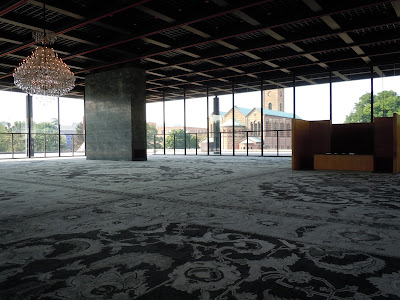 The entry floor, sheathed in glass, contains nothing but a couple of support columns and an attendant to point you toward the down staircase; all the art is housed below ground, partly to protect it from sunlight. When we visited, the entry floor was the site of a temporary installation by Rudolf Stingel, a huge carpet woven with patterns from 19th century Indian rugs to complement the stark architecture and to reference the iconic place of oriental carpets in well-to-do European households. I've seen Stingel's carpets in other venues but this space was spectacular, with nothing to interrupt your view of the goods.
Downstairs, the permanent exhibits provided a chronological view both of German art in the 20th century and of the German society and history reflected in it. I'll have to take more than one post to tell you about this fabulous collection, so I'll start with the earliest parts. In the 20s, for instance, Neue Sachlichkeit (New Objectivity) artists wanted to distance themselves from war and emotions, painting cool and precise pictures of architecture and technology.
 Franz Radziwill, Der Hafen II (The Harbor II), 1930
 Gustav Wunderwald, Am Wedding (a neighborhood in Berlin), 1927
 Georg Schrimpf, Bahnübergang (Railway Crossing), 1932

Oskar Nerlinger, Funkturm und Hochbahn (Radio Tower and Elevated Railway), 1929
In contrast to these cool characters, another school of art seized on politics for its subjects, with scathing views of the social turmoil following the World War. (Today is what we used to call Armistice Day, commemorating the end of that war on the Western Front, at 11 AM on 11/11/18.)

Josef Scharl, Ecce Homo/Der Verstümmelte (Ecce homo / Mutilated Man), 1931

Curt Querner, Agitator, 1931

Conrad Felixmüller, Der Agitator, 1944

Reinhold Rossig, Polizieterror (Police Terror), 1933

George Grosz, Stützen der Gesellschaft (Pillars of Society), 1926
Both my husband and I have always loved Grosz and his savage portrayals of German society between the wars. Seeing so many of these images, both by Grosz and others, was a real punch in the gut. This museum has a powerful impact throughout but nowhere as strong as in these pictures, which presciently anticipate the even greater turmoils ahead (note the swastika on the tie of the guy in front).

Downstairs, the permanent exhibits provided a chronological view both of German art in the 20th century and of the German society and history reflected in it. I'll have to take more than one post to tell you about this fabulous collection, so I'll start with the earliest parts. In the 20s, for instance, Neue Sachlichkeit (New Objectivity) artists wanted to distance themselves from war and emotions, painting cool and precise pictures of architecture and technology.


Oskar Nerlinger, Funkturm und Hochbahn (Radio Tower and Elevated Railway), 1929
In contrast to these cool characters, another school of art seized on politics for its subjects, with scathing views of the social turmoil following the World War. (Today is what we used to call Armistice Day, commemorating the end of that war on the Western Front, at 11 AM on 11/11/18.)

Josef Scharl, Ecce Homo/Der Verstümmelte (Ecce homo / Mutilated Man), 1931

Curt Querner, Agitator, 1931

Conrad Felixmüller, Der Agitator, 1944

Reinhold Rossig, Polizieterror (Police Terror), 1933

George Grosz, Stützen der Gesellschaft (Pillars of Society), 1926
Both my husband and I have always loved Grosz and his savage portrayals of German society between the wars. Seeing so many of these images, both by Grosz and others, was a real punch in the gut. This museum has a powerful impact throughout but nowhere as strong as in these pictures, which presciently anticipate the even greater turmoils ahead (note the swastika on the tie of the guy in front).
Sunday, November 7, 2010
Textilkunst auf Deutsch
I took two years of German in college, made As, learned to read and write grammatically, and was on the very cusp of a permanent grasp of the language -- but then I stopped. Six years passed, then I moved to Germany as a new bride. We checked into a hotel and the next day my husband went off to work. I went downstairs, opened my mouth to say something to the desk clerk, and was paralyzed. I remembered enough of my college German to know that the words I was about to utter were ungrammatical, but not enough to make them grammatical. The paralysis continued for two or three days, after which I said to myself, "you're going to either talk or starve."
Thus I embarked on Plan B -- forget about grammar, concentrate on communication. In the next three years I became fluent in bad German, heavy on nouns (but never worrying whether they were masculine, feminine or neuter), adequate in verbs (but never worrying about the tense or the word order), liberally greased with "bitte" and "danke." Since the bulk of our life was spent in the American military ghetto, the crudeness of my German didn't hamper my social, intellectual or economic endeavors, and I had no major incentive to raise the level of my language skills.
Many more than six years passed, with only one visit to German-speaking lands, in which I was pleased that my ability to order dinner, get a hotel room and buy a train ticket was miraculously unimpaired. The linguistic highlight of that trip was my arrival at the airport in Vienna, when I plonked my bags down at the emigration checkpoint, said "Guten Morgen," and was greeted by a response in German. "Können wir Englisch sprechen?" I asked helplessly. The official switched to perfect English and said "Sorry, I thought from your accent that you were German!" He was probably just being polite, but I took it as a compliment. (Thanks, Grandpa, for teaching me perfect hochdeutsch pronunciation -- too bad you didn't teach me how to say anything in that beautiful accent!)
So this summer we returned to our honeymoon locales, and again I was pleased that a good bit of the German came back. Not the grammar, but the words, and after almost a month in Germany I was beginning to feel comfortable enough with the language to think that if I were to spend six months there, I could probably get a fair amount back.
This is a long, rambling way to get to last week. My good friend Uta Lenk, who lives near Munich and who has two quilts in the Color Improvisations show now touring Europe, sent me a clipping from an art magazine -- in German. I figured this was her way of telling me to resume my learning process. It was about six inches long and included a picture, so this was not a huge translation task. Nevertheless, it took me a half hour with the dictionary to get it right (I made her correct my translation after I did it).
I hadn't even put the dictionary away when, a couple of days later, Uta started two new blogs, one in English and one in German. Of course I had to sign up as a follower. I can get the general drift of the German narrative on my own, but not the full story. And I fear the nuances remain beyond my grasp even with the dictionary. But I am resolved to improve, and decided the dictionary will just have to live on my computer table.
 So far the blog in German has much better pictures, including this one, which mystifies me because I haven't put in my dictionary time yet. I'll let you know when I figure it out. Meanwhile, if you speak English and/or German, check out Uta's blog(s)! I know she will have good things to show us and to say about them, and I will do my best to follow along. Dankeschön!
Thus I embarked on Plan B -- forget about grammar, concentrate on communication. In the next three years I became fluent in bad German, heavy on nouns (but never worrying whether they were masculine, feminine or neuter), adequate in verbs (but never worrying about the tense or the word order), liberally greased with "bitte" and "danke." Since the bulk of our life was spent in the American military ghetto, the crudeness of my German didn't hamper my social, intellectual or economic endeavors, and I had no major incentive to raise the level of my language skills.
Many more than six years passed, with only one visit to German-speaking lands, in which I was pleased that my ability to order dinner, get a hotel room and buy a train ticket was miraculously unimpaired. The linguistic highlight of that trip was my arrival at the airport in Vienna, when I plonked my bags down at the emigration checkpoint, said "Guten Morgen," and was greeted by a response in German. "Können wir Englisch sprechen?" I asked helplessly. The official switched to perfect English and said "Sorry, I thought from your accent that you were German!" He was probably just being polite, but I took it as a compliment. (Thanks, Grandpa, for teaching me perfect hochdeutsch pronunciation -- too bad you didn't teach me how to say anything in that beautiful accent!)
So this summer we returned to our honeymoon locales, and again I was pleased that a good bit of the German came back. Not the grammar, but the words, and after almost a month in Germany I was beginning to feel comfortable enough with the language to think that if I were to spend six months there, I could probably get a fair amount back.
This is a long, rambling way to get to last week. My good friend Uta Lenk, who lives near Munich and who has two quilts in the Color Improvisations show now touring Europe, sent me a clipping from an art magazine -- in German. I figured this was her way of telling me to resume my learning process. It was about six inches long and included a picture, so this was not a huge translation task. Nevertheless, it took me a half hour with the dictionary to get it right (I made her correct my translation after I did it).
I hadn't even put the dictionary away when, a couple of days later, Uta started two new blogs, one in English and one in German. Of course I had to sign up as a follower. I can get the general drift of the German narrative on my own, but not the full story. And I fear the nuances remain beyond my grasp even with the dictionary. But I am resolved to improve, and decided the dictionary will just have to live on my computer table.

Sunday, October 17, 2010
Subway art
When we visited Berlin this summer we were on foot, an intelligent way to travel in a city with superb public transportation. One of the pleasant side benefits of getting around so easily was enjoying the art on the subway platforms. It was all permanent, executed in tile, and rather than having each station look like the others with generic art, there was a wide variety of styles and moods. Here's a sampling:


Sunday, September 5, 2010
Nürnberg museums 1 -- Germanisches Nationalmuseum
The Germanisches Nationalmuseum in Nürnberg is one of those huge, rambling, mysterious places where no matter what you're interested in, you can find a bit of. First we headed for the small section of modern and contemporary art and found an assortment of German artists and themes.
There were several Expressionists, as you might expect in a survey of German art.
 Ernst Ludwig Kirchner, Interieur mit zwei Mädchen (Interior with two girls), 1908/1926
(Kirchner was one of the Brücke artists I wrote about in an earlier post)
 Werner Gilles, Steinbruch (Stone Bridge), 1948
Several of the more recent artists had political themes.
 Helmut Middendorf, Flugzeugtraum (Airplane Dream), 1982

Klaus Staeck, Am Anfang war das Geld, 1973
A riff on the opening words of the Gospel of John -- Am Anfang war das Wort (in the beginning was the word) -- here, in the beginning was the money.
Next we went to the old masters, mainly in search of Albrecht Dürer, who was born in Nürnberg. We found three beautiful pictures.
 Albrecht Dürer, Emperor Charlemagne (left) and Emperor Sigismund, 1511/1512

Albrecht Dürer, Portrait of the Nürnberg Painter Michael Wohlgemut, 1516
Also found works by other Greatest Hits artists.

Rembrandt, Self Portrait in a Gorget, 1629
Don't know how he snuck into this pantheon of German art; maybe they made him an honorary member. This is his earliest known self-portrait; sorry for the side view, but the reflections were fierce.

Lucas Cranach, Frederick III the Wise, Elector of Saxony
(Martin Luther's patron, if you're interested in history)
 Lucas Cranach, The Fable of the Mouth of Truth
(you put your hand into the lion's mouth; if he ate it you were lying and deserved it)
There were several Expressionists, as you might expect in a survey of German art.

(Kirchner was one of the Brücke artists I wrote about in an earlier post)

Several of the more recent artists had political themes.


Klaus Staeck, Am Anfang war das Geld, 1973
A riff on the opening words of the Gospel of John -- Am Anfang war das Wort (in the beginning was the word) -- here, in the beginning was the money.
Next we went to the old masters, mainly in search of Albrecht Dürer, who was born in Nürnberg. We found three beautiful pictures.


Also found works by other Greatest Hits artists.

Don't know how he snuck into this pantheon of German art; maybe they made him an honorary member. This is his earliest known self-portrait; sorry for the side view, but the reflections were fierce.

Lucas Cranach, Frederick III the Wise, Elector of Saxony
(Martin Luther's patron, if you're interested in history)

(you put your hand into the lion's mouth; if he ate it you were lying and deserved it)
Friday, September 3, 2010
Berlin museums 4 -- Hamburger Bahnhof
If you have any German at all, even the Berlitz guidebook variety, you will be able to translate the name of this museum as "Hamburg Railroad Station." Yes, it used to be a railroad station (the trains to Hamburg left from here) but since they built a fabulous, shiny new station a few years ago, a couple of blocks away, the old station has been converted to a contemporary art museum. The core of its collection is art donated by a rich guy who particularly liked five artists: Germans Joseph Beuys and Anselm Kiefer, and Americans Andy Warhol, Robert Rauschenberg and Cy Twombly.
I have never been a big fan of Beuys, even though I identify strongly with his tendency to pick up junk on the street and call it art (perhaps this is a slight oversimplification). His shtik has been his use of felt and fat, supposedly because he was rescued from a winter plane crash in Crimea (he was in the Luftwaffe in World War 2) by nomadic Tatars who saved him by smearing fat all over him and wrapping his body in felt. The story doesn't hold up to fact-checking, but the shtik continues. I do have a soft spot for artists who use felt, being a fiber type myself, and a huge sculpture of tallow on display at the Bahnhof was impressive, probably my favorite Beuys artwork I've ever seen.

Joseph Beuys, Skulptur, die nicht kalt werden will (Sculpture that will not get cold), 1977
By contrast, I love Kiefer and was delighted to see several paintings and a sculpture. Kiefer's recurrent theme is Germany and the toxic fallout from war and nationalism. Many of his paintings are variations on the image of a deserted battlefield, endless expanse of mud and waste. I wrote about his "Hermannschlag," also at this museum, in an earlier post.
 Anselm Kiefer, Hoffmann von Fallersleben auf Helgoland, 1983 1986 (H von F was a poet who went to the island of Helgoland and wrote what became the German national anthem)

Anselm Kiefer, Maikaefer flieg, 1974
 Andy Warhol, Mao, 1972
"Mao" dominates its room, one of the biggest Warhols I've ever seen. He used the image of Mao in many different versions, including four-patch and nine-patch arrays, but this one is just the one face, vastly larger than life. (The purple doodads on the wall behind it aren't part of the painting but they sure add to the impact!)
And then there's Robert Rauschenberg, also on my top ten artist list (or maybe top five??). I liked two of his earlier paintings, which seemed similar in their use of red, black and white.

Robert Rauschenberg, First Time Painting, 1961

Robert Rauschenberg, Summer Rental + 3, 1960
I could go on and on -- this art is world-class and there's lots of it.
I have never been a big fan of Beuys, even though I identify strongly with his tendency to pick up junk on the street and call it art (perhaps this is a slight oversimplification). His shtik has been his use of felt and fat, supposedly because he was rescued from a winter plane crash in Crimea (he was in the Luftwaffe in World War 2) by nomadic Tatars who saved him by smearing fat all over him and wrapping his body in felt. The story doesn't hold up to fact-checking, but the shtik continues. I do have a soft spot for artists who use felt, being a fiber type myself, and a huge sculpture of tallow on display at the Bahnhof was impressive, probably my favorite Beuys artwork I've ever seen.

Joseph Beuys, Skulptur, die nicht kalt werden will (Sculpture that will not get cold), 1977
By contrast, I love Kiefer and was delighted to see several paintings and a sculpture. Kiefer's recurrent theme is Germany and the toxic fallout from war and nationalism. Many of his paintings are variations on the image of a deserted battlefield, endless expanse of mud and waste. I wrote about his "Hermannschlag," also at this museum, in an earlier post.
 Anselm Kiefer, Hoffmann von Fallersleben auf Helgoland, 1983 1986 (H von F was a poet who went to the island of Helgoland and wrote what became the German national anthem)
Anselm Kiefer, Maikaefer flieg, 1974

"Mao" dominates its room, one of the biggest Warhols I've ever seen. He used the image of Mao in many different versions, including four-patch and nine-patch arrays, but this one is just the one face, vastly larger than life. (The purple doodads on the wall behind it aren't part of the painting but they sure add to the impact!)
And then there's Robert Rauschenberg, also on my top ten artist list (or maybe top five??). I liked two of his earlier paintings, which seemed similar in their use of red, black and white.

Robert Rauschenberg, First Time Painting, 1961

Robert Rauschenberg, Summer Rental + 3, 1960
I could go on and on -- this art is world-class and there's lots of it.
Subscribe to:
Posts (Atom)