Showing posts with label hand stitching. Show all posts

Friday, April 21, 2023

More daily Joanne

I wrote last week about my daily art project for this year, and showed you several collages that depended on the prints in my friend Joanne's leftovers.  My task in working with these strong patterns is mainly to find a few that want to play together, then put them together and stand back.  On the other end of the spectrum are the pieces that I make on solid color fabrics, or those with minimal patterning.  Those generally serve as the base for more elaborate stitching or applique.

mostly blanket stitch, plus an appliqued moon


cretan stitch and a few beads


machine appliqued tiny trees, about 3/4" from ground to tip


stacked running stitches make mandalas


more stacked running stitches


Wednesday, April 12, 2023

Daily Joanne update

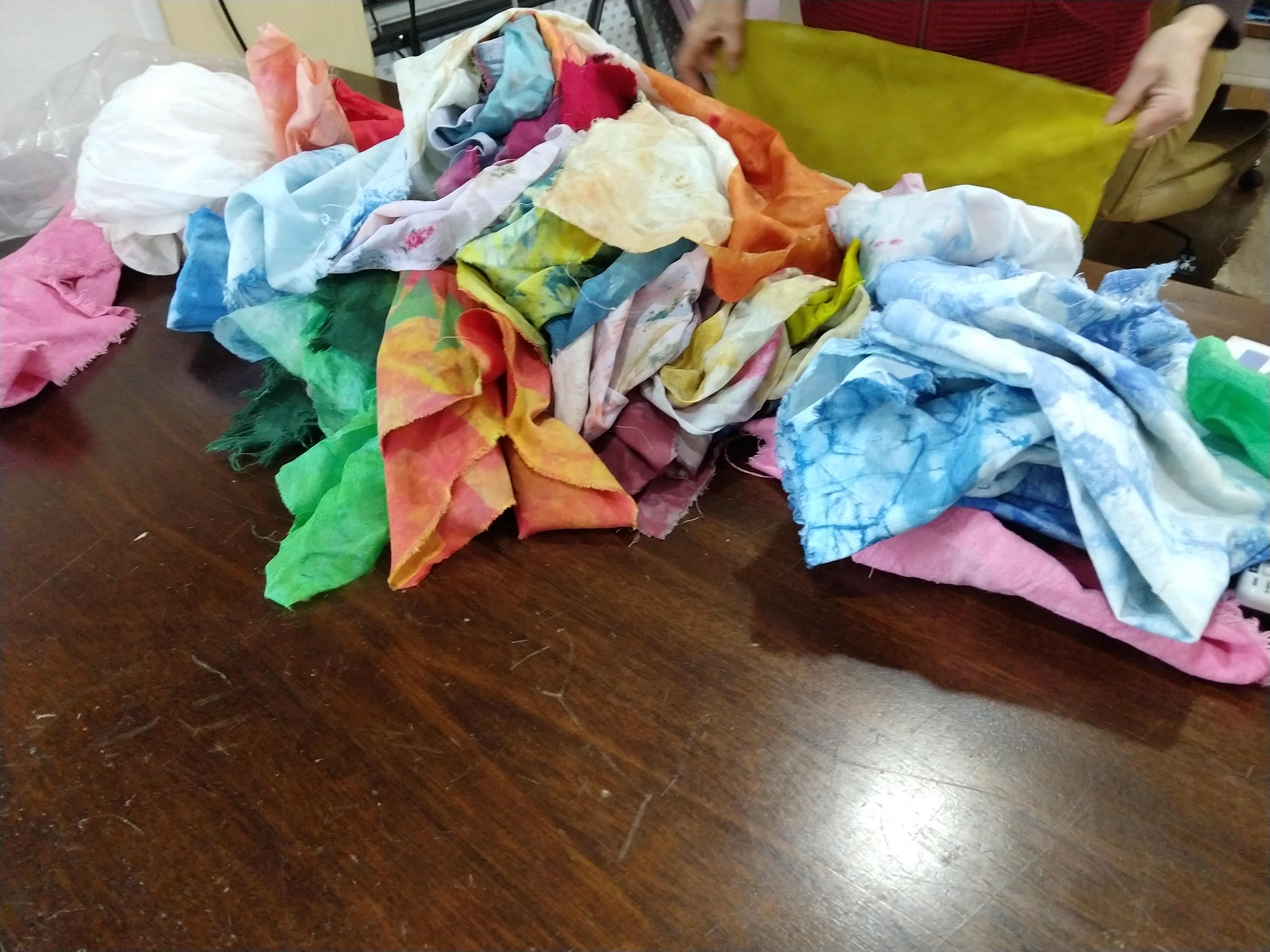
I told you several weeks ago about my daily art project for this year: to make a small stitched collage using fabrics that I scored from my long-time art pal Joanne Weis.  She cleaned out her huge stash of fabrics that she had dyed and surface-designed over two decades of making fiber art, and I brought home two huge garbage bags full.  I have been reveling in the huge array of different fibers, colors, patterns and techniques that she used to create wonderful fabrics.

Most of her fabrics have some kind of design printed or painted on top of a dyed base.  My challenge is to add enough of my own work on top so that it stops being Joanne's work and starts being Kathy's.  Usually that has been stitching, mostly by hand but occasionally by machine.  Sometimes I meld bits from several different fabrics and try to put them together into a single cohesive composition, unified by stitching.


This collage started with two different pieces from the Joanne bags: the red-white-brown print on top, and the coral-blue on the bottom.  Joanne had laminated the green paper on top of the red print.  I added two strips of off-white to cover the join between the two prints, and two more to provide interest in boring parts of the red print.  Then I added lots of cross stitch in a few different threads.  I was particularly enamored of the messy torn edge on the bottom of the coral, and took pains to keep it intact.

This one started with a small bit cut from a sample that Joanne had already collaged onto the gold fabric at left, adding the green and white papers and a lot of yellow machine stitching.  I added a piece of the same coral-blue print that I used in the composition above, and tied it together with a strip of painted white paper.  I added machine stitching in a dark teal to pick up the blue of the coral print, and more stitching in yellow (which doesn't exactly match the original, but I think I'm the only one who will ever notice that).

This one started with a bit of fabric painted in yellow, pale turquoise and white.  I found some bits of blue that were left over from previous daily collages (I am scrupulously throwing away nothing of Joanne's stuff, because ever the tiniest piece may find a place in a subsequent collage).  I had torn 1/4 inch strips of the green sateen a couple of weeks ago, but didn't use all of it, so they got stitched on top.  I mounted the little collage on black (I was delighted to find about a half yard of plain black in the garbage bags, because sometimes you just need a plain fabric as a background or support).  Then I machine stitched curvy leaf shapes to hold the whole thing together.

I'll show you more of my daily collages in another post or two!


Sunday, February 12, 2023

This year's daily art

In November I usually start thinking about daily art, and what I'm going to choose for my project in the coming year.  I had pretty much narrowed it down to some kind of collage, whether paper or fabric, but didn't have any details in mind.  Then when I went to the December retreat from my fiber art group, I was delighted to find that Santa Claus also came.

Santa aka Joanne Weis, who has been one of my closest art pals for more than two decades.  She has experimented with every conceivable method of surface design (dyeing, screenprinting, laminating,  painting, etc.) and every conceivable fiber (silk, hemp, linen, cotton, nylon, etc.).  She always does considerable testing to develop a palette before embarking on a new project, and often prepares a lot more fabric than she actually uses.  And for years, she stashed her unused fabrics in drawers.


Then last year she decided she needed the drawers, stuffed all the fabrics into big bags, and brought them to the retreat. 

I let others in the group go through the bags for more than an hour, cherry-picking pieces that called out to them, and when everybody else had enough, I packed up everything that was left.

Two huge bags worth.  And realized that clearly Santa wanted me to do fabric collage as my 2023 daily art.

I have defined the project as follows:  All fabric must come from Joanne's leftovers.  I can add hand- or machine-stitching of any kind, plus notions like beads, buttons or found objects.  Most days I will finish a collage, but occasionally I can hold it over to another day (or two) as long as it's documented at the end of each day.

This one took several days to finish (Day 1 here)


I haven't felt this exhilarated in a long time.  I find myself getting up in the morning and thinking about what I will do in the studio, and the daily stitching is usually the first thing I tackle when I get there.  (By contrast, toward the end of the year, my daily painting got to be a chore, done after dinner with the same enthusiasm as kids have for the last bit of homework before bed.)  Often I spend some time preparing fabrics for future days, cutting them into small pieces, maybe putting the pieces through the wash to fray the edges, maybe auditioning possible combinations. 

I haven't posted any of the collages on my daily art blog yet, but that's on my to-do list.  Meanwhile, here are a few of my favorites.  Obviously I'll be telling you a lot more about this project as the year goes on.


Saturday, June 11, 2022

Getting ready -- a lot of work...

My new show opens four weeks from yesterday and I'm now in the stage that is probably the least fun.  All the art is made, but it has to be made ready to hang.  I've made about 20 hand-stitched pieces in varying shapes and sizes, most of them pretty small, and to make a cohesive body of work they're all going to be mounted on stretched canvases, covered with black fabric.  

Unfortunately, the black fabric is not tightly woven (I bought the cheapest cotton in the store) so the white canvas shows through when it's tightly stretched.  So I had to paint the outer border of the canvas black first. 

Then to the stretching.  The parts in the middle are easy to do, but the corners are tricky if you want them to be as flat as possible.  (The purchased canvas already has a triangle of three layers at each corner, so perfectly flat isn't going to happen, but by pulling tight you can get them to fold neatly, without bulges.)  

I do this by pulling and pinning and inspecting and pulling some more and repinning everything before putting in the final staples in the corners.  

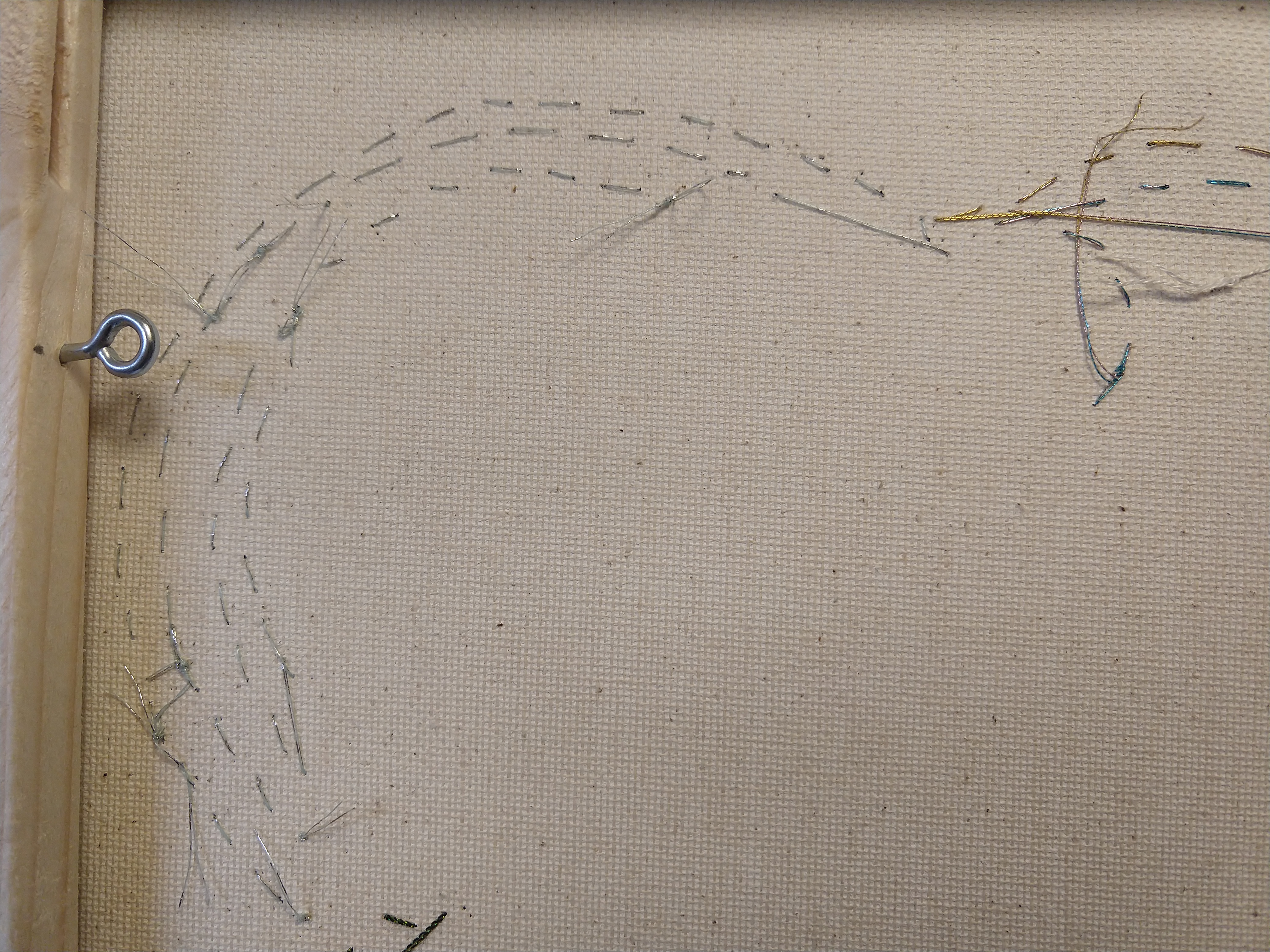
I sew the embroideries to the canvas,  sometimes with the stitches invisible (time-consuming, but it's almost like magic when you're done) and sometimes visible.  Fortunately it's easy to stitch through the canvas and sometimes I got into a groove, carrying many of the stitching lines off the original fabric and well onto the background.  


I am deliberately avoiding calculating how much time it takes me to get a "finished" embroidery onto a canvas.  If I did, I'd probably realize that I'm paying myself a minimum wage of about 95 cents an hour.  But there are compensations, such as seeing a big stack of canvases, all looking the same, ready to go.


Monday, February 14, 2022

Asking for advice

I am of two minds when it comes to asking other people for advice, especially in large groups (whether in person or virtual).  There are people whose advice you respect, and there are those who just volunteer useless praise or counterproductive suggestions.  It's easy to ignore those in the second group, but what happens when those in the first group don't agree?

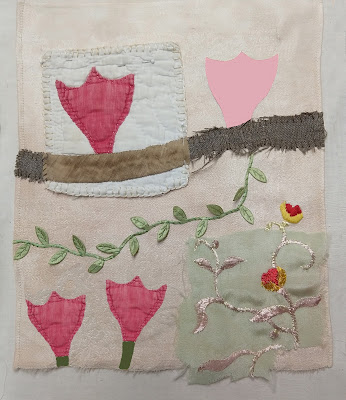
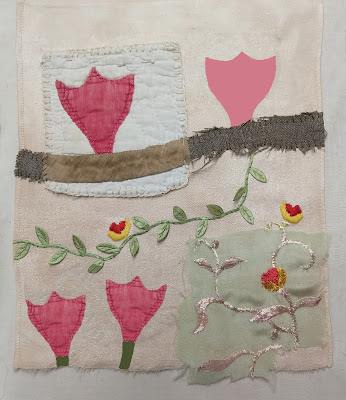
I have had a compositional fragment on my design wall for more than a year, a tulip on a branch cut out from a very old and distressed quilt, sitting on a torn piece from a linen napkin or tablecloth for background.  At some point a length of leafy vine joined it, but I couldn't figure out what else needed to be there.

Last week I found a piece of embroidered silk that seemed to want to join the party, so I stitched it to the bottom corner of the linen.  The original embroidered stems and leaves had begun to disintegrate, so it took a fair amount of stitching with almost-matching thread to secure the fabric and restore the design.

Next I extended the branch from which the quilt tulip was growing, and added another tulip.  Also another little yellow and red flower to match the one on the embroidered silk.


I also found a butterfly, cut from a vintage kimono scrap, but wasn't sure where or if it should go in the composition, so I just pinned it on.  I posted it on instagram as work in progress.  Two people whose opinions I respect suggested that it was finished (I think they meant without the butterfly).

Then I showed it to somebody else whose opinion I respect, and she was not happy.  She said, and I see her point, that the two halves of the composition don't really play well together.  The top half is big and bold, the bottom half is small, pale and delicate.  She thought each half would be better off on its own.

Hmmm.  I thought about it for a while and realized that it wouldn't be too hard to cut the piece in two, since the quilted tulip hasn't been sewed down yet.  I mentally tried out different ways to do this, but none of them seemed great.

Then I thought that maybe the trouble was the right hand tulip, which took on too much weight because of its dark value.  What if it were paler, to restore the focus to the original quilt tulip?  And I realized that the easiest way to consider the alternatives was via photoshop.

So here are four possibilities.  I put them out to you to share my thought process, not to put it up for a vote (I will happily read your comments but unfortunately the buck stops here and I'll be stuck with the final decision).  
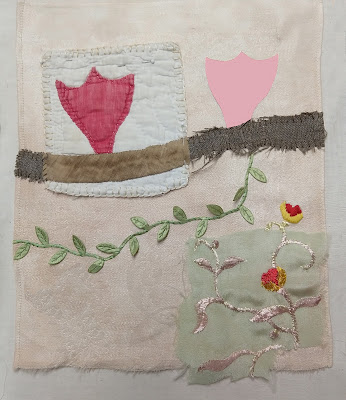
Pale tulip

Pale tulip + butterfly

Pale tulip, two new flowers

Pale tulip, three new flowers


I usually audition design decisions in person, pinning and repinning on the design wall; the advantage is that a possibility can stay on display for a long time and your opinion can change over time.  But doing it on photoshop certainly is quicker, and allows a side-by-side comparison with all the versions, or at least as many as you can tile onto your computer screen. 


Now I have a lot more to think about.  And I guess I should really photoshop some possibilities from cutting the piece in two...
Wednesday, September 8, 2021

Another Afghanistan quilt

I wrote earlier about a project that I'm working on now, a postage stamp quilt to mark the US military dead in Afghanistan.  But I am reminded of another quilt I made several years ago that is also about Afghanistan.

In 2015 I had the pleasure of attending and teaching at a big quilting show in Prague, along with my dear friend and art pal Uta Lenk.  Uta had arranged for the show to display a bunch of quilts by International Threads, a group of quilters from four different countries (US, UK, Germany and Israel).  After I said I would come to Prague, she promoted teaching gigs for each of us, which didn't make us rich but did pay for our hotel rooms and a bit of spending money.

Uta in the International Threads exhibit

In between teaching and hanging around our exhibit, we hit the vendors, and discovered a booth selling embroideries made by women in Afghanistan.  We were intrigued by the work, and when we found that many of the embroideries were made by the same woman, Nasrin, we decided to buy eight of them for the members of International Threads, which would be the theme for our next project.


I chose the embroidery with the most abstract and geometric design, and when I made my quilt, I echoed the gray-blue-turquoise-white palette, the bold zigzags and the half-square-triangle sawtooth edging, adding some yellow to pep up the composition.  I called the quilt "Nasrin's Magic Carpet."


With Afghanistan in the news again, I thought it would be a good time to pull out the quilt again and put it up in public.  It's hanging at PYRO Gallery right now, through the end of this month.  And of course I thought about Nasrin and her friends and family, wondering how they have survived through six more years of war and oppression.

After Uta and I bought the embroideries we sent them to our fellow members and I copied from the package the name of the nonprofit that distributed them: The Guldusi Project of Embroidery.  When I looked it up on the internet this week I learned that the organization was begun in 2002 by a German artist.  They have embroidery projects in several rural Afghan villages, and when I paged through the website I was excited to find exactly the kind of embroideries we had bought.

Uta's Nasrin square


You'll notice that the center portion of each square is a kind of mesh, the kind that's used to make the eye holes in a burka. The website confirmed that this type of stitching is called tsheshmakdusi (tsheshmak = eye, dusi = embroidery) and only a few women in a village in Laghman Province use this stitching in their work for sale.  This had to be the source of our Nasrin squares.

Red pin marks Laghman Province

And yes, when I looked through the thumbnails of work on this page of the website, I found one using the same palette, chevrons and sawtooth border, that was labeled "03Nasrin."  Unless there are many women with the same name doing very similar embroidery for the same nonprofit organization, this is indeed our artist.  At least, that's what I'm going to believe.

Uta has also been remembering her Nasrin quilt recently; check it out on her blog. 


Friday, August 6, 2021

Pandemic knots

Earlier this year I did a project of memorializing each of the 2,662 people in Kentucky who died of coronavirus in 2020. I stitched 2,662 french knots onto a roll of vintage gauze bandage, distributed by month, starting in March with only 15 deaths and ending with 754 in December.


I finished the project about two weeks ago and had already decided that I needed to continue into this year, since the virus has done the same.  

I learned some things from my 2020 memorial.  First is to be more careful in counting!  In the first project I tended to get carried away, stitching while watching TV without really noticing how many knots I had made.  I ended up having to cut out dozens of knots where I overshot the mark -- and that hurt.  Fortunately the gauze was forgiving, and I was able to erase the needle holes with a scratch of fingernail or needle end.  But it was stupid to do it that way.

This time I'm going to plan ahead a bit and gauge the relative density of the knots in a given month by comparing to the 2020 piece.  For instance, January 2021, which I'm working on right now, has to have a third more knots in the same space as December 2020.

This is a meditative project.  When I posted a shot of the new stitching on instagram earlier this week, a friend left a comment: "I imagine you have a very profound realization of exactly how many deaths the "number" represents.  So easy to see a number and move on."

I replied: "You're right -- that's exactly what I think about when making these marker pieces.  I guess this is the sixth death marker that I have embarked upon (one is half done) and this genre, if you want to call it that, has great meaning for me."

Meanwhile, if more people would just get the damn vaccine, there would be a lot fewer knots in my future.

Wednesday, July 7, 2021

Form, Not Function 4 -- realistic people

I was surprised at the number of representational works at FNF this year.  Of the representations, most were of people, and mostly faces.  Here are some of the more realistic treatments:

Linda Anderson, Remembering 

Linda was a prizewinner at last year's FNF, using the same technique of fabric painting plus intricate multicolor threadwork to make beautifully accurate portraits.


Deborah Hyde, Monkeys In My Hair (Evie), detail below

Deborah is another repeater, in both appearance and technique, having been in FNF in 2019, 2017 and 2016.  All of her quilts are pieced from tiny squares of fussy-cut print fabrics, about a half-inch apiece.  This year she's added little cartoony critters,  including monkeys, in and around the little girl's hair, emphasized with a bit of hand stitching.


Finally, my favorite of the realistic portraits is this tour-de-force of hand stitching.

Shin-hee Chin, The Evening Hour of a Hermit, details below

The painterly strokes of this stunning image are made from long strands of perle cotton, stitches that are interlaced in deep tangles of thread that only occasionally go through to the back layer of the quilt.


Faces also came in other varieties than super-realistic; I'll show you some of them in another post.

Sunday, March 7, 2021

Mystery stitching -- did you do it?

Dabbling in the never-ending task of trying to clean out and organize my studio, I came upon a bag of hand stitching.  One piece I recognized as my own, from several years back, but three others were a total mystery.  On two of them I thought the base fabric looked somewhat familiar, from the days when I was using black walnuts for home-made dye, but the stitching was definitely not mine.


Very nice, but definitely not mine.  See details below.

I wrote two friends with whom I had loose collaborative agreements to do hand stitching together, and asked them whether they were the artists and if so, did they want the pieces back.  Neither one recognized any of the work.

So I'll ask everybody out there -- are you the mystery stitcher?  If so, (1) why is your work in a bag in my studio? and (2) do you want it back?