Showing posts with label composition. Show all posts

Monday, February 14, 2022

Asking for advice

I am of two minds when it comes to asking other people for advice, especially in large groups (whether in person or virtual).  There are people whose advice you respect, and there are those who just volunteer useless praise or counterproductive suggestions.  It's easy to ignore those in the second group, but what happens when those in the first group don't agree?
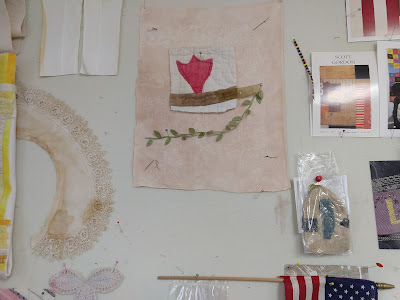
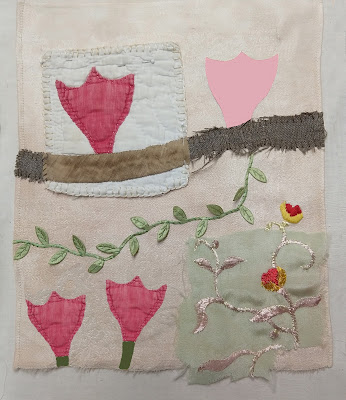
I have had a compositional fragment on my design wall for more than a year, a tulip on a branch cut out from a very old and distressed quilt, sitting on a torn piece from a linen napkin or tablecloth for background.  At some point a length of leafy vine joined it, but I couldn't figure out what else needed to be there.

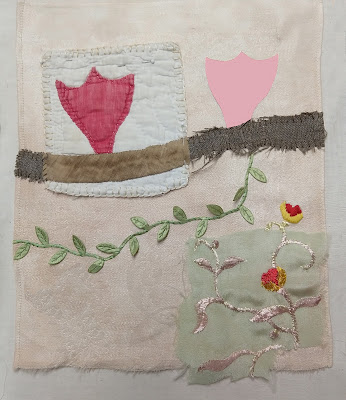
Last week I found a piece of embroidered silk that seemed to want to join the party, so I stitched it to the bottom corner of the linen.  The original embroidered stems and leaves had begun to disintegrate, so it took a fair amount of stitching with almost-matching thread to secure the fabric and restore the design.

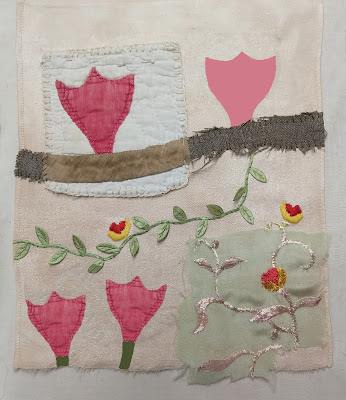
Next I extended the branch from which the quilt tulip was growing, and added another tulip.  Also another little yellow and red flower to match the one on the embroidered silk.


I also found a butterfly, cut from a vintage kimono scrap, but wasn't sure where or if it should go in the composition, so I just pinned it on.  I posted it on instagram as work in progress.  Two people whose opinions I respect suggested that it was finished (I think they meant without the butterfly).

Then I showed it to somebody else whose opinion I respect, and she was not happy.  She said, and I see her point, that the two halves of the composition don't really play well together.  The top half is big and bold, the bottom half is small, pale and delicate.  She thought each half would be better off on its own.

Hmmm.  I thought about it for a while and realized that it wouldn't be too hard to cut the piece in two, since the quilted tulip hasn't been sewed down yet.  I mentally tried out different ways to do this, but none of them seemed great.

Then I thought that maybe the trouble was the right hand tulip, which took on too much weight because of its dark value.  What if it were paler, to restore the focus to the original quilt tulip?  And I realized that the easiest way to consider the alternatives was via photoshop.

So here are four possibilities.  I put them out to you to share my thought process, not to put it up for a vote (I will happily read your comments but unfortunately the buck stops here and I'll be stuck with the final decision).  
Pale tulip

Pale tulip + butterfly

Pale tulip, two new flowers

Pale tulip, three new flowers


I usually audition design decisions in person, pinning and repinning on the design wall; the advantage is that a possibility can stay on display for a long time and your opinion can change over time.  But doing it on photoshop certainly is quicker, and allows a side-by-side comparison with all the versions, or at least as many as you can tile onto your computer screen. 


Now I have a lot more to think about.  And I guess I should really photoshop some possibilities from cutting the piece in two...

Friday, February 12, 2016

Start with a piece of paper...


For a long time I  have recognized a fundamental difference between working on paper or canvas and working in fabric.  On paper or canvas, you start with a support of a predetermined size and shape, and have to decide at the very beginning how the composition is going to fit into that shape.  With fabric, your shape changes continually as you stitch pieces together.  If you have a beautiful red shape at the center of your composition, you're only a slice away from moving it to the edge; if your composition starts out squarish and you decide it would look better as a rectangle, you need only add more fabric or cut away some at one side.

As a result of decades of making art from fabric, I think I'm pretty good at composition, but have noticed in the past that whenever I have to make art to fit it's a lot harder.  I have written about this problem before in the context of making quilts, and acknowledge that my improvisational working style makes it even harder; my mantra is "sew first, plan later."  My inability to translate a composition into a space has not been helped by years of photography, where I have infinite capability to shoot and reshoot, adjusting the camera position to get the scene framed exactly as I want it.  (And if that doesn't work there's always cropping...)

Now that I am both taking a drawing class and drawing as a daily art project, my spatially challenged chickens are coming home to roost.  I am having a hard time getting my drawings to fit onto my paper.  Even when I spend time thinking about it and figuring out how big the drawing should be, I end up with it huddled over in one corner of the page or, more frequently, I run out of paper before I run out of drawing.


I guess the remedy for this is practice, practice, practice.

Wednesday, February 10, 2016

Yet another new project begins


For some reason I'm bouncing all over the place this winter, one day on one body of work and then the next day on another so different that it doesn't even seem to be coming from the same person. Later this year I'll have to get focused on my Quilt National entries, but for now I'm happy playing with a whole lot of different things.

This week I've started a new project which is sort of a charity endeavor, the product of one of those daisy chains of friends-of-friends.  My art pal Keith Auerbach knows a young couple in Portland OR, Payal Parekh and Geoff Bugbee, who have a business selling artisan screenprinted clothing and scarves.  Several months ago when they were visiting, they saw Keith's Photoshop wizardry and asked him if he would design some images that would be suitable for silk scarves.

Payal's father has a silkscreen operation in India that makes scarves and other fine textiles for high-end designers, and he took Keith's designs and translated them into reality, choosing fashion-forward colorways and borders that will become one-meter-square scarves.  The theme of this collection is horses, and Payal and Geoff hope to raise enough money through a Kickstarter campaign to produce the collection and market it to horse lovers and racing fans; the campaign will begin in late March with fancy cocktail parties in Louisville and Lexington, the twin centers of the Kentucky horse community.

When they were visiting Keith, they saw a little wall hanging that I had made for him using cut-up postcards from one of his photo exhibits. (I wrote about it here.)  They liked it, and as plans for the Kickstarter parties proceeded, they thought maybe it would be cool to have a paper quilt made from their scarf images.  I agreed to make one, impelled by visions of some free silk at the end of the road.

A postage quilt from Keith's postcards

So last week I was thrilled to get a big package from Portland with proof sheets, I guess you would call them, of the scarves in the collection.  They are printed onto heavy paper, which I have cut into three-inch squares in preparation for making my quilt.  The paper copies are gorgeous; I can't wait to see what they will look like in silk!

Working with paper has some important differences compared to working with fabric.  In some ways it's easier to cut and sew, because it's naturally stiff and doesn't fray.  But in other ways it's harder: you can't make mistakes, because needle holes can't be concealed, and you have to take extra care not to crease the paper.

And you can't just slap the bits up on the design wall for composition, since paper doesn't stick to the felt backdrop the way fabric does.  So I had to improvise, and came up with this system:


Start with a strip of adding machine tape, fold it up to make a little pocket, pin it to the design wall and add a thread to hold the paper squares upright.

I've got the quilt almost entirely laid out, and after a day of contemplating the design I'll be able to start sewing.  I think the construction will go exactly like it does in fabric, which means I won't have to be inventing any more new techniques.