Showing posts with label fiber art. Show all posts

Friday, July 17, 2020

Fiber art on the obit page


Today's New York Times had a two-fer: fiber art prominently displayed in both the obituaries on the first page of that section.  You rarely see even one, so this was good.

Obituary 1: Molly Parker, 81, master basket maker from the Passamaquoddy Tribe in Maine.  She learned her ancestral craft from her mother, and as a young woman made work baskets for fishing and potato farming.  Later her "fancy baskets," like the strawberry below, became collector's items.  Go to the obit and make sure to see the video of her at work, with close-ups of the elaborate techniques that make the baskets fancy.

photo from New York Times


Obituary 2: David Kaiser, a great-great grandson of John D. Rockefeller.  What he did was intriguing (fought to make Exxon, the descendent corporation of the Rockefeller oil monopoly, more accountable on climate change) but what caught my eye was the photo of the antique quilt in his office.  I think it's hung in a plexiglas box.  Loved the colors; would be happy to put it in my own office if none of his heirs want it now.

photo from New York Times


Friday, March 20, 2020

"Fiber art" at the Indianapolis Museum 2


More work from the Indianapolis Museum of Art.  For discussion: Is it fiber art?

Michelle Grabner, Granny Square Afghan, detail below

No, it's not an afghan, it's a painting, in shiny enamel.  Shall we call this "fiber art" or "art about fiber"?

Fred Sandback, Untitled, detail below


It's four lengths of bright warm red acrylic yarn stretched between the corner of the room and a spot on the floor.  The wall sign says it "intersects the space it occupies, creating a geometric form that deftly defines pictorial planes and architectural volumes."  It also says that the placement in front of a window was deliberate, although I thought the red line was hard to see against the outdoors, and would have liked it better against plain walls.  Is this fiber art, or not?  Although it's 99% fiber, I say not.

Alyson Shotz, Wave Equation, detail below


A whole lot of piano wire, strung tight with silver glass beads between circular hoops.  I could almost get my camera to focus on the longest bugle beads, but there were also beads in different sizes.  A really ethereal installation, mysterious in how she got the wires to defy gravity and swoop upward to the bottom hoops.

Is it fiber art?  There are several beaders in my local fiber and textile art group, and beading falls in our definition of fiber art, but I don't feel entirely comfortable calling this beautiful piece "fiber art."  I can't tell you exactly why not.

Finally, here's one of my top three living artists; I was delighted to find not one but two of his works on display.  But only one of the three about which you can ask, is it fiber art?

El Anatsui, Duvor (communal cloth), details below

Understand that this piece is 13 feet tall, 17 feet wide -- that's a lot of metal liquor bottle caps and labels wired together.  Everyone who sees it, visitors and critics alike, uses fabric metaphors to describe how Anatsui's works drape and billow; even the title of this piece references cloth.

But it's metal.

So is this fiber art?  I want to say yes, because I want to be as much like this guy as I possibly can, and if I say he makes fiber art, and I make fiber art, then we're practically siblings, right?

What do you think, about Anatsui or any of the others in these posts?

Monday, March 16, 2020

"Fiber art" at the Indianapolis Museum 1


We visited the Indianapolis Museum of Art a couple of weeks ago to see the Yayoi Kusama infinity room, which took a stopwatch-timed 45 seconds, and then went on to the contemporary art collection for a more leisurely visit.  When I go to museums I always look for how mainstream artists incorporate fiber into their work.  Sometimes there's even enough that I would call it "fiber art."  Here's some of what I found on this trip.

Orly Genger, Len

It's two big rectangular piles of "looped and knotted" nylon rope, with "acrylic latex," whatever that is, apparently coating the rope.  Sorry, my camera refused to focus on the shiny surface, so no detail shots.  The wall sign says the sculpture "evokes the intimate processes of knitting and crocheting, but expanded to an epic scale."

Of course that made me crabby, because why does looping and knotting "evoke" knitting and crocheting, they're disrespecting us again, anything with yarn-like stuff makes them think of grandma.  But then I thought, well what is knitting and crocheting if not looping?  So maybe I'm not crabby.  What do you think? 

Either way, I say this is fiber art.

Nick Cave, Soundsuit, details below


Cave has made hundreds of these works, sometimes with a mannequin inside for display like this one, sometimes wearable for performances.  They're called soundsuits because when worn, they rustle and clink and clank and that sort of thing.  The headdress of this suit is full of random found objects, but the body is mostly crocheted doilies, with knitting underneath and a nifty hooked codpiece.  My internet research seems to say that Cave doesn't do his own handwork, but uses found doilies and fabric (although obviously somebody has to put it all together; wonder who?).  Definitely fiber art.

Antoni Tàpies, Dìptic amb collage, details below


Here the fiber is a hunk of an old basket, partly unwoven and affixed to a support described as wood but looking to me like plaster or ceramic.  I like the simplicity of the composition and the contrast between the dark and light halves of the diptych; I like the finger-in-the-sand glyph.  But I say this is not "fiber art," this is "art with a little bit of fiber."

More in the next post....


Wednesday, October 10, 2018

Cyanotype on parade


I was in Memphis last week and visited Crosstown Concourse, an exciting new residential/commercial/community development built inside an old Sears distribution center.  And was pleasantly surprised to find fiber art on display in one of the gallery spaces.  John Pearson, an artist who has apparently taken pains to make sure we can find out nothing about him on the internet except that he went to school at Cal Arts and the Art Institute of Chicago, showed a dozen cyanotype prints on fabric.

They're big -- the largest one is more than eleven feet tall and seven feet wide.  Most of them were seamed vertically down the center before being set out in the sunshine with stones or palm fronds laid on top to make a resist against the sunlight. 

The cyanotype process requires the fabric or paper to be soaked in a cyanide-derivative solution, dried, and then exposed to light.  Where the light strikes, it develops as deep blue pigment; everywhere that was masked out is left the original color.  The one piece that Pearson made onto red and white striped fabric was the most striking of the show.


The others were made onto plain white, yielding more subdued compositions.

 (detail below)


I found the pieces beautiful and intriguing, but I thought they suffered from the same existential dilemma that faces many of us who do surface design.  You make a beautiful piece of fabric, but then what?  On the one hand, you don't want to cut it up into little bits for piecing or collage, because you will lose the gorgeous sweep of color and design that makes the big piece beautiful.  But on the other hand, if you just pin it up on the wall, or turn it into a whole-cloth quilt or hanging, is it art yet?  Or does it need something else, and if so, what?

I thought these would benefit from something else, not that I have any brilliant ideas about what that something might be.

One last thing that I loved -- these works are described as "soft photographs."  I've never seen this locution before but it's certainly appropriate!

The show continues through November 25 at Crosstown Arts East Gallery, 1350 Concourse Avenue in Memphis.  If you go, make sure to take some extra time to poke around and appreciate the huge complex of buildings.

Monday, October 1, 2018

Found and lost -- Geta Brătescu


Last month I had the pleasure of a day at the Museum of Modern Art in New York, and discovered an artist I had not previously known -- Geta Brătescu, born in 1926 in Romania, who worked in fiber.  The museum had three of her works, collaged and machine-stitched onto heavy canvas, in an exhibit called "The Long Run."


Medea's Hypostases II, 1980 (side view below)

The conceit of this exhibition was that artists with long careers keep on being innovative and creative (duh!), and included works from their later years.  Some of the artists in the exhibit are well known -- Louise Bourgeois, Ellsworth Kelly, Georgia O'Keeffe, Andy Warhol, Philip Guston -- while others were new to me, including Brătescu. 

Each of her pieces was about 30 inches tall, rippled from the heavy stitching, with the edges roughly zigzagged.  The wall tags identified the medium as "drawing with sewing machine on textile."

Medea's Hypostases III, 1980 (detail below)


Medea's Hypostases IV, 1980 (detail below)

When I got home I tried to understand the titles -- "hypostasis" (the preferred spelling) in philosopher-talk means "substance, essence or underlying reality".  In medical and science talk it refers to blood settling in the lower part of the body or sediment settling to the bottom of a fluid.  In genetics it refers to the action of one gene being suppressed by the action of another gene.

Apply all of these to Medea, Euripides' tragic heroine who kills her own children to spite the husband who cruelly abandoned her, and maybe we're seeing the revenge course through her system and sink, overpowering her motherly love.  Or maybe something else...

As you might imagine, I loved these works, took pictures and looked forward to sharing them with you.  Finally last night I got home, ready to write some blog posts after a long time on the road.  But in this morning's newspaper was an obituary of Geta Brătescu, who died at age 92 in Bucharest, the week after I saw her work.

She worked in many styles and mediums, in graphic design, collage, drawing, photography and film; turned to textiles only in the 1980s.  After the breakup of the Russian bloc, she was discovered in the West, had some high-profile shows and represented Romania at the Venice Biennale last year. 

In some ways Brătescu's work reminds me of that of Ana Lupas, another Romanian fiber artist whom I discovered a couple of years ago -- both of them working with modest materials and basic sewing stitches, but with a lyrical quality and powerful presence.  Indeed, when I googled Lupas just now to see whether she is still alive (I think yes) I found that she and Brătescu had at least one joint exhibit, about ten years ago.

I'm happy to have discovered this work, but unhappy to find out, so soon, that this artist is gone. 
 

Monday, August 6, 2018

Art report / Hamburg 5


This is the end of my art reports from Europe, with something kind of funny from the Hamburger Kunsthalle.

Annette Streyl,  BMW München / Palast der Republik / Reichstag Berlin (details below)

As the wall sign explains:  "The sculptures use architectural models as their starting point.  Annette Streyl had the Reichstag and other landmarks of German politics and history knit at a scale of 1:100 and hung them over a clothesline.  Deprived of their power and importance, they resemble pieces of wet laundry."

Germans might find more of an instant frisson of recognition, but if you aren't familiar with the buildings (as Americans would be, for instance, with a model of the White House) you have to take it on faith that these are accurate scale models.

I got a laugh out of these pieces, especially the limply dangling flag atop the Reichstag.  The tall BMW towers looked to me just like as a pair of long johns.

Worth the price of admission!


Friday, August 3, 2018

Art report / Hamburg 4


Two more pieces of art from the Hamburger Kunsthalle featuring fiber -- both very simple, little more than big pieces of fabric hanging flat against the wall.


Franz Erhard Walther, Three Wall Pedestals, 1980-1 (detail below)

Well, this has a little bit extra added onto the big pieces of canvas, with extensions that are arranged on the floor, and on two of the pieces, to the top and sides.  The left-hand and central panels have strapped pockets at floor level, the right-hand panel has some kind of extra fabric-covered plane standing an inch out from the wall.

I wasn't sure what to think of this piece; perhaps I was confused by the translation.  The card on the wall translated Drei Wandsockel as "Three Wall Pedestals" -- but what's a wall pedestal?  Google translate gave me "Wall Sockets," but where would you plug something in? 

I asked my German friend for clarification, and didn't get much.  She wrote me back: "A Sockel is some construction on which you can present something, typically it would be a statue on a Sockel.  Probably fixed to it, and when upheaval is on, statues are pushed off the Sockel, or if you lose confidence into an idol you push that idol from a (metaphorical) sockel.  So Karl Marx was pushed off the Sockel in East Germany after 1989 a number of times. A Wandsockel would normally be some Sockel fixed to the wall with something fixed onto it, but it is not a typical German word. With the photo illustration I would think it is giving the construction a name so it is not 'no title'."

So I remain mildly impressed, by the size of the work and the technical excellence of construction (although I bet he didn't do the sewing himself), but puzzled about the meaning -- I didn't get much out of it.

I was much more taken by these two works by Sara Sizer.  Although the velvet panels look like creased pieces of fabric dramatically shadowed in oblique light, they're actually stretched and perfectly flat -- the patterning is done with bleach discharge.

Sara Sizer, Scarlet, 2017 (detail below)


Sara Sizer, Please, 2017


Having done a fair amount of bleach discharge in my artistic career, I was transfixed by these pieces -- how on earth did she achieve that photo-perfect image?  A fruitless google expedition provided no answers (note to artists -- I sure wish you would put a word or two onto your website alongside the ravishing photos).

Friday, July 13, 2018

Art report / Hamburg 2


The Hamburger Kunsthalle had several pieces of fiber art from well back in the previous century, giving an interesting spin on the days when it was considered avant-garde simply to get some nontraditional materials and display them (gasp!) in a mainstream museum.  Seeing them five decades later makes me realize that fiber art has come a long way.

Robert Morris, Untitled (Felt Tangle), 1967

Robert Morris is an American artist who has worked in sculpture, land art, performance and conceptual art.  One of his favorite materials has been industrial felt, which in this piece is both hung from the wall and arranged on the floor.  I'm not sure this particular installation does much for me; I can't tell whether he's exploring felt's drapability, its firm structure or just its ability to sit there in the gallery looking transgressive.

Reiner Ruthenbeck, Hammock, 1969

Yes, it's a big piece of red cotton, suspended across a corner of the gallery from four skinny straps.  What is it saying to us about cotton-ness, about redness, about hammock-ness?  Beats me.

As I contemplated these two works in the gallery and now at home reviewing my photos, I confess that my major questions had to do not with the materials, not with the formal aspects of the compositions, but with their maintenance.  Do the janitors come in every morning and carefully pick up the edges of the felt so they can dust under the first six inches of the sculpture?  Do they vacuum the whole thing every now and then?  Does the hammock require periodic washing and ironing to keep the drapey folds from getting permanently creased?

I don't suppose the artists wanted viewers to be thinking about such issues, but they didn't give me much else to chew on.  Sorry.

Thursday, July 12, 2018

Art report / Hamburg 1


Rosemarke Trockel is a German artist who works in practically every medium and technique that she can think of, but I have always kept an eye out for her knitted works.  Seen in the Hamburger Kunsthalle, this large work from 1986:

Rosemarie Trockel, Ohne Title (Untitled)

In the traditional modernist trope of referring to art in your art, Trockel has cleverly executed the "Woolmark" logo in her wool knitting.  She stretched the knitted fabric over a canvas for rigid display.

Whenever I see mainstream artists use fiber techniques I wonder how much if any of it they did themselves.  A bit of googling gave me this explanation from a London gallery that exhibited some of her knitted works:  "In choosing wool and knitting, a material and technique traditionally associated with the female domestic realm and craft, Trockel explores the negative connotations of these 'inferior materials and skills'.  Distinguishing her practice from traditional craft, Trockel made blueprints for her designs and had them produced by a technician using computerised machinery.  By mechanically producing the knitted patterns, she questions whether the cliche of women's art relates solely to the choice of materials or whether it is also influenced by the treatment of these materials."

Hmmm.  I wonder what was the answer to her questioning -- is the cliche just in the wool, or in how you process it, or in what you choose to depict in your knitting?  And I also wonder what she considers to be "the cliche of women's art."

Do you suppose we'll ever get past being a cliche?  I'm not sure Trockel is helping on that score.  What do you think?

Friday, June 29, 2018

Art report / Denmark 1


When I visit a big-time museum I always like to look for fiber.  The fiber art you find in such venues hardly ever looks like any fiber art you would see at a dedicated fiber show in the U.S.; more inscrutable, often more casual in construction.  Many times you'll find fiber constructions made by artists whose major reputations are in other mediums.

Here's a major work from the Statens Museum for Kunst (the Danish National Gallery) in Copenhagen, by Yvette Brackman, a Danish-American sculptor.  It's a series of five cloaks or garments, made in 2014, titled The Troublemaker, Father America, The Chorus, The Good Mothers & Hitler-Stalin.  Inexplicably I have photos for only four of the five, and don't know which is which.


As you can see from the details, the construction is indeed on the casual side.  The pink and green one is drooping, without any interior structure to hold the layers flat.  The blue and white one looks like it was folded into a box for storage or shipping, and put directly on the wall without a touch of pressing.  The red and black one appears to have its smaller shapes fused on, with fraying edges.

To my eye, the way these pieces are slapped together is so distracting that I have a hard time focusing on the meaning.  When I do, I'm still mystified. 

I recognize the fragmented shapes on the red and black one as bits of swastikas and sickles (that must be the Hitler-Stalin cloak) and I suppose the meaning is that totalitarian regimes, whether left or right, are all the same.  I suppose the yellow cloak with the strange maroon joined sleeves is The Good Mother -- are her arms permanently joined to cradle her child or because she's locked in a straitjacket?  I get no clues from the other pieces, and I feel as though each cloak might be stronger displayed by itself instead of in with the others. 

I hate to not like fiber work when I see it in a mainstream museum venue, but this batch left me cold.

Wednesday, December 13, 2017

Disappointment in the museum


We drove over to Evansville IN on Saturday night to attend the opening of the 45th Mid-States Craft Exhibit, a venerable juried show that the Evansville Museum has sponsored for many years.  This show appears every other year, alternating with the Mid-States Art Exhibit (which doesn't accept textiles).

I was pleased to have one of my big flag quilts accepted for this show, and was looking forward to the visit.  Six years ago this week I was planning to attend the opening of the same show, and even receive an award, but found myself in the hospital instead for sudden surgery.  So this was a chance to remove a jinx.

As we walked through the museum, we passed signs:

But when we got to the Mid-States room, and I took out my camera, the guard leaped on it.  No photos.

But this is my piece!

Sorry, no photos.

An onlooker summoned the museum director, who said of course it would be fine for me to take a picture of my own quilt.  She explained that they banned photography because the museum doesn't own any of this work and they didn't know whether it would be OK with the artists to have their work photographed.

This explanation was more mystifying than reassuring.

First off, why do artists enter juried shows?  Presumably because they want their work to be seen, by as many people as possible.  (At least that's why I enter.)  And in this day of social media, having your work posted online has the potential of reaching far more people than just those who come to the museum.  Which is presumably the reason why the museum posts those "Snap it share it" signs.  So presumably artists would be happy to have their work photographed, and with any luck, distributed online.

Second, I don't believe I have ever entered a show where I didn't expect my work to be on display for public consumption (including photos).  Yes, some shows are picky and ban photos, but I've always thought this was (a) wrong-headed and (b) because they want to sell catalogs.  For shows that don't have catalogs, like the Mid-States, I am especially interested, as an artist, in having the show documented as widely as possible.  I know my work is going to be displayed in public, and I expect -- even hope -- that people may want to take photos.

Finally, if in fact there are artists who might have reasons to want their work NOT photographed -- which I have a hard time imagining -- show sponsors can take care of that in an instant by putting a line on the bottom of the entry form.  "I understand by entering this show I give permission for my work to be available for photography by the public."  Many shows have similar disclaimers on entry forms for allowing images to be used for public relations, so why not require that we allow use by public photography?  What's the difference?

Please don't protect me from the public!!!  If I want my work not to be photographed, I can easily deal with that by not entering the show.

I am sorry that I can't give you a review of the show, as I customarily do when I get to visit shows and museums that many of my readers can't.  There were interesting pieces on display in the Mid-States, and I would have liked to share my responses with you. 

Thursday, December 7, 2017

Chicago art 3 -- Campeche wax


Ever hear of Campeche wax?  I hadn't either, until I ran into not one but two spectacular works of art in Chicago that use it.  Campeche is the Mexican state just west of Yucatan, and Campeche wax is a very dark beeswax originating there.  Because the wax is sticky, it's used for the substrate of art where you want to adhere a top layer of decorative stuff.

Eduardo Terrazas, 1.1.30, detail below

This large piece, at the Museum of Contemporary Art, was made by covering a board with wax, and fine wool yarn was pressed on in an elaborate pattern that must have taken ages to lay down.  (The piece is dated 1974-2014, and I hope he had time to make other things besides this during that half-a-lifetime.) The slight irregularities in the pattern showcase the artist's hand up close.
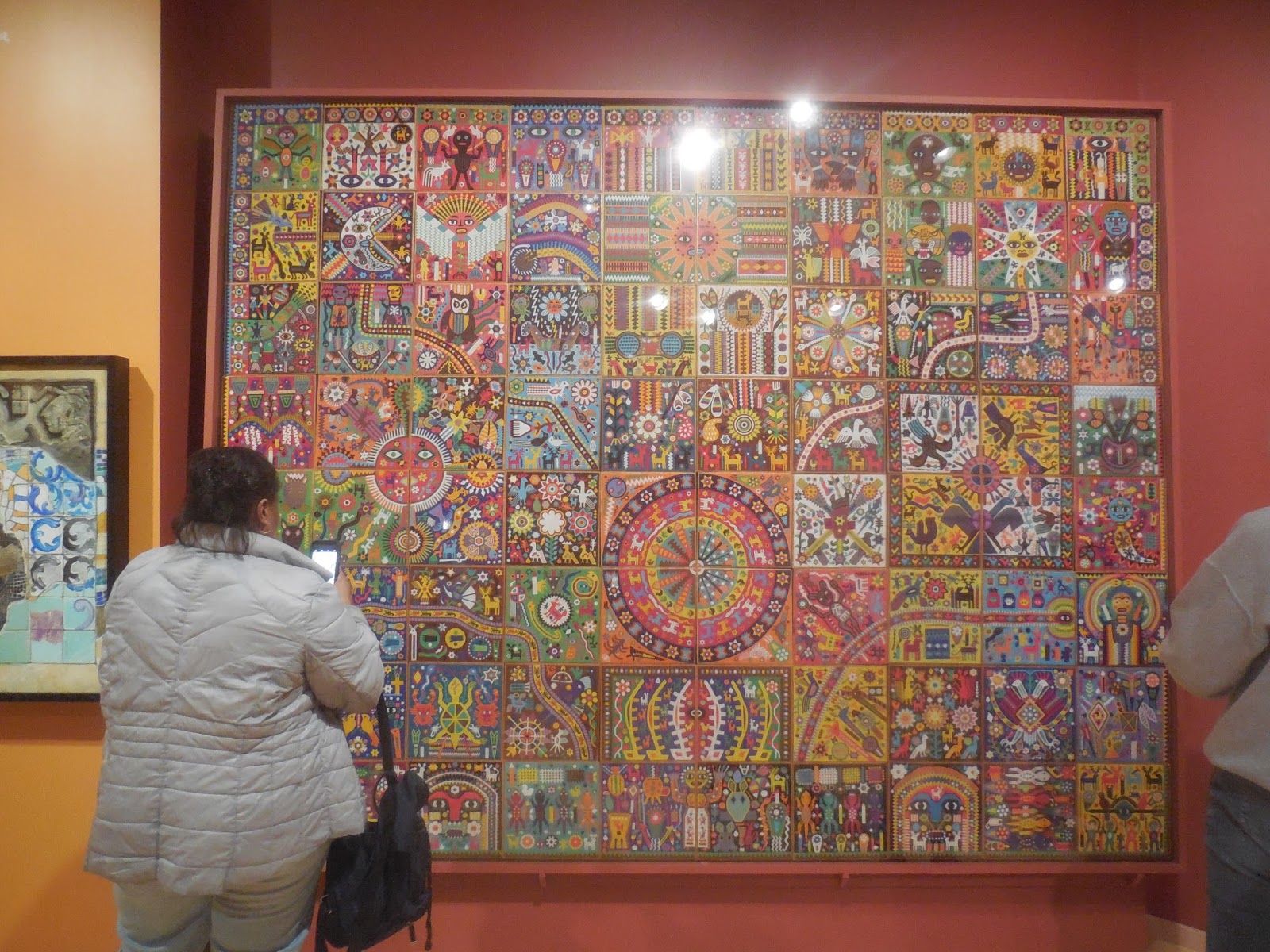
Santos Motoaopohua de la Torre de Santiago, The New Awakening, details below

Glass beads were introduced to Mesoamerica by the Europeans in the 1590s and became an important part of jewelry and ritual objects.  This huge work, at the National Museum of Mexican Art, references traditional motifs.  Tiny seed beads are pressed into the Campeche wax on a plywood support, painstakingly arranged so the holes point up (can you imagine how long that takes, and with what tiny tweezers?), although I was happy to see that a few beads escaped, slumped over on their sides and proved that even the most meticulous artisan takes a ten-second vacation every now and then.