Showing posts with label subject matter. Show all posts

Thursday, January 31, 2019

A little stitched house


My gallery is having an all-member theme show in April and I have been trying to figure out what to make.  The theme is "home" and the organizer had lots of philosophical thoughts about how we are supposed to contemplate the true meaning of "home."  I find myself turning off when asked to contemplate the true meaning of anything, so I am just trying to come up with something that will kinda sorta have to do with "home" and not be too cutesy or precious.

So what to do.  My first thought was to make some more refugee quilt people and stick them under the interstate bridge to represent the homeless people that we have way too many of.  But I realized that I would have to build an interstate bridge for them to live under, and that would get pretty involved, since I am not a woodworker.  I also realized that while I am personally concerned about homeless people, I didn't particularly want this to become a subject for my art.  (I am personally concerned about a lot of things that I don't want to become subjects for my art, and I don't feel a bit guilty about that.  Your art practice has to be a lot more selective and focused than your personal political agenda.)

My second thought was to riff on the stitched pyramids that I made a couple of years ago.  These were so heavily stitched that they took on structural integrity and were able to stand by themselves, a theme that I have been exploring in various ways.  After I finished the five pyramids below, I thought I would continue with different shapes and thought I might equip them with doors or awnings or other architectural features.  But I had never gotten around to this.

I have written many times about how I will respond to theme challenges only by making something that was already on my to-do list, and adding doors to pyramids qualified.  So I made a little house with a little door that opened.

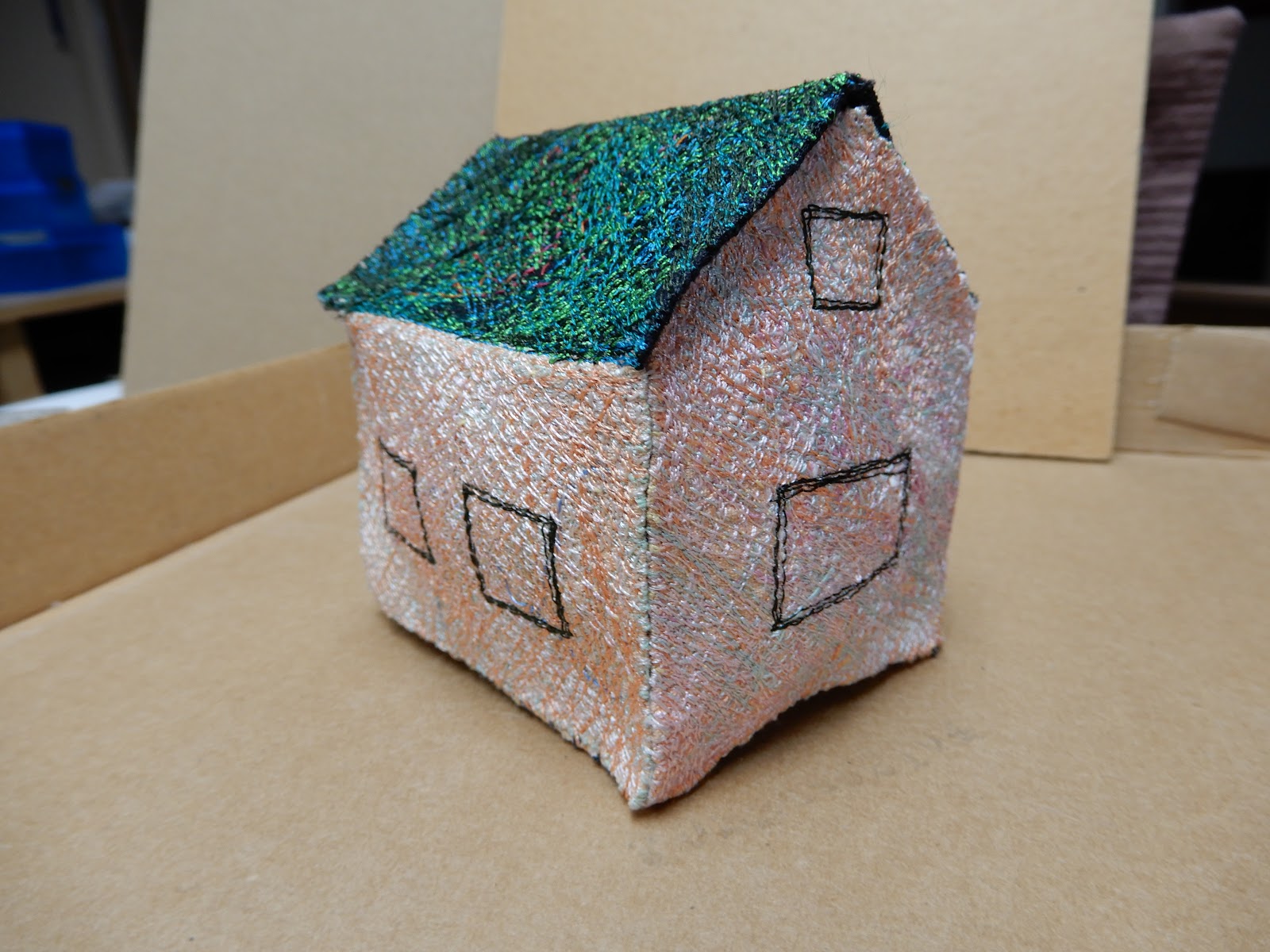
Here's a picture of the heavily stitched house, complete with door:


Although I had made a carefully measured template for the house, I was unhappily surprised at how some of the segments got distorted with the heavy stitching.  In particular, the left-hand house side developed a droop at the lower left, and the door ended up bigger than the opening it was cut from.  The sides of the roof also weren't exactly the same length as the sides of the house they had to be connected to.

When I stitched the pyramids together it made absolutely no difference whether the sides ended up exactly the same length.  I was happy to leave half of the seam unstitched.  But that approach wouldn't do for a house.

So I had to do a fair amount of remedial sewing by hand to get everything put together.  Some roofs ended up with an overhang, and all of the walls ended up with bulges.  But in the end, everything fit together.
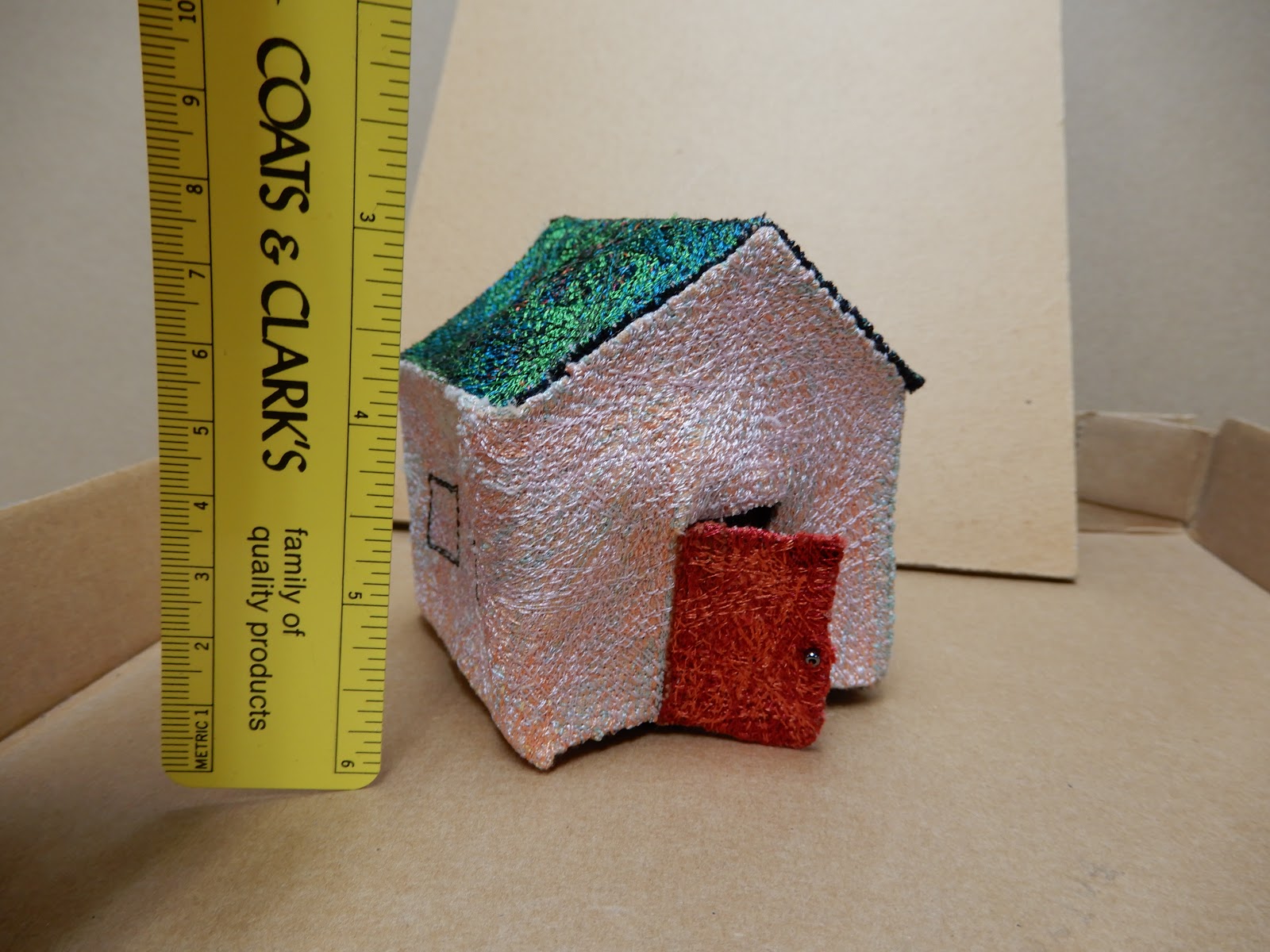


I still don't know whether this piece is too cutesy for the gallery, or too glib and superficial, or too lacking in artistic substance.  But at least it's finished.

Thursday, January 31, 2013

Back in school -- more on death images

Yesterday I posted an essay that I wrote for my art history class about the power of images to shock viewers, and mentioned specifically how images of dead bodies have such mojo in today's world.  To illustrate it, I went to Google Images to find a photo of flag-draped coffins coming back from Iraq, considered so inflammatory that for many years the Bush Administration was able to ban any such pictures from being taken.

To my amazement, when I typed in "flag-draped coffins Iraq" I found on the first page of images a photo that looked quite familiar -- it was my own quilt, Kentucky Graveyard (Iraq).


The quilt indeed featured flag-draped coffins.  I made it in 2006 and I had written about it in my blog at the tenth anniversary of 9/11.  The next thing you know, there it is on page one of Google.

Heck, the only way I knew of to get on page one of Google was to type in my own name, and even then, other people show up.  On a more serious note, it's only because there were so few photos made of the flag-draped coffins from Iraq that my quilt had the slightest chance of being noticed.  I guess that proves the original point: images of death have immense power.

Wednesday, January 30, 2013

Back in school -- sex and death

I wrote last week about how I'm taking a graduate-level art history class, after an extended absence from the classroom.  We're writing every week, and I thought I might share some of my work with you.  Here's a slightly edited version of my first paper, based on an article that riffed on Titian's Venus.  

The author writes at length about images that are sexually arousing, and suggests that we of the 21st century can barely imagine how transgressive and shocking these subjects were in early modern times.  I am reflecting on a class of images that have taken the opposite trajectory: far more transgressive and shocking today than they were five centuries ago.

I’m talking about images of dead bodies.  Death has always been a subject for art; images of Christ on or just taken down from the cross, and of martyred saints were mainstays of churches, Bibles and devotional books.  Sarcophagi of nobles and high clergy were customarily crowned with sculptured corpses.   The Black Death brought a plague of artworks of horror and disruption following that vast series of epidemics.   The danse macabre, showing partying skeletons, was a common image. 

Michael Wohlgemut, Danse Macabre, 1493

Slightly more subtle, but still firmly focused on the inevitability of death, were the memento mori and other still life paintings that came later.  The dead bodies might be rabbits, pheasants and fish rather than people, but the message was the same – you’re next. 

People who saw art, whether as paintings, sculpture or book illustrations, had to be familiar with images of death.  They probably took the images seriously as come-to-Jesus reminders, but I suspect their emotional responses were more awestruck and solemn than shocked.

Even as the centuries passed, images of death stayed at the forefront of consciousness.  Early photographers frequently took pictures of the dead (a big plus in those days of long exposures: the dead could really hold still) and it was fashionable to wear lockets with little death photos, perhaps along with a lock of the deceased’s hair. 

I don’t know exactly how public attitudes (at least American attitudes) toward death images changed, or how quickly.  Perhaps it started with the advent of “real” death images instead of mere artist representations; if so, the extensive photographic documentation of the Civil War surely was an important first step.

The horrors of subsequent wars were even more closely covered.  And yet there was a consensus among photographers to withhold the most disturbing images of battlefield casualties in the World Wars, at least until years later.  The American public saw photos of the dead at Dachau but not on the Normandy beaches.  The very fact that television news of Vietnam showed same-day carnage is credited with changing the public view of that war.  

It’s not as though we haven’t seen plenty of images of death, primarily in wartime.  But in the last half-century those images seem to me to have become more shocking, more taboo, even as sexual images have become more commonplace and less shocking.

I’d like to know more about how contemporary artists  have depicted dead bodies, and how these images were received by the critics and by the public.  Warhol’s images of car crashes and suicides, and Serrano’s images of bodies from the morgue, would be high on the list.  A bit of googling reveals that critics and public alike found it easy to disapprove of these artworks, and I suspect these were not the only such cases.

Andres Serrano, Morgue Photos

Andy Warhol, Green Disaster Twice (sold for $15.2 million last year)


More recently the public was shocked by images of people falling from the World Trade Center on 9/11.  Readers protested when newspapers published photos of falling victims.  Eric Fischl’s bronze statue, “Tumbling Woman,” inspired by the event, was installed at Rockefeller Center but within days it was covered up and subsequently removed after people were upset.

Eric Fischl, Tumbling Woman


Not high art, but certainly important in the public consciousness are many disturbing death images from the war in Iraq.  The Bush administration was so aware of the power of images to shock and galvanize the public that it banned any photography of flag-draped soldiers’ coffins returning to the US. 


Journalists have gone through immense self-flagellation over whether and how they should present notorious death images such as the video beheading of Daniel Pearl, and the US contractors ambushed by crowds in Fallujah, then killed, burned and hung from a bridge.  Almost always their readers and viewers rise up in protest when such images are published, accusing the editors of sensationalism, and perhaps political motives.

Perhaps sex and death have changed places in the public's visual universe in the last fifty years.  Where one used to be seen as shocking and pornographic, now the other one is.


Saturday, August 20, 2011

Talking about diversity

A couple of days ago I was invited to a lunch for artists; we were being asked to donate or lend work to be displayed at a women's shelter, whose inhabitants need all the pleasure, hope, and caring they can get.  Our hostess is African-American and she had decorated her table from her extensive collection of salt-and-pepper shakers, in honor of  the new movie "The Help," which she had just seen.

We talked about how difficult it is for members of one race to fully appreciate how members of another see the world, especially for privileged people (whether by race, income, family situation or any other marker) to understand less-privileged people.  And that conversation morphed easily into discussion of what we should be sensitive to as we made or selected art for the women's shelter.

One artist suggested that it would be good to depict people of different races, to increase the potential for viewers to identify with the subjects of the art.  But another, who used to live in Santa Fe, a crossroads of cultural diversity and high art, said that the etiquette there, enforced by great indignation, was that you don't borrow motifs, images or any other references from cultures or even genders not your own, because "how could you possibly know" anything about them.  She was so put off by this attitude that she started making all the people in her own work purple and green, without any identifiable cultural identification.

We continued this discussion in the car on the way home.  Not only could we whites not fully understand how a black person thinks about Aunt Jemima salt shakers, we non-victims cannot fully understand how a battered woman or abused child will respond to some art we might produce.  Somebody had suggested making a whole lot of small pieces of art, to give to every woman or child who came through the system.  But we didn't know whether this would truly be appreciated by the recipients, or whether it would just be a way for the artist-donors to feel good.

As an artist I generally don't spend a lot of time thinking about how viewers will understand and interpret my work.  I am clear about what I think, and what I'm trying to say, and will discuss it in an artist statement or gallery talk, but I do not adjust that message out of concern for how it will be received.  Yet in considering art in a specialized or therapeutic setting rather than in ordinary public gallery display, a different level of sensitivity is in order.  It was a new concept for me to be grappling with these questions.  I don't suppose this train of thought is going to arrive at the station any time soon.

What do you think?

Tuesday, February 22, 2011

Form, Not Function 1

"Form, Not Function: Quilt Art at the Carnegie" is an annual juried show in New Albany IN that I have had the pleasure of being very closely associated with since its inception eight years ago.  Five years ago after we spent the day hanging the show, I commented to the others in the room that I was pleased to see a couple of quilts with somewhat edgy political messages.  It's long been one of my favorite rants that a lot of art quilts are just too darn nice, portraying a lot of sweethness and light and few darker thoughts or concerns.  So the others rolled their eyeballs waiting for me to carry on again on that subject.

Which I did for a bit, but then had an idea -- that perhaps I should put my money where my mouth was.  And since one of the people in the room was the director of the Carnegie Center, she was very happy to stick her hand out, take the check I wrote, and enable me to give an award for Political and Social Commentary.  And I've continued to do it every year since.

Past winners of the award have been Claire Fenton, Karen Stiehl Osborn, Shawn Quinlan and C. J. Pressma, and I like to think that giving the award has in a small way helped encourage people to make and enter quilts that have something to say about the contentious issues of our society.

But this year there was a wrinkle: the day the awards had to be chosen, I was on my way to Antarctica instead of at the museum looking at quilts!  I delegated the task of choosing "my winner" to Joanne Weis, who was one of the juror/judges of Form, Not Function.

When I got home and saw the show, I was pleased to see that the award had gone to someone I know, Caroline Szeremet, and that I love her quilt.


Caroline Szeremet, Oil Spill 2 -- detail below

The quilt is a whole cloth monoprint and has beautiful detail in the surface design. 


Without taking one iota of credit away from Caroline, I have to say that had I been there to do my own choosing, I would have had a hard time deciding between this piece and one by Shawn Quinlan.  Shawn does wonderful things with found fabrics, and obviously also has great sources for weird commercial prints which he combines in unexpected ways.

Shawn Quinlan, Church and State


Since I like the concept of political commentary in quilt art, I'm particularly happy to see not one but two good quilts in that category in the same show.

Tuesday, December 7, 2010

Art or trash?

I've written in the past about the difficulty in telling whether a given assemblage of stuff in a museum is art or just a pile of trash waiting for the janitor.  I was delighted to see a quiz on Joanne Mattera's blog regarding 25 such assemblages observed at last week's Miami art extravaganza, Art Basel Miami Beach and related fairs.  She will post the answers on Friday but meanwhile you might want to test your own critical eye.


Here's Joanne's #16, which I think is trash.

(A couple of people who have already posted comments suggested that they're all trash.  I found 14 that seemed to be art but am prepared to be roundly humiliated when the answers show up.)

Monday, December 6, 2010

Dark thoughts revisited

Several days ago I wrote about how few quilts deal with "dark thoughts," subject matter or emotions that are not nice, pretty, calm or cheerful, and suggested that perhaps our overwhelming focus on niceness keeps quilters from being seen as serious artists.  A late comment was added yesterday that makes me think more about the issue.

Deb wrote:  "Part of the problem with working dark subject as a quilt is the length of time one spends working with the thing. If I were angry or frightened or crazed enough with, say, being assaulted by a TSA pig at the airport (and I nearly am) I don't think I could stand putting in the necessary time from conception to promotion. I think very many people gravitate to quilt making for the personal gratification and comfort of the sensual input of working with cloth. I know I have, and many times keeping the principles of good art will slip away in favor of the mindless good times and instant feedback of making."

Deb is right on two big counts.  Quiltmaking is a time-consuming way to make art (although I suppose painters and sculptors can also take months on a single work) and that's a long time to live with an emotion like anger or sadness.  And quiltmaking is often used as personal therapy, a pleasant way to escape for a while from frustration. 

I know as well as anybody how sitting down at the sewing machine can help sublimate the pain of a bad spell in life.  During one such spell two decades ago, the only thing I could do, night after night, was to sew tiny bits of fabric into two-and-a-half-inch squares, no thinking required.  Somehow sewing those little bits together made me think I was repairing the tears in my own life and slowly, slowly making things a little better.  Eventually I had thousands of squares, which became a quilt. 

My Life in Pieces


In difficult times, it's probably good to be able to escape from your day-job dark thoughts into comforting, pretty quilting.  But on the other hand, sometimes it's better to confront your demons and exorcise them by putting them into your art.  Art therapists make a living helping people do that.  And artists too spend much of their lives confronting the bad things in life.

Imagine Shakespeare with only the comedies and no Hamlet, Picasso with only the guitars and no Guernica.  Our civilization would be lacking a bit, wouldn't it?

How can historians go to work every day and deal with the Holocaust?  How can reporters go to work every day and write about poverty or crime or epidemics?  How can artists go into their studios and relive their own divorce or rape or child abuse or racist insults?  In all cases, because they believe there's good to be had at the end of the day from bearing witness.

There may be some emotional difference between making art to exorcise your personal demons and making art to bear witness to problems in the overall society.  But I have ended up in tears while making my war quilts, even without knowing a fallen soldier personally.  If you don't want your studio time to be like that, then you should choose happier subjects -- and most quiltmakers do.

Yet quiltmakers are not all alike.  Some make art to confront the dark side, just as some people in every other medium do.  I do not want to suggest that those people are right and people who make cheerful quilts are wrong.  But I do want to suggest that if the establishment wants to encourage quilts to become part of the mainstream art world (and perhaps it doesn't) then it should be equally welcoming to quilts with dark subjects as it is to those full of sunshine.