Showing posts with label handwork. Show all posts

Wednesday, February 9, 2022

Disrespecting us again?

For months I've been getting my trash TV exclusively from Netflix and Hulu.  Now that I've switched over to watching the Olympics, I realize that my fast-forward skills have atrophied, and I find myself listening to commercials for a bit before I snap to and realize that I don't actually have to.  I had sort of forgotten how puerile and patronizing commercials can be, but today one really yanked my chain.

It's for USBank, and it begins with a perky customer service rep hooking up on her laptop with a guy who has an account.  "Cody!" she exclaims, "Hi!  How are you!" 

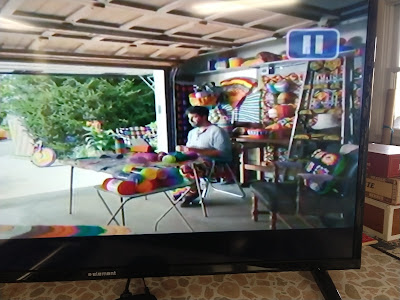
Cody is sitting on a lawn chair in his garage and apparently he has a laptop too.  He overexplains, "I'm good.  I'm crocheting!  It started off as a hobby, kind of snowballed from there, and Alex, I don't want to stop!"  As the camera pans back we see him surrounded by a whole lot of yarn (looking as though it just came home from the store, as none of the skeins appear to have been touched).  Many of his tools and the kids' toys have been cozied in crochet, a large afghan is spread out on a table, a granny-square pillow decorates a leather armchair.

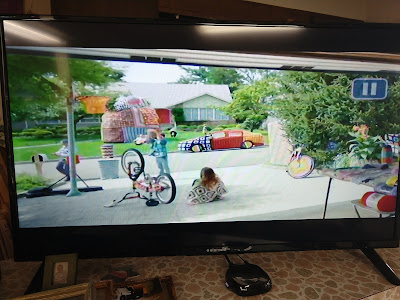
We also see a whole bunch of his finished work, including covers for his car and a very large object -- a camper van with a boat on top? -- that is inexplicably parked in the middle of his neighbor's lawn.
Alex says, "Well, I don't see why you should have to.  Let's set you up with a side gig savings goal on the US Bank mobile app.  This way you can turn it into your main hustle before you know it!"

Cody is thrilled.  "You're my hero, Alex!"  (Is this an acknowledgement that the mobile app is so hard to use that he couldn't set up his side gig savings goal by himself??)

Alex grins wildly and asks, "What are you working on now?"

He holds up a crocheted round about the size of a potholder.  "Pool cover."

Alex keeps grinning.  "That's fun!"

"Oh, I made my wife a bathing suit!"

"Did she like it?"

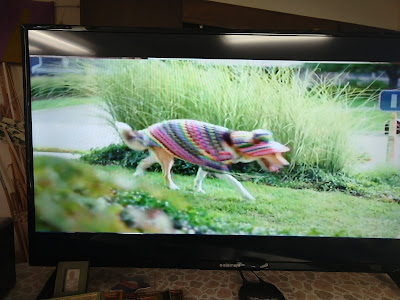
"She did not.  See what I made for Max.  Max!!  Look at him!  He loves it!"  Max, we see, is the dog, wearing a crocheted poncho and hat.
Now the voice-over intones, "The confidence to make your dream a reality.  USBank.  We'll get there together."

I don't know about you, but I found this commercial about as unappealing as Mrs. Cody apparently found her bathing suit.  

I can just see the ad guys lounging about in a conference room.  "Let's have somebody who wants to quit their job and go into business for themself and we can help them save money to do it."  They brainstorm somebody who wants to open a restaurant or a tattoo parlor, to become a wedding photographer, to start a landscaping service.  Nothing sounds really appealing, so one of them says, "Let's do something light-hearted and funny!!  Let's come up with a business that's really silly."  

Maybe a woman who wants to make jewelry or bake cupcakes.  "What's funny about that?" somebody asks and they all agree.  "That's something that women do all the time.  It's not funny.  If a guy did it, maybe that would be funny."   They think of all kinds of frivolous things that would be hilarious if a guy did it.  Now they're yukking it up.  After many sidesplitting suggestions, some of them even appropriate for family viewing, they finally come up with the most ridiculous career choice that a guy could possibly have -- crocheting!!

And of course, the way they portray crocheting, it IS ridiculous that anybody could ever turn dog ponchos and RV covers into a "main hustle."  Especially a guy.  

I could see how a woman (or a man) crocheting something beautiful could be a plausible example of an idea that could conceivably be turned into a business.  But the ad guys wanted the cheap laugh, and you can always get one by making fun of people who do handwork.  And what's funnier than silly women doing crocheting, but a DUDE doing it!!!    

This commercial is supposed to make people want to do business with USBank???  As a USBank customer for more than three decades, it made me want to take my money somewhere else.

Wednesday, February 17, 2021

A reader finds inspiration

It's always great when somebody out there not only reads your blog, but grabs an idea and does something lovely with it.  This time it was Jennifer Allen, who wrote me:

"I fell onto your blog while searching for ideas about working in series and I'm glad I fell.  I've been looking for a way to find some focus, to narrow parameters, to slow down and explore... just be more thoughtful in what I'm doing.  Here's a pic.


"Parameters: limited to the 5 wool swatches I had on hand for size (about 8 x 6) with no trimming allowed, each to use buttons already on hand (and long forgotten), some hand stitching (however primitive) on each one and other sources of fabric being one old hat, one old dress, and two remnants all on hand.  

"I'm so pleased with the Button Box series that I've hung them.  Very satisfying.  I'm looking for my next 'series' and thinking in place of buttons, button holes might be interesting.  

"Narrower parameters and small size seem to be key for me to gain some focus; a step in a good direction.  Buttonholes are now lodged in my imagination and I'm enjoying just thinking about the idea.  Enjoying is pretty good too."

Jennifer, you're welcome!  I'm so glad you stumbled on advice that obviously you were ready for, and able to make good use of.  The old saying: when the student is ready, the teacher will appear.  

Note to all:  Good for Jennifer to set rules that worked, and double good for her to plan her next series on the shoulders of the first one.


Friday, October 16, 2020

Last month on Art With a Needle -- Designer DIY

It's been a while since I caught up with the comments that you all have left on the blog.  

I've gotten many comments on my snarky remarks about the Designer DIY series in the New York Times, which has appeared on and off on Thursdays since springtime.  It disappeared for a few months in late summer, reappeared for two weeks this month, and then was AWOL this past week -- I hope for good. 

Shannon spoke for many of my readers when she said "the horribleness of these makes me think surely they are tongue-in-cheek, yet they seem so self-serious..."  Marilyn wrote: "I'm on a news fast this weekend, the news is so miserable, and this is a perfect antidote.  Funny!  Do you think anyone really makes these things?"

Several people snarked at the "ironic Amish" designer who would have us cut up pillowcases to make dresses.  Shasta wrote: "This is a good way to make clothes when you are under 9 and haven't figured out how to use the sewing machine yet.  I am still trying to figure out 'ironic.'  My nephew took my old TV for his dorm room because he said it was ironic."  LES wrote: "My parents were Amish as children, and I can tell you, that ain't Amish, ironic or not.  Pillowcase dresses are for 3-5 yr olds, not grown women.  Once again, thanks for the laughs!"

Rena wrote: "Thoroughly enjoyed your critique.  First gut-busting laugh this year.  Would be fun to see photos from NYT readers modeling their pillowcase creations..."

And yet... I got an email from my friend Susan who said, "But the truth is, when I was in my teens, and much scrawnier than now, I did make a few sleeveless summer dresses out of (not very worn) king sized pillow cases.  I opened up the seams at the top center and top of each side, and then used the seam allowances as facings for the boat neck and armholes... and they came pre-hemmed.  Thanks for the memories!"

Several readers have commented over the months of the Designer DIY feature that I could do the job better than the editor/writer.  I will modestly point out that it's much easier to make fun of the finished product than it no doubt was to wrangle articles out of prima donna designers who clearly have no idea of how to actually make something.  But thank you for your kind thoughts!  Norma wrote: "Kathy, I love reading your critiques of these articles.  Can there really be an editor that approves of these?"  Bea wrote:  "You might compile these blogs in a book and send to the Times?"

Bea, I'm way ahead of you.  During the summer I wrote a long message to Vanessa Friedman, the fashion editor of the Times, pointing out how lame this series has been.  I sent links to all the blog posts I had done to date and begged her to pull the plug on the series.  "If your purpose in this series is to win brownie points in the fashion community and give some designers a bit of free ink, then you have probably succeeded, especially among readers who don't actually try to do the projects.  But if your purpose is to give your readers projects they can succeed at and feel proud of, your are failing miserable," I wrote.  "I apologize for the snarky tone of these posts, but Ms. Friedman, you have certainly asked for it.  Properly executed, this could be a wonderful series.  But instead it's a laughingstock among people who know sewing, embroidery and crafts.  And probably it's a great disappointment among people who don't, and looked to you for guidance that didn't work." 

I suggested that she let people who know how to do handwork write the instructions, or "better yet, let somebody who does actual handwork come up with the ideas too, so you could present projects that are doable and attractive."

I received no response, of course.  I have spent a little time thinking about what kinds of projects I could dream up for housebound readers with little or no experience in sewing or working with fabric if indeed I were running this project.  Easier said than done, especially when you realize that most people out there, unlike you and me, don't possess fabric, needles, thread, embroidery hoops, pins, sewing machines or any of the huge array of stuff that makes our projects possible.  Nor can a lot of them sashay down to the local fabric store and stock up. 

So what projects would you recommend if you were in charge?


Friday, January 12, 2018

Tension headaches


Our fiber art group just scored two huge garbage bags full of old doilies and tablecloths in a variety of techniques -- crochet, tatting, hairpin lace, cutwork, bobbin lace, embroidery and who knows what else.  As we sorted through, contemplating what we'll do with them, I noted how some were obviously made at less-than-expert level craft.

And I thought, as I have so often in the past, that in every single fiber art, the key to mastery is control of tension.

Check out this cute little crocheted doily, made in granny squares.  The white is tighter than the pink, hence the 3-D effect.

When I first learned to crochet, taught by my mother-in-law, I made a fairly large afghan.  I was proud of how neatly it was done, flat and even -- until I finished and tried to fold it up.  Oops -- one end was a good six inches longer than the other!

What had happened, of course, was that as I got more comfortable with the yarn and the stitch, I eased up on the tension and the finished fabric got more expansive.

I have taught many beginners how to crochet, sew and embroider, and have watched myself try to learn knitting, weaving, felting, macrame and many other techniques.  In 99% of the cases beginners' work is too tight.  We clench up on the needle or hook or whatever tool we're using, we pull too hard on the thread or the yarn, we hang on too tight to the underlying material.  We grab that quilt in a death grip and resist the pull of the sewing machine; we wrap the french knot so firmly that we can barely pull the needle through; we tug the weft through the weaving so hard that the selvages bow inward. 

(Weavers may correct me on that last remark -- I think some beginners err in the other direction, leaving the weft too loose so the selvages are uneven and loopy.  But that's the other 1% of tension headaches.)

The problem usually disappears with practice; we relax, we learn to let the yarn flow easily, we develop muscle memory so all the stitches have the same tightness throughout the whole work.  In knitting parlance, we automatically maintain the right gauge without having to stop and measure all the time. 

That's not to say we can stitch in oblivion.  It's still good to stop every now and then, lay the work out flat, check how it's coming along.  Note whether your afghan is still the same width as when you started.  Check that the second sock is the same size as the first one.  Make sure your seams are smooth, not drawn up in a ruffle.  Look at the back of your work and see that the threads are well-behaved, not forming tangles and knots. 

It's not just the sewist that can have tension problems -- the machine can too.  In my experience, Bernina sewing machines, which I love, adore and have used exclusively for almost 30 years, have one achilles heel, and that's tension control.  I have had to learn tricks to keep them from spoiling my work: avoiding threads that the machine doesn't like, making sure the bobbin thread matches the top thread so if it's pulled up too far, it will be less visible. 

All these issues are part of mastering the craft of our art.


Thursday, November 2, 2017

Handwork in miniature


The Art Institute of Chicago is known for its collection of 68 miniature dioramas depicting rooms from different places and times.  They were made after extensive research into the authentic furniture and architecture styles, and crafted meticulously in the 1930s under the direction of Mrs. James Ward Thorne, a rich benefactor of the museum.

The rooms are done to a scale of one inch to one foot, and situated low in the walls, with a convenient step beneath each one so small visitors can get a good view.

I was intrigued to see that the inhabitant of the New England Bedroom, 1750-1850, was at work on an embroidery in a standing hoop.

It's apparently an allover floral design, only half finished.  And what a bright, sunny, spacious room in which to sit with your needle in front of the fireplace!


Monday, August 21, 2017

Grandchildren and fiber art 3


Several weeks ago I posted a photo of Vivian asleep while I crocheted.  At the time, she had spent practically all of her time with us asleep, a source of frustration to grandparents who wanted to play with her.  But I predicted that pretty soon she'd be up and about.

And sure enough, she's now awake.  My dear friend Uta Lenk from Germany, whom I met years ago at a quilt workshop and have been close with ever since, is visiting the States this month and brought her knitting along.  We noticed that Vivian seemed transfixed by watching Uta knit -- was it the click of the needles, the light reflecting from them, or just the repetitive motion?  Whatever, she watched Uta intently all evening.


Uta promised to come back and teach Vivian to knit when she's old enough.  Uta learned when she was six, taught by her grandmother who rewound balls of yarn to include coins and little toys, an incentive to keep going.  What a great idea!  Only five and a half years till we can try it with another little girl.

Friday, August 19, 2016

Love will find a way


My son sent me an email the other morning -- "Do you have fiberfill?"

What on earth could this be about?  He said it was for a secret project and he would come over and show me.

He pulled this out of his bag:

It  was about five inches long and four inches across.  This required further explanation.

The occasion was his first anniversary, and after some discussion with his wife about what she would like him to do for her, she tossed out an off-hand remark -- "what I really want is a crocheted Oddish but you'd never be able to do that."  (She has been bribing herself with Pokemon Go to walk 20 miles a week, and the Oddish is her favorite character.)

My son being the kind of guy he is, filed away that remark and said to himself, "that couldn't be too hard."  So he found directions on the internet, bought some yarn and a crochet hook and went to work.  As you can see, there were a few glitches in this first segment, including that protuberance on the right-hand end which we think was supposed to be a flat base.

Fortunately he lives only two miles away so he could come over for consultation several times.  His purchased crochet hook went MIA and he had to come by for a replacement.  We stuffed the segments and figured out how to sew them together.  We found the perfect hemispherical red eyes in my button box and embroidered a blue smile.


The directions had said to put a stitch marker at the beginning of the row.  I was pleased to see his improvised device, straight out of the Lego box:

Here's the surprised recipient with her new toy.  I bet next year she will think carefully before she says what she really wants for her anniversary.


Monday, December 22, 2014

Number one in the series


So a couple of months ago I attended a workshop where we were doing stitched shibori, the kind where you have to draw up the stitched fabric tightly, tie off the threads, and cut off all the long ends.  Found myself with a whole pile of cut ends on my table, and during a slightly boring presentation started tying them into knots.  Just plain old overhand knots, but if you kept tying knots upon knots they developed an interesting knobby texture that seemed intriguing.

I tied all my loose cut ends into the little pieces that were developing shape and substance, and then cut some new threads to tie in, longer ones so I could knot farther without leaving so many cut ends hanging out.  The following day, after we had dyed our shibori in indigo, I took out the stitching and knotted those threads, now a beautiful blue, into my little pieces.

The thread is plain old Coats and Clark upholstery thread, nice and strong, somewhat fatter than sewing thread, with a slight sheen.  After I used up all the bits left over from shibori, I bought a second color of thread and continued to knot.

For several weeks I've been making these little doodads and piling them on my work table, not sure of exactly how I wanted to finish and display them.  When something is only an inch or two long, you have to give some thought to display; you can't just plop it down on a pedestal and call it sculpture.  But just in time for Christmas, I figured out the answer -- at least, I figured out one answer, enough to get the first piece on its way to my friend.

I'll tell you more about the process and show you more pieces as I get them finished, but here's number one in the series.  I'm calling them "Specimens."

The frame has a 2x3-inch opening, and the specimen is about 1 1/4 inches tall.  It has a lot of knots in it.


Tuesday, October 28, 2014

Making a mole


Zoe's chemistry class has come to the part about moles, the quantity of a substance it takes to make up as many grams of the stuff as the stuff's atomic weight.  And to help the kids remember the concept, her teacher traditionally gives extra credit to anybody who makes and brings in a stuffed mole.

I'm not sure about the mnemonic link there, except that the kids will remember there was something about a mole, but nevertheless who would argue with extra credit.  So Zoe brought over the mole pattern and we sewed on Sunday afternoon.

She chose a particularly gorgeous red and gold print, last seen as "A" in The Scarlet Letter, for the body. Scraps of green felt were still lying around the work table from the backing of my Quilt National piece, so we used them for the feet and braided tail.

I sewed the parts together on the sewing machine; Zoe stuffed the mole and sewed up the last seam on his belly.

We thought he was a pretty fine-looking creature, even if he didn't have any eyes.

The Scarlet Letter, 2002 

Monday, June 16, 2014

Dorothy Caldwell Extravaganza 1


My local fiber and textile art group tries to have an internationally famous teacher come in for workshops every couple of years, and this year we were fortunate to have Dorothy Caldwell with us for a week.  She taught two different workshops and gave a lecture, leaving us all in awe of her beautiful art and energized with lots of new ideas for our own work.

It's going to take me a few days to decompress and digest everything she told us, but to whet your appetite for posts to come, I'll tell you about a tiny skill she taught us, which made me so happy.

It's making string, a skill Dorothy learned from India Flint, who in turn learned it from the aboriginal women in Australia.  They would make their string from plant fibers, mostly thin strips cut from pandanus leaves.  Dorothy likes to use silk or organdy.

Cut or tear your fiber of choice into strips about a quarter-inch wide.  Hold two strips together in your left hand (if you're a rightie) with a half-inch or so clasped between your thumb and finger, and the length of the strips extending off toward your right hand.

Grab one of the strips with your right hand and twist it away from you by rolling it between thumb and forefinger.  (Thumb moves up from the tip of your forefinger to about the first knuckle, as seen in the photo.)  Let's call this the twisted strip.

Now grab the other strip -- let's call it the bottom strip -- between the second and ring fingers of your right hand and hold it taut.

Wrap the twisted strip down in front of the bottom strip so it makes a neat little roll tight up against your left thumb.  Grab it between the second and ring fingers, or let go if you're having a hard time hanging onto two strips at once.  Now this will be your bottom strip, and the formerly bottom strip will be ready to roll between thumb and forefinger.

Get into a rhythm -- twist, wrap down in front, switch your grip, twist, wrap down in front, switch your grip.  Continue till you have made a nice long string.  When you get to the end of the strip, you can hold a new strip down overlapping the old one and twist them together, either tucking the ends neatly inside your roll or letting them stick out from the string like little flags.

So each strip is separately twisted away from you, but the two strips together are wrapped/twisted toward you.  The opposition of the two twists is what holds the string together.  You could achieve the same thing by twisting a string a bazillion times with an eggbeater, then grabbing it at the midpoint and letting it twist back on itself, but this method requires no tools and can be done as you watch TV, ride in the car, listen to a lecture or wait for paint to dry.

If you wet the strips before you twist and wrap, the string will be much neater and tighter.

For a final touch, when Dorothy was in Australia she would rub some of the ocher earth into the wet strips as she made the string, so it ended up with rich colors.  Unless you love the color of mud, that approach isn't going to work in Kentucky.  But we did make beautiful two-color strings with leftovers from hand-dyed silk contributed by a workshop participant.


Friday, June 13, 2014

Bad ideas in fiber art for Friday the 13th


I didn't buy this yarn; I acquired it in the grab bag from my fiber and textile art group.  I am grabbing and using just about any kind of yarn there is for a conceptual art project that is probably going to keep me busy for years -- way too big to make with purchased yarn.  So beggars can't be choosers.

But I have to say, scented yarn is the pits.  Although the fragrance at first whiff smells kind of nice, whiffing it continually as I crochet is enough to make me sick.  Even when I go in another room, my hands smell of the stuff.

I can't figure out who the target demographic is, or why they would like this product.  Maybe if you live upstairs from a rendering plant, this would help mask the ambient odor, but otherwise it's hard to understand the rationale.  If I want my work area to smell nice I'll pick some flowers or maybe cook up a pork chop.

Tuesday, May 13, 2014

Truth in advertising


I know that when you make "yarn" from leftover textiles you neither expect nor want to have perfect color matches from skein to skein.  But these don't even look close:

Probably best to choose a project requiring one skein.

Tuesday, November 19, 2013

Lost and found -- good news


One of my daily art projects for 2011 wasn't really daily, more like weekly.  I was making bundles or packages of stuff that I found lying around, either indoors or out, at least one every week.  Some weeks I'd make several if opportunity presented itself.

One week in particular I made a bunch of bundles, since we were at the beach and not doing much except walking in the sand and picking up shells anyway.  There were six, and I carefully put them into plastic bags and cushioned them so they wouldn't get broken or unbundled on the way home.  In a masterpiece of bad vacation planning, we had only one day between getting home from the beach and setting out for a cruise, so between unpacking the suitcases, doing laundry and repacking, some things never did get properly put away.

You guessed it immediately, but I didn't figure it out until eight months later when I was trying to document all the bundles I'd made during the year.  I realized with a terrible sinking sensation that the ones from the beach had never been unpacked and put in the big bag with all the other ones.  I searched around in what I thought were obvious places but never could find them.

At least I had the photos, I told myself, trying to get used to the concept of having lost some of my work for the year.  Heck, what's the point of a daily or weekly art project if you can't assemble the whole thing when it's over?

Time passed.

The other night I was looking for some crocheting to do while we watched TV.  It has just recently gotten cool enough that I want to have an afghan over my lap in the evening.  So I found a bag with a project already begun and worked on it during the movie.  As I was packing up afterwards I noticed the bag was kind of heavy and rooted around to see what was in the bottom besides three more skeins of yarn.

Of course it was the bundles from the beach; apparently I had taken that afghan along on the trip and not looked at it since.  I am so happy, having almost but not quite resigned myself to them being lost forever (or should I say misplaced forever, if there's a difference).

You might wonder how a bag of half-finished crocheting could sit around for two and a half years without being investigated.  But believe me, that's easy.  I own lots of tote bags, and many, many of them contain half-finished crocheting.  Guess I need to watch more TV and work on those afghans!


Monday, August 19, 2013

The fiber bridge

Last week I went on an art road trip with my best museum pal, putting on 960 miles and hitting five different venues in four days.  But the surprise treat of the trip was one that hadn't even been on our radar screen until we arrived in Pittsburgh.  Then we learned that a couple of days earlier, one of the downtown bridges had been yarn-bombed with almost 1000 knitted, crocheted and woven afghans!

And quite the spectacle it made -- each space on the pedestrian railing between uprights was filled with not one but two afghans, one facing outward and one facing in.  Then the railings themselves were covered with black knit or crochet.  Over this past weekend the plan was to go back and also cover the bottom railing, right below the afghans.

In addition, the two big towers of the bridge were adorned with a lot of knit fabric in geometric designs.

The project was dreamed up more than a year ago, planned to coincide with Fiberart International, which is held every three years under the sponsorship of the Fiberarts Guild of Pittsburgh.  (To get an idea of the prodigious planning required to get the project done, check out their blog here.)  The show closed yesterday, but the bridge will remain decorated until September 8.

And to judge from the pedestrians lingering on the bridge last week to inspect, discuss and photograph the afghans, the project is a big hit.

People from all over the region contributed afghans, which had to be 34" x 72" and made of acrylic yarn to stand up to the weather.  After they're taken down, the afghans will be washed and donated to homeless shelters and other charities.

By far the most popular design was the granny square; eight squares and a little border would do the trick.  What I loved best was the improvisational spirit of most of the makers.  A lot of people ran out of the colors they started with, and finished with something else.  A lot apparently decided to use up the yarn they had on hand, no matter what colors.  Some people made only a third or less of a complete afghan, which ended up being joined to other parts.  Some people made only a couple of eight-inch squares.
Mismatched or not, or perhaps because they were mismatched, these hit-or-miss afghans had amazing energy.  It helped that they were all pulled tight around the railings -- flat and taut, they looked like abstract paintings.  If there are bulges or droops, or if the afghans aren't exactly square, which is very likely with makers of all different degrees of expertise, none of that was apparent in this presentation.

Many of the afghans were surprisingly sophisticated in design, considering the limitations of the rules.  Here are some of our favorites.  Sorry about the shadows -- you can't make a bridge move its piers just so you can get a better photo.