Friday, December 12, 2014

Sign of the week


PS  Two minutes later, the train had come to a halt, stretching out of sight in both directions.  Here's what happened then:


Thursday, December 11, 2014

Shallow alert


In the trashy weekend tabloid that appears in our Sunday newspaper, we read that an actress I've never heard of, starring in a miniseries about the four Biblical wives of Jacob, has "a newly acquired skill," thanks to filming the movie.

"I had to learn how to separate the wool that came straight from the sheep, clean it and put it on spools," she proudly tells the interviewer.  (I guess her immersion in useful fiber processes didn't extend to learning the actual terms for these newly acquired skills.)

She didn't think as much about the dust on location.  "We were covered the entire time we were filming," she complained.

Here she (the one at left in blue) and her girlfriends pretend to be carding and spinning.  I'm no ancient history scholar but it strikes me that the clothes seem to come from considerably later times (check those gathered, set-in sleeves and that plunging neckline on the chick in pink.) Likewise, I'm no scholar of textile history but that carding setup also looks suspiciously modern.  And did they have lathes in Biblical times to turn those spindles?

And where's all that dust she was bitching about?

I am so sorry that I missed the miniseries, which ran earlier this week.


Wednesday, December 10, 2014

My new "day job" 3


The 600+ panels in the International Honor Quilt collection were supposedly catalogued in 1994, but don't try to take that to the bank.  The database is supposed to include information on the panel, the woman or group honored in the panel, the maker of the panel and biographical information about her, the maker's statement (about why she chose the honoree, how she made the panel, or whatever else she wanted to say), technical information on the panel's condition, measurements, materials and techniques, and a detailed description of the panel.

Materials, techniques and description are my responsibility, while the other fields are being checked and corrected by others on the project staff.  In my three fields, we're finding that some panels have no information at all, while others have been incorrectly described.

For instance, 18 of the first 54 we've gone through had no information on materials, techniques and description!  That's a lot of blank spaces in the data base.

But even the ones that have been filled in by past cataloguers need to be carefully checked for accuracy.  The previous cataloguers sometimes confuse hand and machine stitching and use catchall terms such as "hand sewn" instead of distinguishing between hand piecing, hand applique and hand embroidery.  Considering that this project is officially about "quilts," it's discouraging that they have not carefully distinguished between quilting and other forms of stitching.

One of the cataloguers seemed enamored of the term "partial machine construction," which means nothing to me.  "Top stitching" is frequently used as a descriptor, except sometimes it means machine applique, other times it means quilting, still other times it means embroidery.

the cataloguer thought this beautiful padded satin stitch was machine embroidered

The previous cataloguers also didn't pay much attention to how the edges of the panels were finished -- traditional quilt binding, facing, knife-edge finish, fabric from the front or back of the panel folded over the edge and stitched down on the other side, or whatever.  In many cases there was no description at all of the edge, and in others it wasn't accurate.

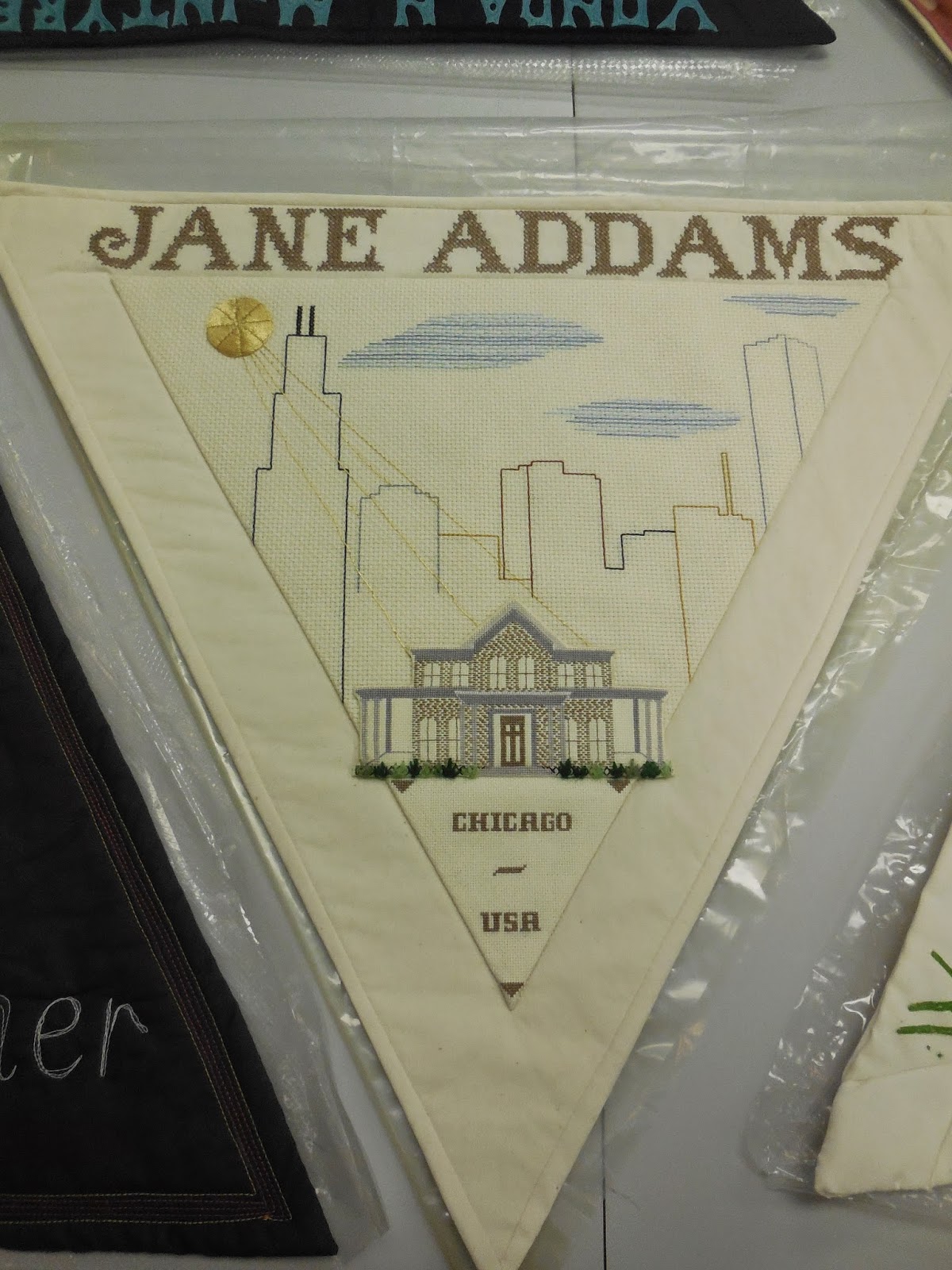
In addition, we've decided that consistency in the descriptions is a virtue, so I'm rewriting them to always begin with the "border," which almost always contains the name and location of the honoree, then describe the interior triangle, then the edge finish, finally the reverse.

So I inspect each panel, compare it to what the cataloguer wrote, poke and prod the work to determine what techniques were used, occasionally feel the goods with my ungloved hand to identify the material, and write my own notes.  Then at home I type it all into the database; it usually takes me a bit longer to type up the notes than it did to inspect the panels.

The curators had acquired several pairs of those baggy, limp white cotton gloves to protect the quilts, but I said we needed Machingers to make it easier to work, so as of yesterday we're the proud owners of four pairs!  I have a long embroidery needle that I use to poke at the work and lift an edge or pull a seam open to see how it was stitched, a ruler to measure the borders and a magnifying loupe to get a better look at the stitches if necessary.  And we had to get a metric tape measure to do all the dimensions in centimeters (we argued for quite a while about whether to stick with inches, but couldn't agree on whether to say 1.125 or 1 1/8 and whether those three decimal places were misleadingly "accurate").

I had to gingerly poke at this one to determine that the tiny orange stitches are made with a punch needle, not french knots

But enough about research methods; more in subsequent posts about what I'm finding as I inspect the panels.

Tuesday, December 9, 2014

My new "day job" 2


When I learned last summer that the University of Louisville School of Art had acquired the panels made by hundreds of volunteers to accompany Judy Chicago's The Dinner Party, my heart sank.  I had two major concerns.


First, I was afraid that the panels would be portrayed as works of art, even though I suspected that many of them would have that loving-hands-at-home air -- exhibiting neither excellent craft nor compelling visual imagery -- that is the antithesis of serious fiber art.  I was afraid that such an endorsement would taint the air, at least locally, and make it easier for people to lump all fiber art into the same shallow bucket, awash in earnest sentimentality.

Second, I was annoyed that the collection was officially named the International Honor Quilt, even though many of the pieces in my first viewing were not quilts.  It's the same quarrel I have with the "AIDS Quilt;" it chops me that the "most famous quilt in the world" is not a quilt, because that disrespects the many works that truly are quilts and encourages people to be haphazard in how they talk about all fiber art and textile techniques.  (Chicago was also involved in the genesis of the AIDS Quilt, so perhaps her cavalier attitude toward nomenclature affected both projects.)

not a quilt


When my fiber and textile art group met with the curators in August and got to see some of the panels, I raised this issue of nomenclature.  It didn't get much response from the curators, none of whom had much experience with fiber art, until I said, "I know that you must be really annoyed when people refer to your work incorrectly, using the terms 'painting' and 'print' interchangeably."   (Winces from the other side of the table; laughter from the assembly.)  "Well, that's the same way I feel when people don't use the term 'quilt' correctly -- it's like fingernails on the blackboard."

But I left the meeting with a feeling that the best -- perhaps the only -- way to be sure my concerns didn't become unpleasant realities was to get involved myself.  I was reassured that the curators had backed away from the earliest PR-release language touting the collection as "an artistic treasure" and were viewing it more as a sociological event, a remarkable outpouring of response from women around the world, embodying the ardent feminism that today seems quaint.

not a quilt

And I was determined to honor the work of these women by describing it correctly.  The curators said at the meeting that they hoped to get volunteer help from our textile group in the cataloguing, and I immodestly thought that I probably had as wide a knowledge of textile techniques as anybody else in the group.  So I told the professor in charge of the project to count me in.

Monday, December 8, 2014

My new "day job" 1


I'm about to tell you several posts worth about my new volunteer project at the School of Art at the University of Louisville.  Today, the back story.

It starts with Judy Chicago's magnum opus, The Dinner Party, made in 1975-6, first exhibited in 1979 and now on permanent display at the Brooklyn Museum of Art.  Widely regarded as one of the high points in feminist art, it is a huge three-sided table with 39 place settings, each one commemorating a famous woman in history with an individualized plate and placemat.  An additional 999 women were memorialized on floormats on which the table rested.

The exhibit toured the world for nine years, drawing huge crowds, and many of the women who saw it were moved to wish that their own favorite women could be included in the show.  At some point Chicago invited submissions from anybody who wanted to make a panel.  Hundreds of panels came in, and on later stops in the tour they were displayed as part of the Dinner Party installation.

The panels covered famous and not-famous women; many people honored their mothers, grandmothers, next-door neighbors and teachers.  Others chose women's organizations such as the League of Women Voters, the American Association of University Women or La Leche League.  Some depicted fictional, mythological or Biblical characters, groups such as farm women or pioneers, or universal themes such as menstruation.

There were only two rules: each panel should be an equilateral triangle, 24 inches on a side, and around the edges of the triangle should be written the name of the honoree and her city and country. Beyond that, the format, materials and techniques were up to the makers.

After the world tour, both The Dinner Party itself and the more than 600 volunteer-made panels went into storage.  Last year, Chicago's foundation donated the panels to the University of Louisville, and the school is now grappling with the task of properly documenting them.

In a moment of some kind of mental aberration, I decided that I needed to be involved with this project, so I'm spending several hours a week with the panels and a spreadsheet, helping the curators with the technical details of textile techniques and materials.  I'll tell you more about the project and my role in it in subsequent posts.