Friday, August 10, 2018

Daily art update 6 -- ticket to ride


Another format for my daily map depends on a train ticket, either one that I bought and used at some point in the past, or one that I found on the street, or one that a friend brought home for me.  And I must give a shout-out to those wonderful friends who are supplying me with tickets, museum brochures, flyers and just plain maps from their travels.  I really appreciate what you have brought me!!!

My rule for this format: paste the ticket onto an index card, add a map.  Thank the friend who brought it to me.


Serendipity struck with this last ticket.  As we went places in Hamburg in May, we ended up at the train station at least twice a day, and if I saw some tickets on the floor or in the street that weren't too encrusted with crud I would pick them up.


When I got home I inspected them closely and realized that this ticket wasn't from Hamburg at all but Graz -- almost 700 miles away in Austria. (I wonder how it got to the floor of the Hamburg station.)  And noted that in my newly acquired  collection of brochures was an ad for Graz tourism, complete with map!  So it was easy to match the ticket with its map.  I don't suppose I'll find that kind of coincidence again.


Wednesday, August 8, 2018

Daily art update 5 -- endless highway


This year my daily art is different from past years in that I don't make a piece every day with the same format that I can easily photograph and post to my blogs.  Instead I have a theme -- maps -- but no rules as to what kind of art I should do each day with a map.  Some days I might be making a little book, other days a collage/painting, other days a 3D construction.  Some days I work on a continuing project without trying to precisely document the beginning and end of that particular day's work.

I haven't reported on my progress in quite a while, so maybe it's time for an update.

One of the new formats that I've been doing more than once is what I call "endless highway," in which I cut small bits from the road atlas or other map source and join them to others.  Sometimes I mount these constructions in accordion books; sometimes I make cubes.


It's amusing to see a highway go from Cleveland to Honolulu to Twin Falls.


The cubes are most difficult to make.  It's tricky to find a map bit with highways heading in three directions, meeting the adjacent sides in exactly the right place.

And it's also tricky to construct the cube from cardstock; how do you get a firm bond when gluing the sides together when you can't get your hands inside?  But these little technical challenges are what I love about making art.

Monday, August 6, 2018

Art report / Hamburg 5


This is the end of my art reports from Europe, with something kind of funny from the Hamburger Kunsthalle.

Annette Streyl,  BMW München / Palast der Republik / Reichstag Berlin (details below)

As the wall sign explains:  "The sculptures use architectural models as their starting point.  Annette Streyl had the Reichstag and other landmarks of German politics and history knit at a scale of 1:100 and hung them over a clothesline.  Deprived of their power and importance, they resemble pieces of wet laundry."

Germans might find more of an instant frisson of recognition, but if you aren't familiar with the buildings (as Americans would be, for instance, with a model of the White House) you have to take it on faith that these are accurate scale models.

I got a laugh out of these pieces, especially the limply dangling flag atop the Reichstag.  The tall BMW towers looked to me just like as a pair of long johns.

Worth the price of admission!


Sunday, August 5, 2018

Friday, August 3, 2018

Art report / Hamburg 4


Two more pieces of art from the Hamburger Kunsthalle featuring fiber -- both very simple, little more than big pieces of fabric hanging flat against the wall.


Franz Erhard Walther, Three Wall Pedestals, 1980-1 (detail below)

Well, this has a little bit extra added onto the big pieces of canvas, with extensions that are arranged on the floor, and on two of the pieces, to the top and sides.  The left-hand and central panels have strapped pockets at floor level, the right-hand panel has some kind of extra fabric-covered plane standing an inch out from the wall.

I wasn't sure what to think of this piece; perhaps I was confused by the translation.  The card on the wall translated Drei Wandsockel as "Three Wall Pedestals" -- but what's a wall pedestal?  Google translate gave me "Wall Sockets," but where would you plug something in? 

I asked my German friend for clarification, and didn't get much.  She wrote me back: "A Sockel is some construction on which you can present something, typically it would be a statue on a Sockel.  Probably fixed to it, and when upheaval is on, statues are pushed off the Sockel, or if you lose confidence into an idol you push that idol from a (metaphorical) sockel.  So Karl Marx was pushed off the Sockel in East Germany after 1989 a number of times. A Wandsockel would normally be some Sockel fixed to the wall with something fixed onto it, but it is not a typical German word. With the photo illustration I would think it is giving the construction a name so it is not 'no title'."

So I remain mildly impressed, by the size of the work and the technical excellence of construction (although I bet he didn't do the sewing himself), but puzzled about the meaning -- I didn't get much out of it.

I was much more taken by these two works by Sara Sizer.  Although the velvet panels look like creased pieces of fabric dramatically shadowed in oblique light, they're actually stretched and perfectly flat -- the patterning is done with bleach discharge.

Sara Sizer, Scarlet, 2017 (detail below)


Sara Sizer, Please, 2017


Having done a fair amount of bleach discharge in my artistic career, I was transfixed by these pieces -- how on earth did she achieve that photo-perfect image?  A fruitless google expedition provided no answers (note to artists -- I sure wish you would put a word or two onto your website alongside the ravishing photos).
Wednesday, August 1, 2018

Art report / Hamburg 3


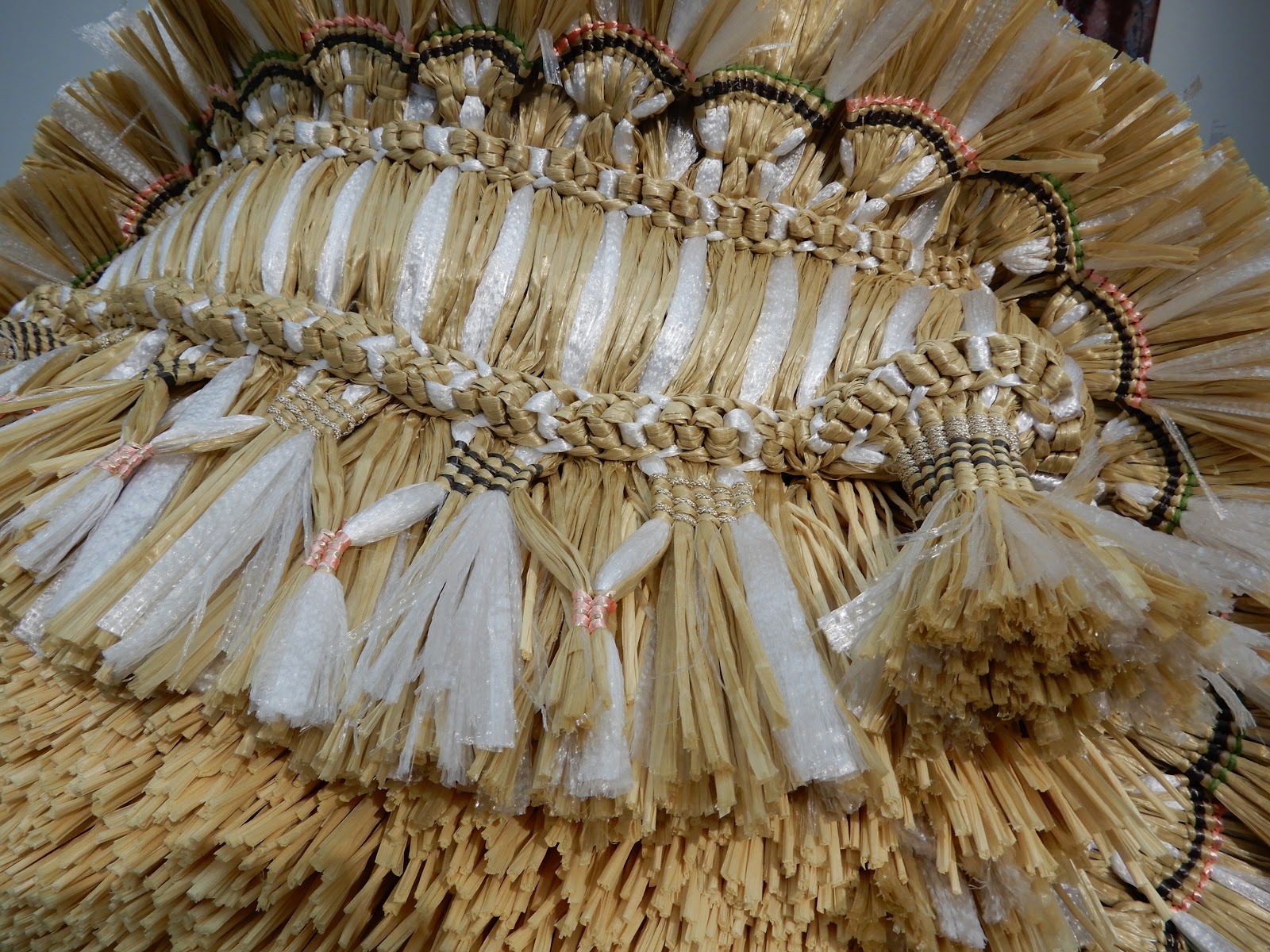
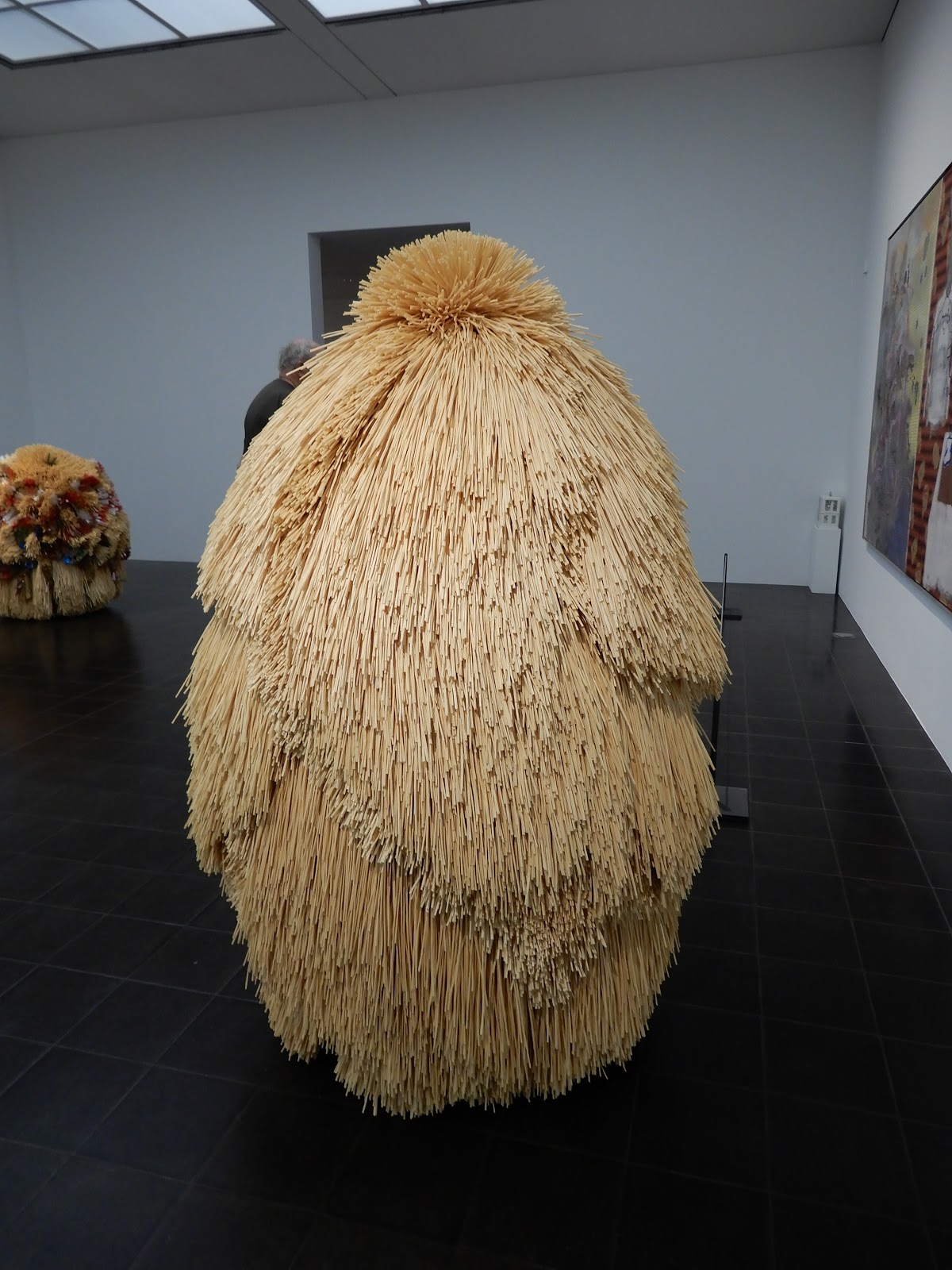
A couple more posts and I will have told you everything about the art I found on my Baltic vacation.  Let's return to the Hamburger Kunsthalle for a collection of works by Haegue Yang, a South Korean artist who is on an artificial straw kick.  She has made three almost-life-size figures out of the straw plus other trimmings. 

At first glance I shuddered -- what on earth was this strange thing, half fat waddly robot and half explosion in a drapery showroom? 


The Intermediate -- Fan Dance around a Pagoda (detail below)

It wasn't until I saw the other two sculptures that I started to feel better; at least this artist was sticking to her theme and exploring its possibilities at some length. 


The Intermediate -- Pungmul Ball (detail below)


The Intermediate -- Hairy All Over

The third sculpture, the plainest one, was my favorite; I thought the unadorned artificial straw worked best without the distractions of other plastic doodads.  I wish the artist had given more of a hint as to what these pieces are supposed to be about.  Online statements about her work comment that her concerns include "migration, postcolonial diasporas, enforced exile and social mobility" but I can't deduce which ones are in play with this series. 

I would also like to have seen more of these figures; I know from google images that she has made many of these pieces and I think seeing a whole gaggle of them together would be impressive.  You would probably see them as people and focus more on their sheer numbers, wondering who they are and what they are doing here, than on the silliness of the craft materials.  But then again, maybe these "people" are part of a postcolonial diaspora, and they're spread out all over the world, only a few in Hamburg.