
Showing posts with label Paris. Show all posts
Showing posts with label Paris. Show all posts
Wednesday, May 7, 2014


Monday, November 25, 2013
St. Catherine's Day
I didn't know that Saint Catherine was the patron saint of seamstresses, till we saw this old poster in a shop window in Paris. Today is her festival day. Here she is, keeping watch over all of us.


Thursday, October 3, 2013

Tuesday, September 10, 2013
Fiber art in Paris -- it's everywhere
You don't even have to go to a museum to find fiber art in Paris.
Yes, all these objets d'art are crocheted.
Seen in a disembodied shop window (not one in the front of a shop), so I couldn't tell what kind of shop it belonged to. I hope it was a flea market.


Yes, all these objets d'art are crocheted.
Seen in a disembodied shop window (not one in the front of a shop), so I couldn't tell what kind of shop it belonged to. I hope it was a flea market.


Thursday, August 15, 2013

Thursday, August 8, 2013
Fiber at the Pompidou 7 -- the last laugh
And as we leave the Pompidou....
My nomination for the silliest use of fiber:
 Sylvie Fleury, Tableau no. 1, 1992
I laughed out loud but if I saw it again and again I bet the joke would get old fast.
Or maybe she's doing a series -- next comes Mona Lisa with faux fur hair, or Manet's picnic on the grass with faux fur grass....
My nomination for the silliest use of fiber:

I laughed out loud but if I saw it again and again I bet the joke would get old fast.
Or maybe she's doing a series -- next comes Mona Lisa with faux fur hair, or Manet's picnic on the grass with faux fur grass....
Sunday, July 14, 2013
Photo suite 81 -- Bastille Day
Political protest at Place de Bastille, 224 years ago (something to do with revolution):
 Political protest at Place de Bastille, one month ago (something to do with immigration):


Non-political protest at Place de Bastille, one month ago (something to do with soccer):

Gendarmes keep the two bunches apart:

Thursday, July 11, 2013


Wednesday, July 3, 2013
Paris museums 5 -- Kandinsky at the Pompidou
Lots of Kandinsky at the Pompidou, which is fitting considering that the guy invented abstraction and also became a French citizen after fleeing the Nazis. The more of his work I see, the more I appreciate it.
 Vassily Kandinsky, Impression V, 1911
 Vassily Kandinsky, Mit den schwarzen Bogen (With the black arc), 1912
The sign explains, "Kandinsky here asserts that the construction of a painting can be based, not only on geometry, but also on the principle of dissonance. This fundamental concept, which he discovered in the musical compositions of his friend Arnold Schönberg, was at the centre of his work during the period 1908-1914."
 Vassily Kandinsky, Bild mit rotem Fleck (Picture with red patch), 1914
"The composition of Bild mit rotem Fleck revolves around a patch of red," the sign explains. "The colour refers to the 'red corner' that housed the protective ikon in the Russian peasant house. The twin trapezoidal arcs at the top of the painting form a bridge between two crucial foci, one perfectly calm -- the red patch -- the other a bouquet of explosive colours on a black background."
These three paintings are such iconic Kandinsky that I was taken aback by this much later work. At first glance I thought it was a Miró, but no.
 Vassily Kandinsky, Bleu de ciel (Sky blue), 1940
Which proves once again that the great artists can always surprise you.


The sign explains, "Kandinsky here asserts that the construction of a painting can be based, not only on geometry, but also on the principle of dissonance. This fundamental concept, which he discovered in the musical compositions of his friend Arnold Schönberg, was at the centre of his work during the period 1908-1914."

"The composition of Bild mit rotem Fleck revolves around a patch of red," the sign explains. "The colour refers to the 'red corner' that housed the protective ikon in the Russian peasant house. The twin trapezoidal arcs at the top of the painting form a bridge between two crucial foci, one perfectly calm -- the red patch -- the other a bouquet of explosive colours on a black background."
These three paintings are such iconic Kandinsky that I was taken aback by this much later work. At first glance I thought it was a Miró, but no.

Which proves once again that the great artists can always surprise you.
Tuesday, July 2, 2013
Paris museums 4 -- Matisse and Picasso at Centre Pompidou
In yesterday's post I got us just barely inside the Centre Pompidou, the primary museum of modern and contemporary art in Paris. The permanent collection starts at the turn of the previous century. The earliest painting I saw was this very impressionistic Matisse:
 Henri Matisse, Pont Saint-Michel, c. 1900
And there were lots more from his later years:
 Henri Matisse, Intérieur, bocal de poissons rouges, printemps, 1914
Apologies in advance if some of my photos are off-square or otherwise nasty -- many of them are under glass and I had to shift position to avoid glare.
 Henri Matisse, L'algérienne, 1909
 Henri Matisse, Figure décorative sur fond ornemental, 1925-6
Cubism isn't my favorite art genre, but the Pompidou had a huge array and I found a lot of intriguing works. Not so top-heavy on guitars and wine bottles as other cubist collections I've seen elsewhere.
 Pablo Picasso, Still Life, 1925
Here's another that I really liked:
 Pablo Picasso, Arlequin et femme au collier, 1917

Look at this little guy lurking in the wings at stage right -- I think I may steal his beautifully simplified form for a collage or embroidery sometime.

And there were lots more from his later years:

Apologies in advance if some of my photos are off-square or otherwise nasty -- many of them are under glass and I had to shift position to avoid glare.


Cubism isn't my favorite art genre, but the Pompidou had a huge array and I found a lot of intriguing works. Not so top-heavy on guitars and wine bottles as other cubist collections I've seen elsewhere.

Here's another that I really liked:


Look at this little guy lurking in the wings at stage right -- I think I may steal his beautifully simplified form for a collage or embroidery sometime.
Monday, July 1, 2013
Paris museums 3 -- Centre Pompidou
So enough of this Mona Lisa stuff, let's hear it for the avant-garde! As I wrote last month, I left the Louvre in the midst of an anxiety attack, exacerbated by a police presence forming outside and some shouting protesters. Wasn't sure what they were shouting about; earlier that week there had been a huge march against gay marriage (just legalized), but it might have just been a soccer riot (two weeks earlier there was a HUGE one around the Eiffel Tower).
 We learned later that Angela Merkel, the German prime minister, was about to make a ceremonial visit to the Louvre for a controversial exhibit of German art. Our knowledgeable and irreverent guide had told us earlier that the gist of the show apparently was that German Romantic painting led directly to Hitler. On my way out the door I had briefly considered visiting the exhibit, but couldn't find how or where to buy a ticket, and when I learned what had happened that afternoon I was glad to be gone. When my husband and others in our group left the museum about an hour later, the entire grounds were teeming with police; Ken counted 11 vehicles in the plaza and most of the walkways were blocked.
After I cleared the impending war zone, a brief walk in the rain to the Centre Pompidou washed away my anxiety.
As you approach the building (not just a museum but a venue for concerts, conferences and other special events), you get an outdoor tableau to get you in the mood for contemporary art.


I felt happy just entering the vast courtyard of the building, an architectural world apart from the medieval Louvre. Famously, the working parts of the Pompidou are placed on the outside of the building, and the big stepped escalator tube is its signature.

 Here's the Pompidou logo, rendered in different colors.
Outside the front door, an Alexander Calder mobile, "Horizontal," which rotates in the breeze.
 A temporary installation by French "urban artist" Ox consists of a lot of translucent orange tape applied to the windows around the entry doors. It's called "La fenêtre scotchée" -- probably no translation required.

I'll write about the art in later posts; right now, the building itself is a lot of fun.

After I cleared the impending war zone, a brief walk in the rain to the Centre Pompidou washed away my anxiety.
As you approach the building (not just a museum but a venue for concerts, conferences and other special events), you get an outdoor tableau to get you in the mood for contemporary art.


I felt happy just entering the vast courtyard of the building, an architectural world apart from the medieval Louvre. Famously, the working parts of the Pompidou are placed on the outside of the building, and the big stepped escalator tube is its signature.


Saturday, June 29, 2013


Sunday, June 23, 2013
Photo suite 78 -- kids on the move
Perhaps it's just spring fever, but everywhere in Paris teachers are herding their students on field trips.


Sunday, June 16, 2013
Photo suite 77 -- Paris from my hotel window


And yes, it's all from the same window! Paris blocks often have huge interior courtyards with subsidiary buildings invisible from the street. Our seventh-floor (sixth, in Europarlance) room had a great view of everything.
Thursday, June 13, 2013
Paris museums 2 -- Louvre
So here we are at the Louvre, getting a bit antsy, and we still haven't seen anything. We decided to skip the Mona Lisa and head for the Vermeers and Rembrandts, which were at the far end of the other building, away from the "Must See" six pack.
We thought this remote area would be less crowded. And in fact it was -- that wing was closed, which we discovered only after hiking through dozens of galleries. Even the museum attendants didn't seem to know why it was closed or for how long.
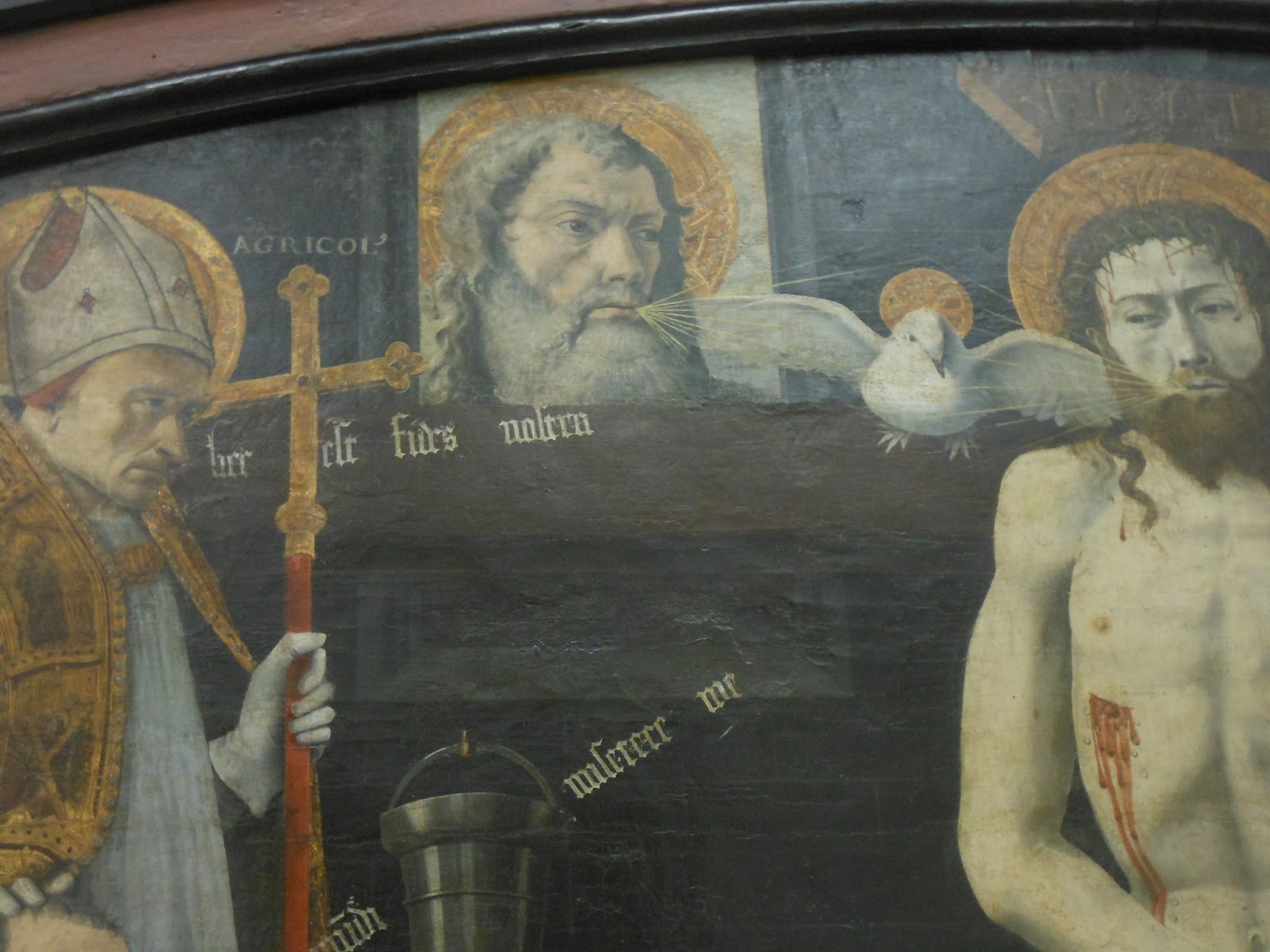
I did see some things I liked on the way. Check out this lovely painting from 15th Century Provence.
 Notice how the priests are speaking, while the breath of the Holy Spirit passes between Jesus and the Father.
 I've always liked the tradition of painting church interiors, done most frequently in the low countries. Here are two by the same guy (although his name is spelled differently on the two signs), perhaps of the same church?
 Hendrik van Steenwijck, Church Interior with a Sacristan, 1608
 Hendrick van Steenwyck; Church Interior, Night; c. 1610-20
I feel immense guilt over my reaction to the Louvre. I know it's the greatest museum in the world, but it stops at 1848, just about when I think art starts getting interesting. Perhaps because I never had a basic art history course, I don't have much appreciation for the subtleties of when perspective was invented or how the Renaissance harkened back to classical art. And I really don't like huge crowds.
So I decided to ditch the Louvre and head for the Pompidou. My next trip to Paris, if I am so lucky, will be in the winter and maybe I'll give the old masters another try in less frantic conditions, with a better guidebook. But not this time.
We thought this remote area would be less crowded. And in fact it was -- that wing was closed, which we discovered only after hiking through dozens of galleries. Even the museum attendants didn't seem to know why it was closed or for how long.
I did see some things I liked on the way. Check out this lovely painting from 15th Century Provence.



I feel immense guilt over my reaction to the Louvre. I know it's the greatest museum in the world, but it stops at 1848, just about when I think art starts getting interesting. Perhaps because I never had a basic art history course, I don't have much appreciation for the subtleties of when perspective was invented or how the Renaissance harkened back to classical art. And I really don't like huge crowds.
So I decided to ditch the Louvre and head for the Pompidou. My next trip to Paris, if I am so lucky, will be in the winter and maybe I'll give the old masters another try in less frantic conditions, with a better guidebook. But not this time.
Subscribe to:
Posts (Atom)