Showing posts with label museums in Germany. Show all posts
Monday, August 6, 2018
Art report / Hamburg 5
This is the end of my art reports from Europe, with something kind of funny from the Hamburger Kunsthalle.
Annette Streyl, BMW München / Palast der Republik / Reichstag Berlin (details below)
As the wall sign explains: "The sculptures use architectural models as their starting point. Annette Streyl had the Reichstag and other landmarks of German politics and history knit at a scale of 1:100 and hung them over a clothesline. Deprived of their power and importance, they resemble pieces of wet laundry."
Germans might find more of an instant frisson of recognition, but if you aren't familiar with the buildings (as Americans would be, for instance, with a model of the White House) you have to take it on faith that these are accurate scale models.
I got a laugh out of these pieces, especially the limply dangling flag atop the Reichstag. The tall BMW towers looked to me just like as a pair of long johns.
Worth the price of admission!
Friday, August 3, 2018
Art report / Hamburg 4
Two more pieces of art from the Hamburger Kunsthalle featuring fiber -- both very simple, little more than big pieces of fabric hanging flat against the wall.
Well, this has a little bit extra added onto the big pieces of canvas, with extensions that are arranged on the floor, and on two of the pieces, to the top and sides. The left-hand and central panels have strapped pockets at floor level, the right-hand panel has some kind of extra fabric-covered plane standing an inch out from the wall.
I wasn't sure what to think of this piece; perhaps I was confused by the translation. The card on the wall translated Drei Wandsockel as "Three Wall Pedestals" -- but what's a wall pedestal? Google translate gave me "Wall Sockets," but where would you plug something in?
I asked my German friend for clarification, and didn't get much. She wrote me back: "A Sockel is some construction on which you can present something, typically it would be a statue on a Sockel. Probably fixed to it, and when upheaval is on, statues are pushed off the Sockel, or if you lose confidence into an idol you push that idol from a (metaphorical) sockel. So Karl Marx was pushed off the Sockel in East Germany after 1989 a number of times. A Wandsockel would normally be some Sockel fixed to the wall with something fixed onto it, but it is not a typical German word. With the photo illustration I would think it is giving the construction a name so it is not 'no title'."
So I remain mildly impressed, by the size of the work and the technical excellence of construction (although I bet he didn't do the sewing himself), but puzzled about the meaning -- I didn't get much out of it.
I was much more taken by these two works by Sara Sizer. Although the velvet panels look like creased pieces of fabric dramatically shadowed in oblique light, they're actually stretched and perfectly flat -- the patterning is done with bleach discharge.
Sara Sizer, Scarlet, 2017 (detail below)
Sara Sizer, Please, 2017
Having done a fair amount of bleach discharge in my artistic career, I was transfixed by these pieces -- how on earth did she achieve that photo-perfect image? A fruitless google expedition provided no answers (note to artists -- I sure wish you would put a word or two onto your website alongside the ravishing photos).
Wednesday, August 1, 2018
Art report / Hamburg 3
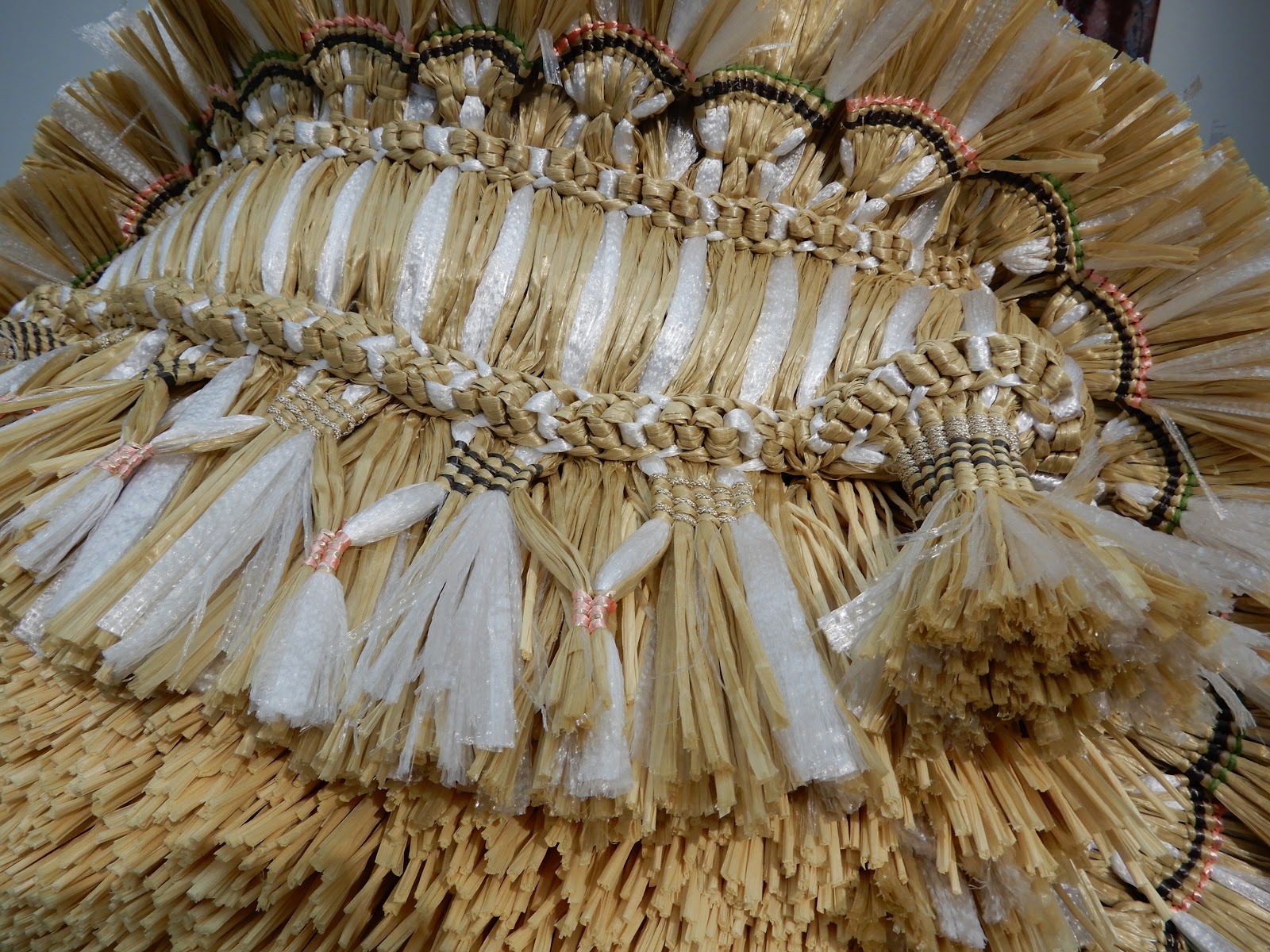
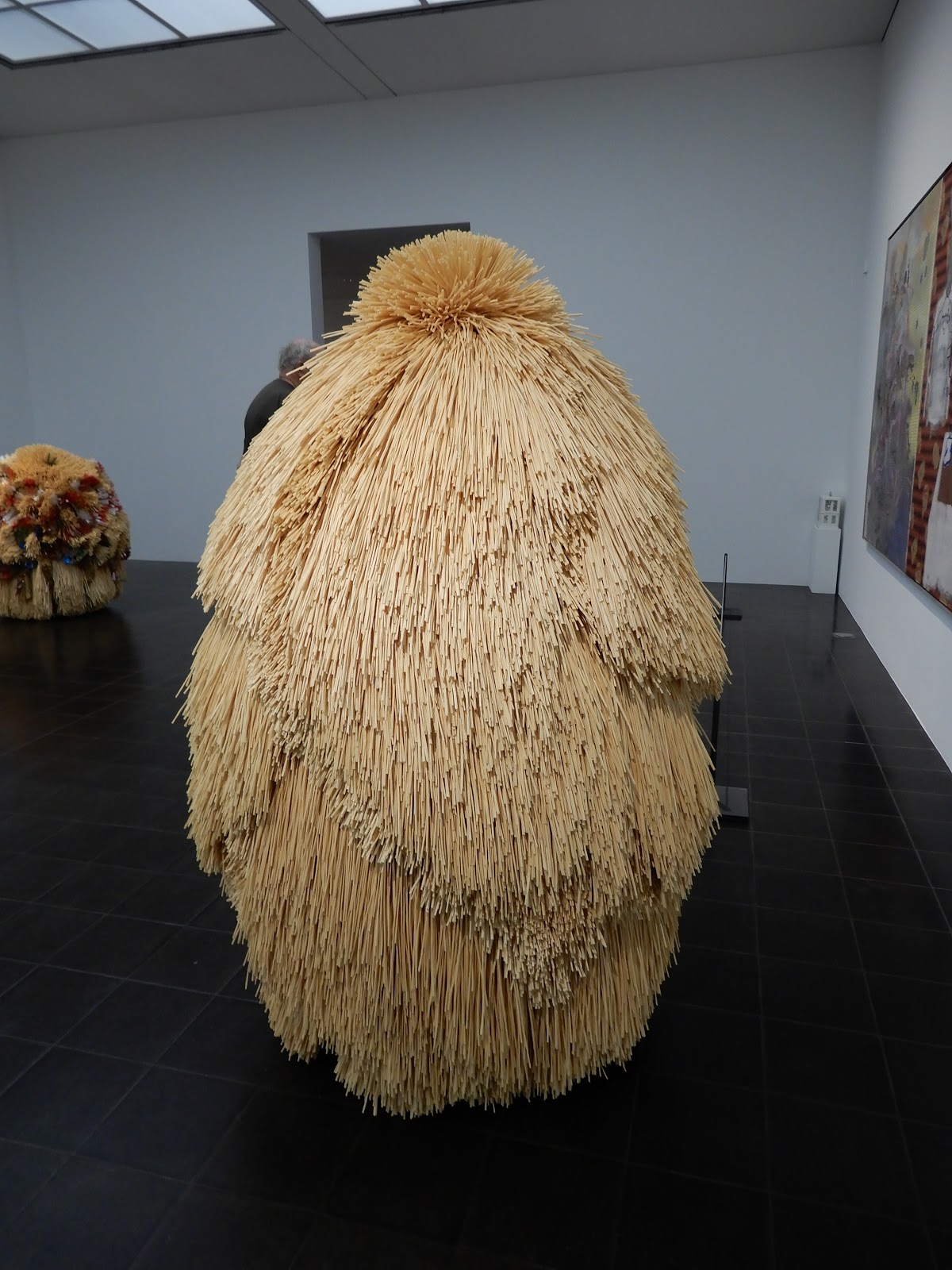
A couple more posts and I will have told you everything about the art I found on my Baltic vacation. Let's return to the Hamburger Kunsthalle for a collection of works by Haegue Yang, a South Korean artist who is on an artificial straw kick. She has made three almost-life-size figures out of the straw plus other trimmings.
At first glance I shuddered -- what on earth was this strange thing, half fat waddly robot and half explosion in a drapery showroom?
The Intermediate -- Fan Dance around a Pagoda (detail below)
The Intermediate -- Pungmul Ball (detail below)
The Intermediate -- Hairy All Over
The third sculpture, the plainest one, was my favorite; I thought the unadorned artificial straw worked best without the distractions of other plastic doodads. I wish the artist had given more of a hint as to what these pieces are supposed to be about. Online statements about her work comment that her concerns include "migration, postcolonial diasporas, enforced exile and social mobility" but I can't deduce which ones are in play with this series.
I would also like to have seen more of these figures; I know from google images that she has made many of these pieces and I think seeing a whole gaggle of them together would be impressive. You would probably see them as people and focus more on their sheer numbers, wondering who they are and what they are doing here, than on the silliness of the craft materials. But then again, maybe these "people" are part of a postcolonial diaspora, and they're spread out all over the world, only a few in Hamburg.
Friday, July 13, 2018
Art report / Hamburg 2
The Hamburger Kunsthalle had several pieces of fiber art from well back in the previous century, giving an interesting spin on the days when it was considered avant-garde simply to get some nontraditional materials and display them (gasp!) in a mainstream museum. Seeing them five decades later makes me realize that fiber art has come a long way.
Robert Morris, Untitled (Felt Tangle), 1967
Robert Morris is an American artist who has worked in sculpture, land art, performance and conceptual art. One of his favorite materials has been industrial felt, which in this piece is both hung from the wall and arranged on the floor. I'm not sure this particular installation does much for me; I can't tell whether he's exploring felt's drapability, its firm structure or just its ability to sit there in the gallery looking transgressive.
Reiner Ruthenbeck, Hammock, 1969
Yes, it's a big piece of red cotton, suspended across a corner of the gallery from four skinny straps. What is it saying to us about cotton-ness, about redness, about hammock-ness? Beats me.
As I contemplated these two works in the gallery and now at home reviewing my photos, I confess that my major questions had to do not with the materials, not with the formal aspects of the compositions, but with their maintenance. Do the janitors come in every morning and carefully pick up the edges of the felt so they can dust under the first six inches of the sculpture? Do they vacuum the whole thing every now and then? Does the hammock require periodic washing and ironing to keep the drapey folds from getting permanently creased?
I don't suppose the artists wanted viewers to be thinking about such issues, but they didn't give me much else to chew on. Sorry.
Thursday, July 12, 2018
Art report / Hamburg 1
Rosemarke Trockel is a German artist who works in practically every medium and technique that she can think of, but I have always kept an eye out for her knitted works. Seen in the Hamburger Kunsthalle, this large work from 1986:
In the traditional modernist trope of referring to art in your art, Trockel has cleverly executed the "Woolmark" logo in her wool knitting. She stretched the knitted fabric over a canvas for rigid display.
Whenever I see mainstream artists use fiber techniques I wonder how much if any of it they did themselves. A bit of googling gave me this explanation from a London gallery that exhibited some of her knitted works: "In choosing wool and knitting, a material and technique traditionally associated with the female domestic realm and craft, Trockel explores the negative connotations of these 'inferior materials and skills'. Distinguishing her practice from traditional craft, Trockel made blueprints for her designs and had them produced by a technician using computerised machinery. By mechanically producing the knitted patterns, she questions whether the cliche of women's art relates solely to the choice of materials or whether it is also influenced by the treatment of these materials."
Hmmm. I wonder what was the answer to her questioning -- is the cliche just in the wool, or in how you process it, or in what you choose to depict in your knitting? And I also wonder what she considers to be "the cliche of women's art."
Do you suppose we'll ever get past being a cliche? I'm not sure Trockel is helping on that score. What do you think?
Tuesday, June 5, 2018
Life imitates art 9
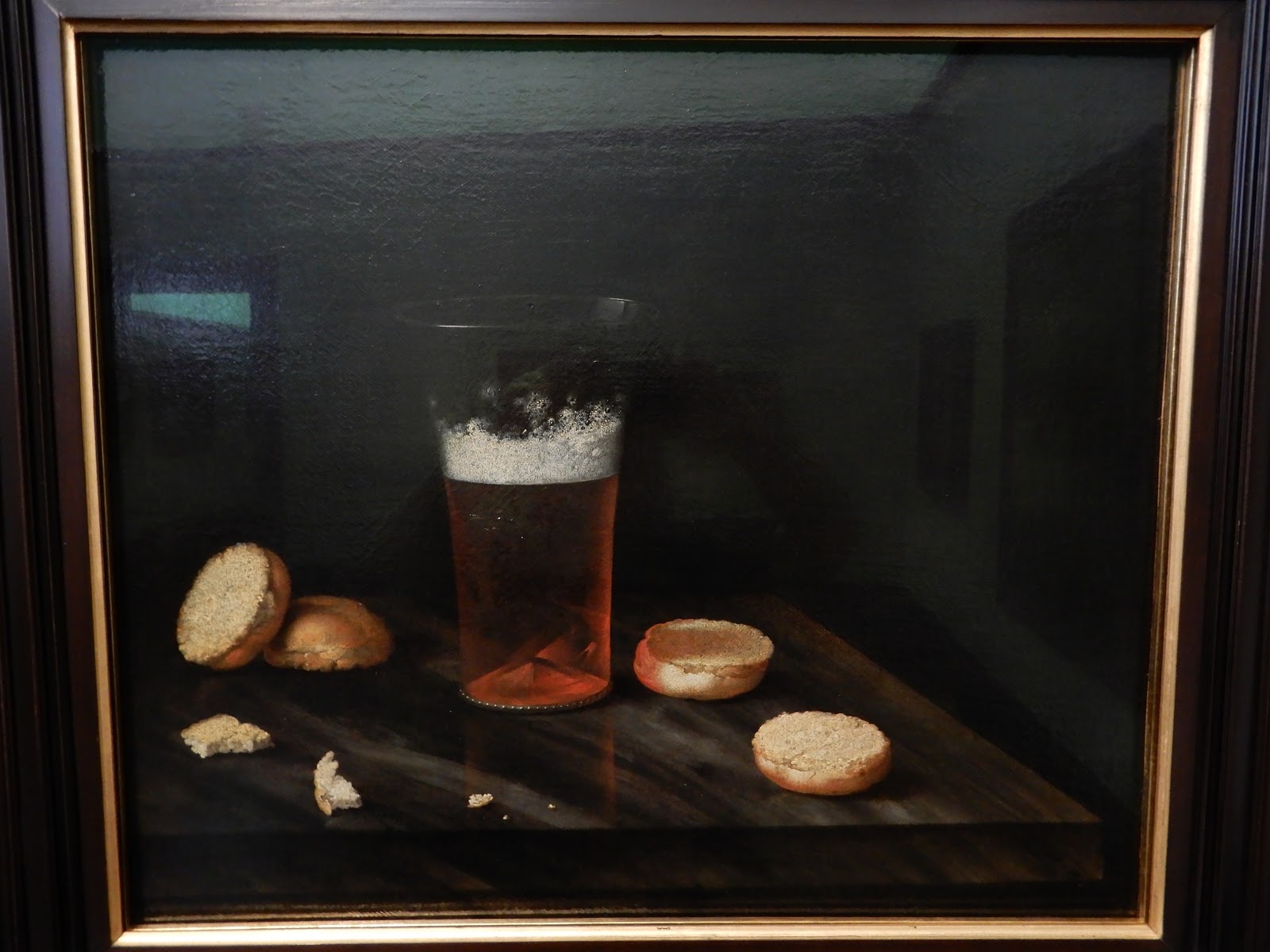
For many years Ken and I have had the tradition of a "beer shot," a photo when we're sitting in a foreign place about to improve our day with a cold beverage. We align the glasses or cans so the labels are visible, along with a bit of the background scenery, such as this picturesque little cafe in Copenhagen three weeks ago.
So when I found this painting in the Hamburg Kunsthalle museum it was clearly a case of life imitating art. Even though it took three and a half centuries.
Johann Georg Hinz, Still Life with Beer Glass and Bread Rolls, 1665
Thursday, June 25, 2015
Happy birthday!
My father would have turned 102 today so I thought it would be appropriate to celebrate by a moment of communion with one of his favorite works of art, which I have fortunately inherited.
Sometime later my dad got to visit another of his great idols, Hermann Zapf, the great type designer of the 20th century who just died earlier this month (you probably know Zapf Dingbats, as well as Palatino and Optima). Zapf had a bust of Gutenberg in his home, and Dad admired it. Yes, it was the same one from the museum, by Wäinö Aaltonen, a contemporary Finnish sculptor. Zapf said he owned the rights to reproduce another bust, somewhat smaller than the original, and would Dad like to have one? Is the Pope Catholic?
So Dad had this bust made by the same foundry, and it has always held the place of honor in the household.
Several years before my parents died, they held an infamous "art auction" among us three children, in which we got to divvy up all their pictures, sculptures and other precious items. (Of course we couldn't take possession until much later.) I am the oldest and thus got first pick, which of course was Gutenberg.
Here's Gutenberg wearing a festive hat to celebrate Dad's birthday.
Friday, February 4, 2011
Textiles -- the old-fashioned way
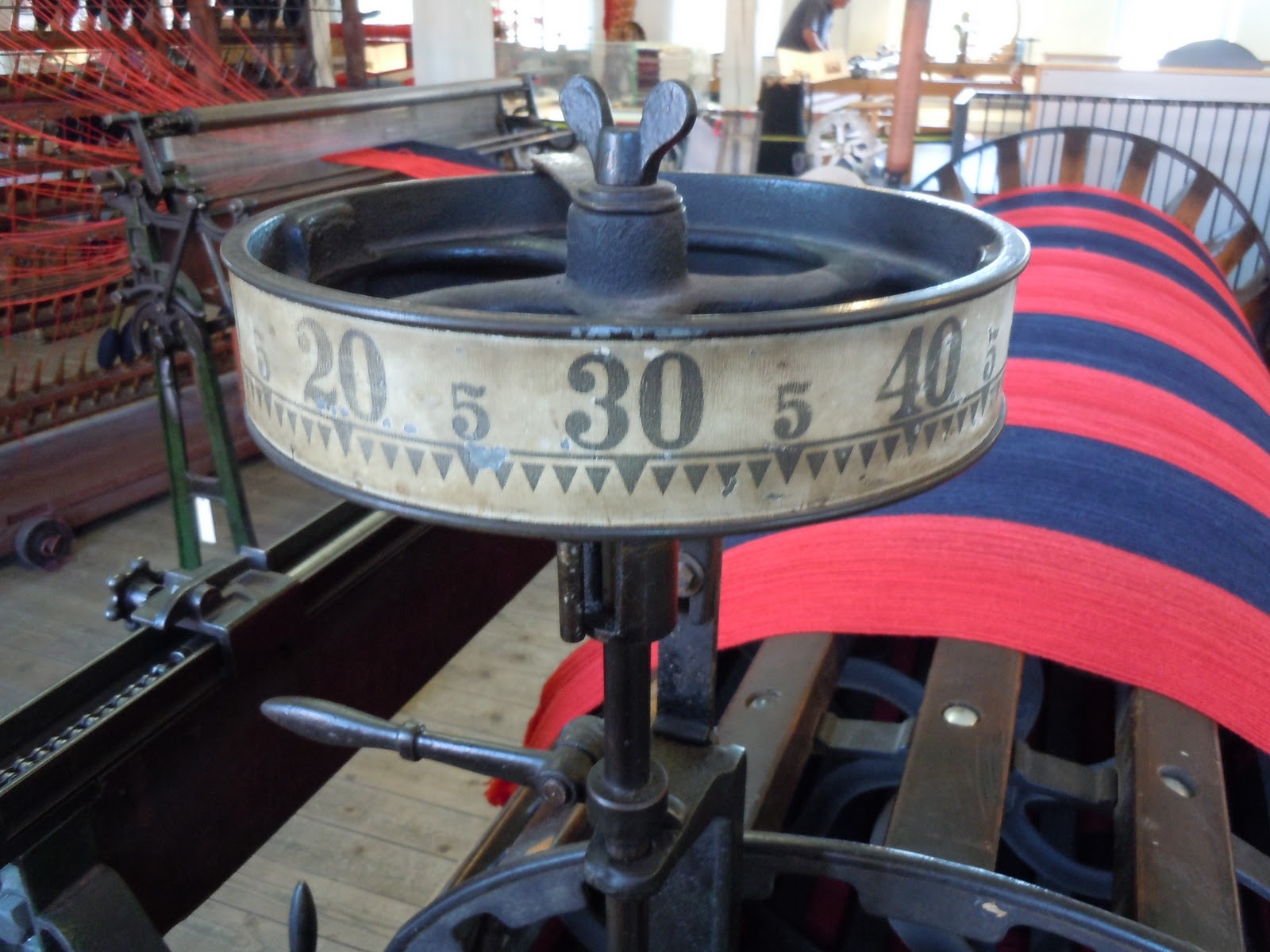
On our trip to Germany last summer we visited more museums than I can count without a cheat sheet, and I have written about most of them on the blog last year. But one I never got around to telling you about. It is in Bramsche, near Osnabruck in northern Germany, and we found it quite by accident because the tourist office, where we needed to stop to find a hotel room, happened to be located in its lobby. When my husband came back to the car he said "there's a museum in this building we might want to go to, but I don't know what it is about." The sign over the door said Tuchmachermuseum; I'm embarrassed to say I had to look it up in my little dictionary.
When I translated it as "clothmaking," I let out a whoop of joy!
Sure enough, the building itself was an old woolen mill, in operation on this river for 400 years. Its specialty was heavy fabric in a special shade of red, used primarily for British army uniforms. It operated as a factory until 1972. Most of the equipment was about a hundred years old, and some machines, acquired by the museum from the old East Germany after reunification were in use in that technologically challenged country until late in the 20th century. The museum depicts all the steps in the traditional carding, spinning, weaving and finishing of cloth.
We found one brochure in English, with a bit of explanation of how the museum came to be but nothing on the details of the machinery or the processes. The signage was exclusively in German, and though I consulted my dictionary many times, most of the specialized terms were not listed. The docent tour was similarly monolingual, but they did turn on most of the machines so we could see them in action.
The good news was that despite my ignorance of what was being told to me, I was able to figure out about 95% of what was going on. It was one of those beautiful moments in which I realized that my decades of devotion to textiles and fabrics had paid off in ways I had not anticipated.
Although my total hands-on experience with weaving has consisted of maybe a total of 30 minutes sitting at other people's looms, weaving a few rows with wobbly selvages, I was able to figure out from watching the machines in action what was going on. First the wool came in the front door and was washed and dyed, then combed and carded. It was spun and wound onto bobbins, a hundred at a time. The looms were warped and the shuttles were thrown from one side to another; on the jacquard looms the punch card "computer" overhead lifted the proper heddles in their turn to make patterns.
Then the easy parts, washing the fabric again, pressing it smooth and winding it onto bolts. The occasional sewing machine and small loom to work out patterns stood by as needed. You may not think you know anything about a woolen mill in action, but if you stood there all afternoon watching the machines at rest and at work you would figure out what was going on, too.
As I figured out each machine, I would explain it to my husband, who learned far more than he ever wanted to about textile production and was dying for a beer long before I was ready to leave.
It was a wonderful afternoon, making me realize how much I love fabrics of all kinds and how watching them made was truly an homage to my artistic roots.
I learned later, in checking my facts on the internet, that this museum is just one on a "theme route" of textile factories throughout the continent, sponsored by the European Route of Industrial Heritage. In addition to textiles, you can check out other industries such as mining, iron and steel, transportation, manufacturing and a bunch of ther specialties. What a great way to plan a leisurely European trip if you have a special interest in a certain field -- perhaps your own profession, or that of a parent or grandparent.
When I translated it as "clothmaking," I let out a whoop of joy!
Sure enough, the building itself was an old woolen mill, in operation on this river for 400 years. Its specialty was heavy fabric in a special shade of red, used primarily for British army uniforms. It operated as a factory until 1972. Most of the equipment was about a hundred years old, and some machines, acquired by the museum from the old East Germany after reunification were in use in that technologically challenged country until late in the 20th century. The museum depicts all the steps in the traditional carding, spinning, weaving and finishing of cloth.
We found one brochure in English, with a bit of explanation of how the museum came to be but nothing on the details of the machinery or the processes. The signage was exclusively in German, and though I consulted my dictionary many times, most of the specialized terms were not listed. The docent tour was similarly monolingual, but they did turn on most of the machines so we could see them in action.
The good news was that despite my ignorance of what was being told to me, I was able to figure out about 95% of what was going on. It was one of those beautiful moments in which I realized that my decades of devotion to textiles and fabrics had paid off in ways I had not anticipated.
Although my total hands-on experience with weaving has consisted of maybe a total of 30 minutes sitting at other people's looms, weaving a few rows with wobbly selvages, I was able to figure out from watching the machines in action what was going on. First the wool came in the front door and was washed and dyed, then combed and carded. It was spun and wound onto bobbins, a hundred at a time. The looms were warped and the shuttles were thrown from one side to another; on the jacquard looms the punch card "computer" overhead lifted the proper heddles in their turn to make patterns.
As I figured out each machine, I would explain it to my husband, who learned far more than he ever wanted to about textile production and was dying for a beer long before I was ready to leave.
It was a wonderful afternoon, making me realize how much I love fabrics of all kinds and how watching them made was truly an homage to my artistic roots.
I learned later, in checking my facts on the internet, that this museum is just one on a "theme route" of textile factories throughout the continent, sponsored by the European Route of Industrial Heritage. In addition to textiles, you can check out other industries such as mining, iron and steel, transportation, manufacturing and a bunch of ther specialties. What a great way to plan a leisurely European trip if you have a special interest in a certain field -- perhaps your own profession, or that of a parent or grandparent.
Labels:
Germany,
museums in Germany,
textile manufacturing
Tuesday, December 7, 2010
Nürnberg museums 3 -- Kunsthalle Nürnberg
This summer I got to see lots and lots of art in our visit to Germany. In cleaning off my desk I found a brochure from one interesting exhibit at the Kunsthalle Nürnberg, which I haven't yet written about. It consisted of ten sculptures by Karla Black, an artist from Glasgow who will be representing Scotland at the Venice Biennale next year.
The pieces fall into two groups: those made primarily with paper, and those made primarily with soft, powdery substances arranged into piles.
The paper pieces are glued together, not very precisely, to make large curtains that flutter ever so slightly in the air and drape over tables.
Division Is, Division Isn't
The powdery piles range from thin layers to imposing shaped masses. The gimmick is that the powders are household substances such as face powder, eyeshadow, hairspray, sand, sawdust and topsoil. In one piece the pink powder on the floor looked like a shadow cast by a pink plastic bag hanging above it. Another was made of liquid indigestion remedies, apparently poured into a puddle and allowed to dry up and separate into leathery peelings.
Left Right Left Right
Platonic Solid
Platonic Solid (detail) (chalk drawings underneath the green powder)
There Can Be No Arguments
Brains Are Really Everything
Better
What do we make of these artworks? You can easily imagine certain visitors making rude remarks along the lines of how their grandchildren could make these pieces, if they only had a wheelbarrow and a shovel. I found the more delicate piles, the pale green and the pale pink "shadow", more appealing than the bigger ones.
I read about Black on the internet today and think I understand her work a little better. She used to do performance art but now calls herself a process artist. She tries to depict "simplicity, purity, cleanness or smoothness" in her choice of materials and says "I make different configurations with or from mess or formless matter." Previous exhibits focused more on feminist concerns than this one does, although you can still see clues that the artist is a woman.
She explains that while there's still an element of performance art to the way she constructs her pieces, they go beyond performance to sculpture. "There is always intent, a support (plinth/frame/stage/ structure), and evidence of a decision-making process; the finished things are almost objects, or only just objects."
Do I want one in my living room? No, although the sawdust pile would just about match my sofa. But the installation has given me something to think about, namely how the use of certain materials brings with it the entire baggage of those materials in their everyday context. Just as face powder and over-the-counter medicines have a homey, feminine connotation that comes with them into the gallery, we fiber artists can never escape the homey, feminine connotations of our materials.
So I got a good think out of the deal, and what more can you ask from your art?
The pieces fall into two groups: those made primarily with paper, and those made primarily with soft, powdery substances arranged into piles.
The paper pieces are glued together, not very precisely, to make large curtains that flutter ever so slightly in the air and drape over tables.
Division Is, Division Isn't
The powdery piles range from thin layers to imposing shaped masses. The gimmick is that the powders are household substances such as face powder, eyeshadow, hairspray, sand, sawdust and topsoil. In one piece the pink powder on the floor looked like a shadow cast by a pink plastic bag hanging above it. Another was made of liquid indigestion remedies, apparently poured into a puddle and allowed to dry up and separate into leathery peelings.
Left Right Left Right
Platonic Solid
Platonic Solid (detail) (chalk drawings underneath the green powder)
There Can Be No Arguments
Brains Are Really Everything
Better
What do we make of these artworks? You can easily imagine certain visitors making rude remarks along the lines of how their grandchildren could make these pieces, if they only had a wheelbarrow and a shovel. I found the more delicate piles, the pale green and the pale pink "shadow", more appealing than the bigger ones.
I read about Black on the internet today and think I understand her work a little better. She used to do performance art but now calls herself a process artist. She tries to depict "simplicity, purity, cleanness or smoothness" in her choice of materials and says "I make different configurations with or from mess or formless matter." Previous exhibits focused more on feminist concerns than this one does, although you can still see clues that the artist is a woman.
She explains that while there's still an element of performance art to the way she constructs her pieces, they go beyond performance to sculpture. "There is always intent, a support (plinth/frame/stage/ structure), and evidence of a decision-making process; the finished things are almost objects, or only just objects."
Do I want one in my living room? No, although the sawdust pile would just about match my sofa. But the installation has given me something to think about, namely how the use of certain materials brings with it the entire baggage of those materials in their everyday context. Just as face powder and over-the-counter medicines have a homey, feminine connotation that comes with them into the gallery, we fiber artists can never escape the homey, feminine connotations of our materials.
So I got a good think out of the deal, and what more can you ask from your art?
Saturday, November 13, 2010
Berlin museums 6 -- Neue Nationalgalerie
I wrote earlier about the powerful paintings in this museum depicting Germany between the wars. Today let's step back in time and look at some Expressionist art, mainly from before the war. This was a pivotal time -- artists had abandoned the classical requirements that paintings should represent reality in terms of color, and that sizes and shapes should obey the rules of perspective. But they still were drawing recognizable objects. Within a year of this first painting, Kandinsky would blaze the trail into abstraction.
Wassily Kandinsky, Skizze: Reiter (Sketch: Rider), 1909
Marianne von Werefkin, Prozession bei Ascona (Procession near Ascona), 1924
Emil Nolde, Pfingsten (Pentecost), 1909
I am a big fan of still lifes, so took a lot of pictures of them.
Oskar Kokoschka, Steilleben mit Ananas (Still Life with Pineapples), 1909
Hans Purrmann, Stilleben (Still Life), 1908
Lyonel Feininger, Stilleben mit Pinseln (Still Life with Brushes), 1915
Wassily Kandinsky, Skizze: Reiter (Sketch: Rider), 1909
Marianne von Werefkin, Prozession bei Ascona (Procession near Ascona), 1924
Emil Nolde, Pfingsten (Pentecost), 1909
I am a big fan of still lifes, so took a lot of pictures of them.
Oskar Kokoschka, Steilleben mit Ananas (Still Life with Pineapples), 1909
Hans Purrmann, Stilleben (Still Life), 1908
Lyonel Feininger, Stilleben mit Pinseln (Still Life with Brushes), 1915
Thursday, November 11, 2010
Berlin museums 5 -- Neue Nationalgalerie
In the beginning, there was the Nationalgalerie, the sacred repository of German art, which I wrote about in a previous post. Then came the partition of Berlin, and the Nationalgalerie, along with other great institutions located on Museum Island, was in the Eastern Zone. The Western powers decided there had to be a national gallery on their side, and it should focus on modern art, and had Mies van der Rohe design a stunningly modern building for the new propaganda tour de force. From that point on, there was the Alte Nationalgalerie and the Neue Nationalgalerie, and you don't need much German to tell the difference as we visit the Neue today.
The entry floor, sheathed in glass, contains nothing but a couple of support columns and an attendant to point you toward the down staircase; all the art is housed below ground, partly to protect it from sunlight. When we visited, the entry floor was the site of a temporary installation by Rudolf Stingel, a huge carpet woven with patterns from 19th century Indian rugs to complement the stark architecture and to reference the iconic place of oriental carpets in well-to-do European households. I've seen Stingel's carpets in other venues but this space was spectacular, with nothing to interrupt your view of the goods.
Downstairs, the permanent exhibits provided a chronological view both of German art in the 20th century and of the German society and history reflected in it. I'll have to take more than one post to tell you about this fabulous collection, so I'll start with the earliest parts. In the 20s, for instance, Neue Sachlichkeit (New Objectivity) artists wanted to distance themselves from war and emotions, painting cool and precise pictures of architecture and technology.
Franz Radziwill, Der Hafen II (The Harbor II), 1930
Gustav Wunderwald, Am Wedding (a neighborhood in Berlin), 1927
Georg Schrimpf, Bahnübergang (Railway Crossing), 1932
Oskar Nerlinger, Funkturm und Hochbahn (Radio Tower and Elevated Railway), 1929
In contrast to these cool characters, another school of art seized on politics for its subjects, with scathing views of the social turmoil following the World War. (Today is what we used to call Armistice Day, commemorating the end of that war on the Western Front, at 11 AM on 11/11/18.)
Josef Scharl, Ecce Homo/Der Verstümmelte (Ecce homo / Mutilated Man), 1931
Curt Querner, Agitator, 1931
Conrad Felixmüller, Der Agitator, 1944
Reinhold Rossig, Polizieterror (Police Terror), 1933
George Grosz, Stützen der Gesellschaft (Pillars of Society), 1926
Both my husband and I have always loved Grosz and his savage portrayals of German society between the wars. Seeing so many of these images, both by Grosz and others, was a real punch in the gut. This museum has a powerful impact throughout but nowhere as strong as in these pictures, which presciently anticipate the even greater turmoils ahead (note the swastika on the tie of the guy in front).
The entry floor, sheathed in glass, contains nothing but a couple of support columns and an attendant to point you toward the down staircase; all the art is housed below ground, partly to protect it from sunlight. When we visited, the entry floor was the site of a temporary installation by Rudolf Stingel, a huge carpet woven with patterns from 19th century Indian rugs to complement the stark architecture and to reference the iconic place of oriental carpets in well-to-do European households. I've seen Stingel's carpets in other venues but this space was spectacular, with nothing to interrupt your view of the goods.
Downstairs, the permanent exhibits provided a chronological view both of German art in the 20th century and of the German society and history reflected in it. I'll have to take more than one post to tell you about this fabulous collection, so I'll start with the earliest parts. In the 20s, for instance, Neue Sachlichkeit (New Objectivity) artists wanted to distance themselves from war and emotions, painting cool and precise pictures of architecture and technology.
Franz Radziwill, Der Hafen II (The Harbor II), 1930
Gustav Wunderwald, Am Wedding (a neighborhood in Berlin), 1927
Georg Schrimpf, Bahnübergang (Railway Crossing), 1932
Oskar Nerlinger, Funkturm und Hochbahn (Radio Tower and Elevated Railway), 1929
In contrast to these cool characters, another school of art seized on politics for its subjects, with scathing views of the social turmoil following the World War. (Today is what we used to call Armistice Day, commemorating the end of that war on the Western Front, at 11 AM on 11/11/18.)
Josef Scharl, Ecce Homo/Der Verstümmelte (Ecce homo / Mutilated Man), 1931
Curt Querner, Agitator, 1931
Conrad Felixmüller, Der Agitator, 1944
Reinhold Rossig, Polizieterror (Police Terror), 1933
George Grosz, Stützen der Gesellschaft (Pillars of Society), 1926
Both my husband and I have always loved Grosz and his savage portrayals of German society between the wars. Seeing so many of these images, both by Grosz and others, was a real punch in the gut. This museum has a powerful impact throughout but nowhere as strong as in these pictures, which presciently anticipate the even greater turmoils ahead (note the swastika on the tie of the guy in front).
Tuesday, October 19, 2010
Nürnberg museums 2 -- New Museum of Art and Design
My favorite museum in Nürnberg was the Neues Museum, aka New Museum for Art and Design. The design exhibits were fascinating – this one showed how different chairs affected the sitter’s body – but I was in search of ART and didn’t linger.
The art part of the museum started with photography. A wonderful installation by Hans-Peter Feldmann, called 100 Jahre (100 Years), had photos of 100 people, ranging in age from 1 to 100. Each photo was identified by the sitter’s first name and age. I scrutinized every photo, wishing the top rows were more accessible through my bifocals.
There were three whole rooms full of photos by Bernd and Hilla Becher, who traveled around Europe in the 60s and 70s documenting old industrial buildings. They liked to group their pictures into categories so you could see which features were common to the process and which varied from one site to another. I had seen and loved their work at Dia/Beacon in Beacon NY and this huge collection was exciting.
These are water towers.
Then I came around a corner and it was as though the volume turned up a dozen notches – this was a room full of Gerhard Richter, one of my favorite artists. Richter is known for the wide variety of painting styles he’s used over the years, and if you want to be floored by the sheer number and vast range of his work, spend some time on his website, especially the section called “Atlas.”
Gerhard Richter, Abstraktes Bild, (Abstract Picture) 1991
Gerhard Richter, Ausschnitt (Detail) 1971
Gerhard Richter, Stadtbild PL, (City Picture PL) 1970
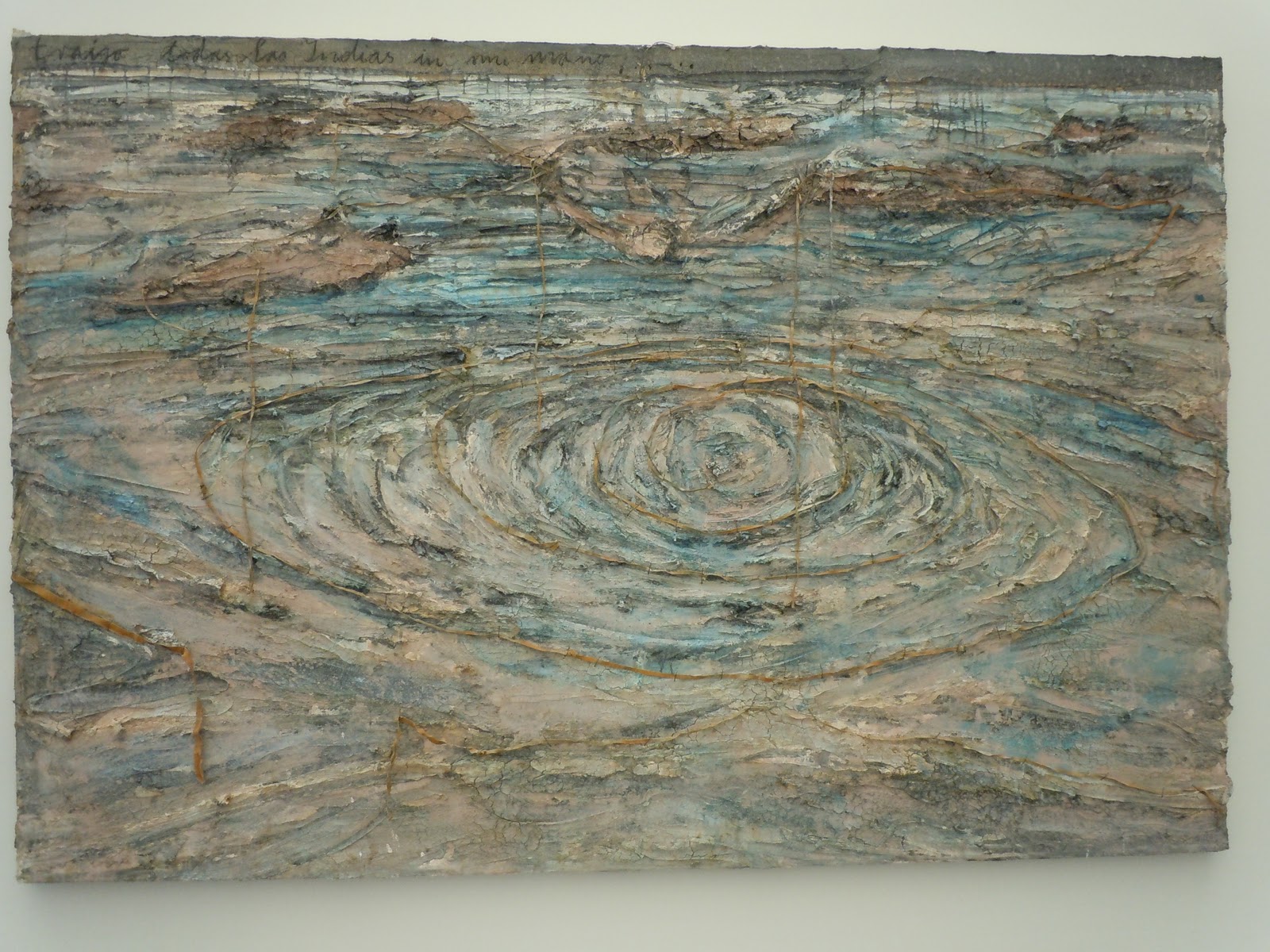
But not just Richter; they had all the big names in German contemporary art. The Kiefer was a surprise -- instead of the dark battlefields of his best known pictures, this one was a pastel confection, easy on the eyes. I think I like the dark and bloody grounds better.
Anselm Kiefer, Traigo todas las Indias in mi mano 2, (I carry all the Indies in my hand) 2001
Georg Baselitz, Der Freund (The Friend), 1988
I wound up my visit in the bookstore, which despite having mainly books in German, could have easily sucked up hundreds and hundreds of euros. But we were on foot with miles to go before we got home, and I wisely (but sadly) passed it by.
The art part of the museum started with photography. A wonderful installation by Hans-Peter Feldmann, called 100 Jahre (100 Years), had photos of 100 people, ranging in age from 1 to 100. Each photo was identified by the sitter’s first name and age. I scrutinized every photo, wishing the top rows were more accessible through my bifocals.
There were three whole rooms full of photos by Bernd and Hilla Becher, who traveled around Europe in the 60s and 70s documenting old industrial buildings. They liked to group their pictures into categories so you could see which features were common to the process and which varied from one site to another. I had seen and loved their work at Dia/Beacon in Beacon NY and this huge collection was exciting.
These are water towers.
Then I came around a corner and it was as though the volume turned up a dozen notches – this was a room full of Gerhard Richter, one of my favorite artists. Richter is known for the wide variety of painting styles he’s used over the years, and if you want to be floored by the sheer number and vast range of his work, spend some time on his website, especially the section called “Atlas.”
Gerhard Richter, Abstraktes Bild, (Abstract Picture) 1991
Gerhard Richter, Ausschnitt (Detail) 1971
Gerhard Richter, Stadtbild PL, (City Picture PL) 1970
But not just Richter; they had all the big names in German contemporary art. The Kiefer was a surprise -- instead of the dark battlefields of his best known pictures, this one was a pastel confection, easy on the eyes. I think I like the dark and bloody grounds better.
Anselm Kiefer, Traigo todas las Indias in mi mano 2, (I carry all the Indies in my hand) 2001
Georg Baselitz, Der Freund (The Friend), 1988
I wound up my visit in the bookstore, which despite having mainly books in German, could have easily sucked up hundreds and hundreds of euros. But we were on foot with miles to go before we got home, and I wisely (but sadly) passed it by.
Subscribe to:
Posts (Atom)