Showing posts with label fabric. Show all posts
Wednesday, May 30, 2018
More about Marimekko
I wrote earlier this week about my trip to the Marimekko store in Helsinki, prompting a comment from Jill Hoddick, which I will reprint in full because it's so wonderful:
I grew up with a mom who wore Marimekko dresses for years. She was a ceramics professor at USC and knew Armi Ratia, the founder. My mom, Susan Peterson, was knighted by the Finnish government for her work as a ceramic educator. I was lucky enough to go to Armi's summer home to spend time in the summer of 1967, when I was 16. The home was very modern, and full of all prints Marimekko. What a delight. And I was lucky enough to come home with gifts!!! Before my mother died, she gave all her dresses (I think about 75) to a Finnish museum. To this day I still use Marimekko to cover dining tables and walls, and bring joy and color to my life. I became a costume designer, and not an art quilter, perhaps because of my experience with Marimekko. I have sheets in this print!
And aren't we all jealous -- imagine having enough Marimekko lying around to cover tables and walls!! And imagine having a mom as accomplished as Jill's -- read about her here.
Several years ago I was quilting some pieces for Nancy Crow, and told her that I needed drapery-weight fabric for the back. So she sent me three yards of Marimekko. How fabulous is that, having enough Marimekko in your stash to use it as backing. If you're not familiar with this brand, the fabric used to come only in a heavy cotton that was perfect for home dec and non-fluffy clothing. This month I was intrigued to see that they now are producing the same designs on a quilting-weight fabric (the saleswoman called it batiste).
I didn't want to spend 40 euros a meter to buy any new fabric, especially since I no longer sew dresses or pillows, and wouldn't dream of slicing up a Marimekko fabric for a quilt, but I did pop 5 euros for a remnant, 13 x 56 inches. At first glance you might think what on earth would somebody do with that piece of fabric, but I think it will make an intriguing background for hand stitching. I'll let you know how that works out.
Tuesday, May 29, 2018
Deja vu in Helsinki
In the early 1970s, when Marimekko was all the rage, I made myself a dress from a huge pink/red print. It was a highly impractical dress, sleeveless and floor-length, and I recall wearing it only once, although maybe I have forgotten. But the print was unforgettable, embodying the minimalist-yet-wow Scandinavian design esthetic.
We had the pleasure of spending the most of this month in the Baltic, and Helsinki was one of the stops on our cruise. One of the other women in the group, a quilter, told the guide that her fondest wish was to visit a Marimekko shop, and the guide figured out a way to make that happen. Since it was a big favor, I thought I should come along too -- a favor for two isn't quite as outrageous as a favor for one.
When we walked into the shop what did I see but my identical pattern from the 70s.
And then I saw that they now offer the same design in at least three different sizes:
And on coffee mugs, trays, cosmetic pouches, oven mitts, napkins, and who knows what else.
They also have "my" pattern in a black/gray colorway, but I like the original better.
It made me feel good to know that some things never change.
Thursday, September 14, 2017
A great week for divestiture
What a great week I just had!
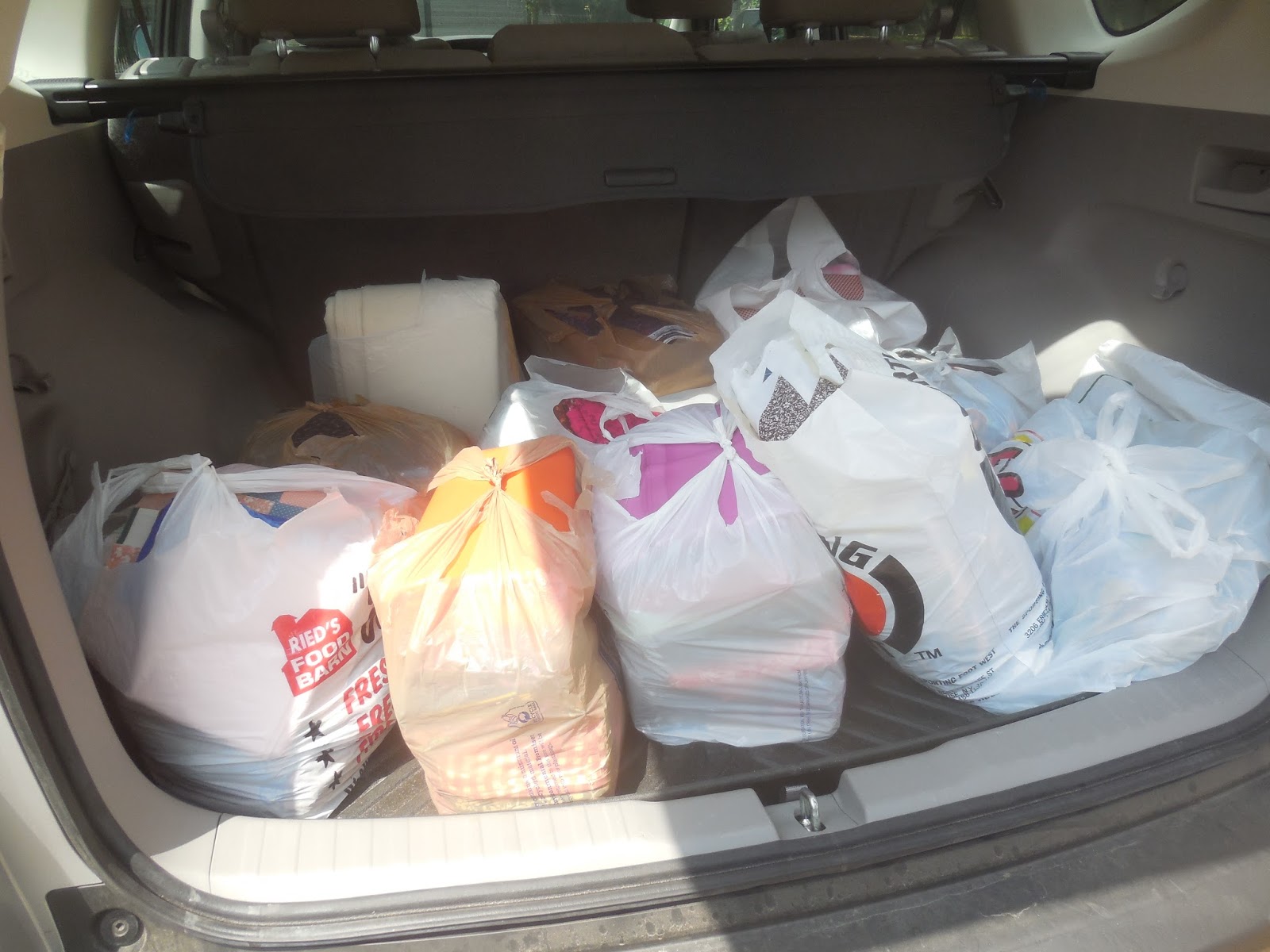
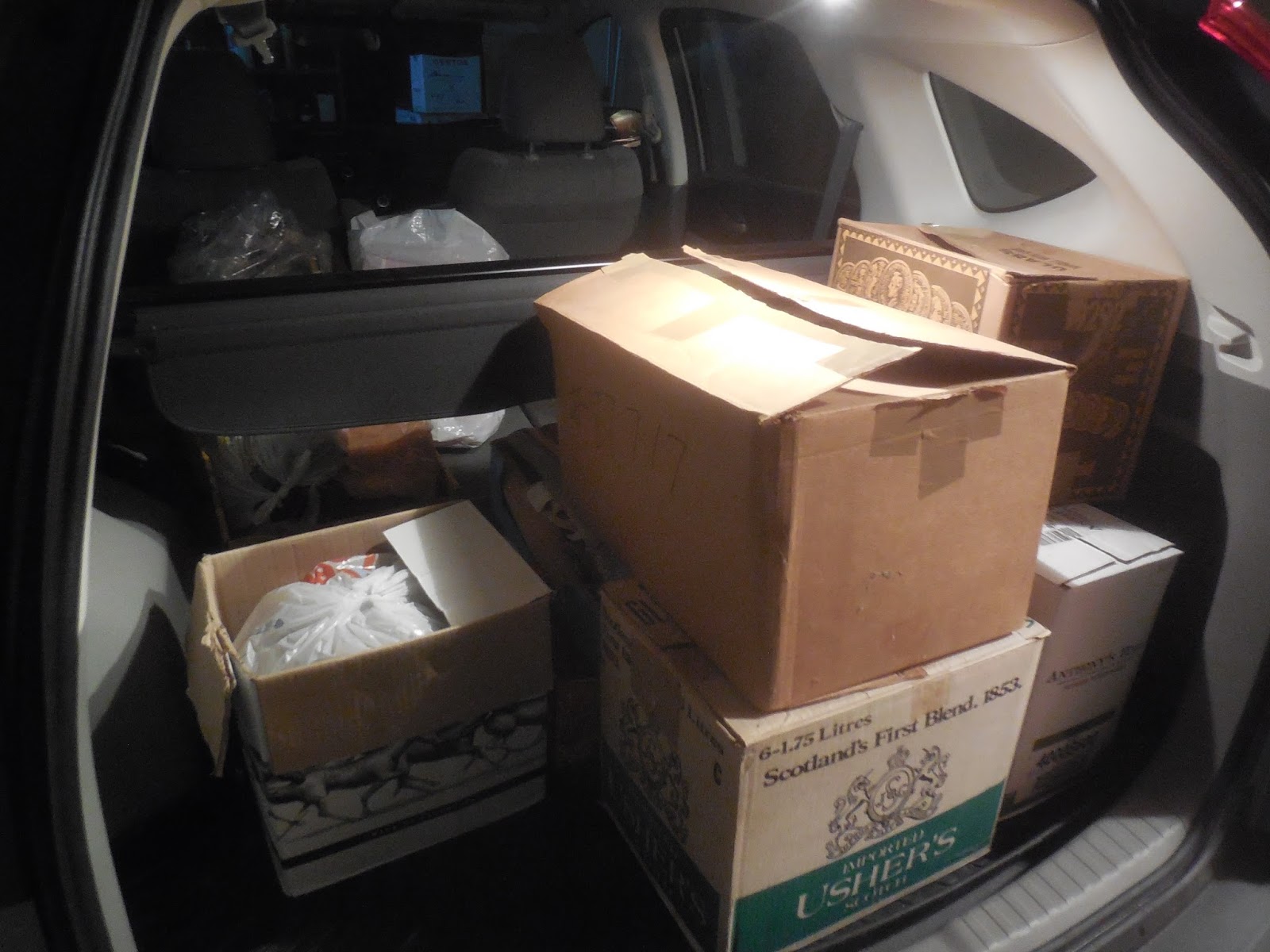
First, I took a carload of fabrics to my friend Ann, whose quilt guild likes to make charity quilts. I've given them four carloads in the last several months, and maybe this is even the last of the bunch. I've saved out the Kona solids, and all the commercial striped fabrics, and the batiks, and the African fabrics, and some other stuff to precious to give away, but now I think all the other quilting fabric is gone.
Next, I took a carload of non-quilting fabric to my friend Alana, who teaches textile art at our arts magnet high school. What a bunch of miscellaneous stuff -- upholstery samples, fabrics too heavy for quilting, cords, tapes, I don't even remember what all. I drove up during textile class and the kids rushed out to the car and unloaded everything, which was delightful.
Then the construction guys started taking apart our old bathrooms. I asked them to remove the cabinets carefully, rather than smashing them to bits, and advertised them on our neighborhood email list.
Some guy came over the next afternoon and took them away. He sent me a thank-you message and said he had also taken the "vintage medicine cabinet" out of the junk trailer. Couldn't believe it -- this fixture was low-end in 1963 and hasn't gotten any more charming in the intervening decades, just a mirror flanked by two naked vertical fluorescent tubes. But somebody wanted it!! What a thrill.
Monday, April 10, 2017
Lots of shelves
My husband flagged a story in Saturday's New York Times about the complicated rules on forgiveness of student loans for people who work in public service. It grabbed his eye because our daughter-in-law (and her student loans) works for Legal Aid. When he passed the paper along, I was way more interested in the photo than in the story.
![]() |
| New York Times photo |
I looked up the organization, which is based in New York City, and learned some things I hadn't known. Such as that in New York, if more than 10% of the waste of a business is textiles, it must recycle. The waste that Fabscrap collects is sold to designers, students, teachers, artists, sewists and quilters, and I guess anybody else who wants some. Some are sold online. Certain materials are shredded for insulation, carpet padding, moving blankets and other industrial products.
Here's the good news for those in the New York area: if you volunteer to help sort the stuff that comes in on the trucks, you can take home anything you want, for free.
But all I could think of when I saw the photo was that Jessica's stash looks kind of lame -- all those shelves, so little fabric! Any self-respecting quilter of my acquaintance, even me, post-divestiture, could come up with a better-populated backdrop for a fabric-related portrait.
Tuesday, February 14, 2017
Divestiture again
Time to clean up the studio.
Were there ever more depressing, discouraging words? Strikes a klong of dark, cold dread up and down your spine, doesn't it?
Not that I really want to clean the studio, but I need to have an electrician come in and fix up my ceiling lights, all of which were installed at the same time and all of which are dying at the same time. And to get to the most important fixture, he will have to stand on my work table, which means the top of the table will have to be visible, which means a midden of boxes and stuff will have to be removed. So while I'm removing stuff from the work table, I might as well simultaneously be cleaning and organizing and finding stuff that can be given or thrown away.
Still dark, cold dread, right?
My first thought was to get rid of my calicos. Years ago I pulled out all those sweet 70s tiny prints that I will never use and put them in the closet. I've given them to new quilters who wanted something to learn on without having to go to the fabric store. I've sent them to internet friends who wanted to finish quilts begun decades ago in similar fabrics. A brainstorm: one of my fiber art pals is in a traditional guild that makes a lot of charity quilts, so I asked her if they might want my calicos.
When she said yes, I started packing them up. It felt good.
And then I had another thought -- why not also give them some of my "better" quilt fabrics? So I started packing boxes full.
I was pleasantly surprised at how little pain I felt in parting with these fabrics -- thousands of dollars worth of beautiful cottons that had called out to me in the past and had given me lots of pleasure over the years just knowing they were there in my drawers ready for a moment in the sun. But I realized that I would never use them, and if I knew they would be going to a good home, where people would use them and love them, I'm OK with that.
Of course, empty drawers aren't worth anything until you fill them with something else that had been occupying other space, such as on top of my work table. So now I'm trying to consolidate the fabrics I still have into the partly empty drawers, and organize them more usefully for my current quilting life. Still lots of work ahead, but seeing those boxes go out the door has been liberating.
Friday, July 8, 2016
Purple is out. Also brown.
For old times sake, I dropped by my local Hancock Fabrics, which is going out of business. Can't even begin to estimate how many hundreds if not thousands of dollars I have spent there over the decades, although I haven't patronized it much in recent years as my sewing habits have changed. I wanted to see if there were any fabulous markdowns that called out to me.
None did, except some $2 a yard fabric that will be great to wrap rolls of quilts before they go under the bed for storage, and a couple of spools of thread.
I was interested to see what was left after several weeks of markdowns.
If you want purple, this is your chance. Many, many, many bolts of tiny purple prints -- for some reason, many, many duplicates. I think these shelves are full of only three or four different patterns. Do the overseers of liquidation send all the purple prints to my store, and all the blue ones to Indianapolis?
Also plenty of brown.
Same theme in the thread department, where the secondary colors were the sole survivors in this rack. I guess the people who didn't buy the purple prints didn't need any purple thread.
I'm always sorry to see a fabric store go out of business. Does this reflect declining interest in sewing or just bad management? I've been to so many going-out-of-business sales over the years it's discouraging.
But there are glimmers of hope, even among the carnage. The African man ahead of me in line was buying hundreds of yards of fabric. The clerk asked him if his wife, who had been gliding around in an elaborate floor-length dress and headwrap outfit, did a lot of sewing.
"No," he said, "I do the sewing!"
And you could tell he knew his way around a mess of fabric, expertly winding this length back on the bolt after measuring. That made me smile.
Friday, April 29, 2016
Opening the mystery package
A few years ago, my dear friend and fiber art pal Joanne Weis went to Tuscany on vacation, and bought a mystery package at a Sunday flea market for a couple of euros. The woman who sold it to her thought it was a roll of old linen, but it had been neatly sewed up so Joanne bought it pretty much sight unseen. She brought it home and put it away, and just recently came upon it and decided it was high time she opened the package and saw what was inside.
She decided this needed to be a ceremonial occasion, so she brought it to our fiber art support group. First we surveyed the package and heard the story.
Then we noticed how neatly the roll had been sewed together, and the tiny brown cross-stitched motif on the roll.
Joanne cut the stitches and undid the roll.
We measured it -- about nine and a quarter yards. It had brown spots on the first foot or so but was creamy white on the inside of the roll.
Best of all, Joanne gave me a piece to use in my next flag quilt. If I can stand to machine stitch all over it; maybe I'll have to keep out a bit for hand-stitching.
What a find to come across such a treasure in a faraway place, and how nice it is to have fiber friends who appreciate it to share the moment with.
Monday, November 9, 2015
Chevrons in fashion
I've written in the past about trends in fabric production. For several years I've been frustrated because I want to work in stripes and they're out of fashion; polka dots have been all the rage at the fabric store.
Now I want to report that the latest trend seems to be chevrons. Here's what I've seen at the fabric store recently.
I find it interesting that the chevrons are available in a variety of sizes and shapes. Stripes seem to be coming back too, but in my local fabric store it's all 1/4" color-and-white. That means the powers that be aren't all that committed to stripes.
So if chevrons are something you might like to use, go out and buy every one you see. Who knows how long they will be in the stores!
And yes, orange seems to be in too. Grab it while it's there.
Friday, April 10, 2015
Sign of the week
My camera didn't want to focus on this label -- that's OK, I don't particularly want to think about it either.
Saturday, January 24, 2015
The SAQA collection -- seeing it all
I wrote yesterday about the new fabric collection designed by SAQA members, and got some comments about the different colorways available.
Each design has three colorways. I tried to put in a link so you could see all of them, but for some reason that page has the same URL as the page that only shows one colorway per design.
So if you click here you'll get the following screen, showing the designers of each of the fabrics.
By the way, last week I wouldn't have known how to make that nifty hot pink arrow, so you see I'm really learning things from my class with Pixeladies.
Friday, January 23, 2015
New SAQA challenge -- it's quite a challenge
First, a shout-out to the Pixeladies, Kris Sazaki and Deb Cashatt, two art quilters who have made a great day job out of their computer knowledge. They conduct online classes in Photoshop Elements and I am taking class 1, the total beginners' program. I may write more about the classes later but for now just let me say they're great teachers.
Yesterday I tackled the lesson on how to make quiltlike designs by copying a fabric swatch, cutting "squares" out of it, and arranging them into patterns. Sure, I could have googled "fabric designs" or gone to any one of the prominent fabric manufacturers' sites, but only minutes before I had looked at my email and found a call for entries from SAQA.
It seems that last year SAQA paired up with Andover Fabrics to put out a collection called Urban Textures, six different fabrics designed by six SAQA members. Now the fabrics are in the stores, and there's a challenge to make quilts from the fabrics, which will be shown online and in the SAQA Journal.
Longtime readers of this blog may recall my ambivalence about challenges; they're a temptation I try to resist except in closely defined circumstances. But now I needed some "fabric samples" to practice my Photoshopping, so I got them from the Andover site.
After most of the day I think I have pretty much mastered the art of making nine-patch "quilts" on my computer. I can even make twelve-patch quilts! But what I realized about the SAQA collection is that it's not really a collection, it's a bunch of unrelated designs. Each of the designs is attractive by itself, and if you were to combine all three of its colorways you could probably make an interesting quilt.
I particularly like this first pattern below, "Urban Gesture," designed by Elizabeth Brandt. I can't tell from the website how big the designs are on the fabric, but I hope this one is REALLY BOLD.
Unfortunately, the six patterns don't play well together.
Not sure what kind of responses they will get to this challenge; I suspect those who participate will buy just one of the fabrics, perhaps in different colorways, and combine it with stuff from their stash. I don't anticipate much mixing.
Monday, October 13, 2014
Stripes are back!!
Longtime blog readers probably recall my past rants on how difficult it is to find striped fabric (and just when I have decided that stripe-on-stripe is the design motif I am most excited to explore). For a couple of years it's been polka dots 24/7, stripes zero. But when I went to the fabric store last week for last-minute supplies I was delighted to find several stripes on the shelf. The clerk told me they had just come in the day before.
As you read this I'll be starting my week of teaching at the Crow Barn, and I wanted to bring stripes for people to use if they want. It's often fun to use stripes for these very skinny lines because they show up as dotted lines, more interesting than solids.
Crazed 8: Incarceration (detail)
Right now the stripes in the store are pretty basic -- white and a color, quarter- or eighth-inch stripes -- but it's a start. Fortunately I've been feeding my habit online, where Fabric.com claims to have 5,376 items classified as "stripes." I bought two huge orders of stripes from them in the last several months, which produced my Quilt National piece and left plenty for future projects.
But here's a thought -- if stripes are coming back, maybe it's time to buy dots before they disappear.
Wednesday, August 6, 2014
Good thoughts
Every now and then I take down at random one of the hundreds of art and quilting books on my shelves and reread it. If nothing else, you can usually find some nice pictures to drool over, but often you find some words of wisdom that are worth thinking about. In the latter category, some words from Ruth McDowell's book, "Fabric Journey."
I've always been a fan of Ruth McDowell, even though I would never in a million years try to work as she does, with intricate designs totally planned out in advance and executed with precise freezer-paper templates. To me most of the fun of quiltmaking is improvisation, solving problems as you go rather than charting out your course before you even start to cut and sew.
But I'm still in awe of her ability to combine commercial prints into harmonious and evocative compositions that faithfully reproduce the character and feeling of nature, even if they are miles away from the actual appearance of that nature. Only Ruth can make skies out of plaid, pumpkins out of polka dots, flamingoes out of floral prints. And she does it all the old-fashioned way, with traditional piecing techniques.
Ruth McDowell, Fort Morrison Jerseys
I was impressed by her remarks about her use of purchased and found fabrics:
"My quilts are visual compositions in line, color, and pattern, as well as interpretations of the inspirational subject; they must work graphically from a distance as well as reward close study of the details. The use of commercial fabrics contributed to this outcome, not only with their variety of colors and patterns, but also because of the historical and emotional connections these fabrics make.
"Fabrics have been part of the human experience, providing comfort and warmth for thousands of years. Technically, it would often be much easier to dye or paint the fabrics I need, but the deliberate use of the same fabrics found in clothing and furnishing in my quilts links both the quiltmaker (me) and the viewer to other lives and times, whether or not we are intellectually aware of that connection."
I don't work much with found fabrics in my own quiltmaking, but I do love to work with other people's scraps or abandoned projects, and it's for exactly the reasons that Ruth points out -- the connection between me and some other woman who once sat down at a sewing machine or a cutting table to work on her own project and express her own joy and creativity in its making. We all honor the same ideal: the power of the needle to stitch together our world and the loved ones who inhabit it.
Tuesday, October 29, 2013
Details of my Cinderella quilt
After I wrote about my "Cinderella quilt" last week, one reader asked whether I could show some closeup details. Always happy to oblige.
As you can tell, the entire quilt is made up of commercial stripes. A few were enhanced with fabric markers so I could get a wider variety of stripes; for instance, the black-and-pinkish-brown and black-and-red pieces in the top photo both started as black-and-white; the two-tone red pieces started as red-and-white.
At the left edge of the quilt most of the pieces are about an inch across. Toward the right edge they're bigger, maybe as much as three inches across. The fine lines of "mortar" between the "bricks" are about an eighth-inch wide.
As you can tell, the entire quilt is made up of commercial stripes. A few were enhanced with fabric markers so I could get a wider variety of stripes; for instance, the black-and-pinkish-brown and black-and-red pieces in the top photo both started as black-and-white; the two-tone red pieces started as red-and-white.
At the left edge of the quilt most of the pieces are about an inch across. Toward the right edge they're bigger, maybe as much as three inches across. The fine lines of "mortar" between the "bricks" are about an eighth-inch wide.
I've complained in the past about how hard it is to find stripes these days; they're out of fashion, while polka dots are IN, IN, IN. But I scraped together enough to make this quilt last year, and since then have discovered an online source for lots more stripes, so I'm happily embarked on more big projects in this same vein.
Saturday, September 21, 2013
Good news on the textile front
I don't often recommend you read articles in the newspaper, but yesterday's New York Times had a fascinating, detailed explanation of how some textile factories in the U.S. are actually getting business back from Asia because they can make better fabric and garments, despite our higher labor costs.
The article focuses on a new company making high-end sweatshirts. The company started out using a textile mill in India, but had problems with quality control, turnaround time and bureaucratic hassles. Recently it brought the manufacturing back home to a plant in South Carolina that can actually produce the fabric for less than the plant in India. Also there are no customs duties and less than a third the shipping costs.
![]() |
| photo -- New York Times |
Those of us who love textiles and use them in our work should be intrigued by this -- dare we call it a trend? At one time or another we've all bemoaned the spotty quality in a bolt of fabric, wished we weren't losing jobs to other countries, or worried about the appalling working conditions of overseas textile and garment workers. It would be nice if we could make more of our precious fabrics here at home.
The key to this resurgence of American textile manufacturing, as with other types of manufacturing, is automation. The yarn mill in South Carolina featured in the article needs 140 workers to make a quantity of product that would have required more than 2,000 workers in 1980.
I commend this article to you -- if for no other reason than the mesmerizing videos of yarn being spun and fabric being woven.
Saturday, February 2, 2013
Just complaining...
Before we headed off on vacation in December, my husband decided he needed new sweatshirts (his favorite around-the-house garment in cold weather). I reminded him to buy the best quality, so he came back from the store with three labeled Hanes' Premium. But within a couple of weeks they were starting to pill alarmingly.
I've never known a sweatshirt to pill, except maybe on the inside. (Remember when wearing your sweats inside-out was a badge of cool? But only after you had cut off the sleeves. Bad fashion trends of the past.)
Sure enough, closer examination showed that under the words Hanes' Premium was the word EcoSmart, which led me to believe they were made from old plastic grocery bags. Much closer examination allowed us to find the sewed-in tag which, in 4-point type, said that they were 30% polyester. The Hanes website says, "Thanks to its breathable, moisture-wicking cotton-polyester blend, Hanes' Premium EcoSmart cotton fleece sweatshirt is perfect for a morning jog or lounging around the house."
We're going to give the three disreputable-though-new sweatshirts to some bums and start over.
So my questions -- how can you call something "cotton fleece" when it's 30% polyester? Is this a plot by Hanes to get us to buy new sweatshirts every two weeks? And why is this EcoSmart? I'd call it EcoStupid.
I've never known a sweatshirt to pill, except maybe on the inside. (Remember when wearing your sweats inside-out was a badge of cool? But only after you had cut off the sleeves. Bad fashion trends of the past.)
Sure enough, closer examination showed that under the words Hanes' Premium was the word EcoSmart, which led me to believe they were made from old plastic grocery bags. Much closer examination allowed us to find the sewed-in tag which, in 4-point type, said that they were 30% polyester. The Hanes website says, "Thanks to its breathable, moisture-wicking cotton-polyester blend, Hanes' Premium EcoSmart cotton fleece sweatshirt is perfect for a morning jog or lounging around the house."
We're going to give the three disreputable-though-new sweatshirts to some bums and start over.
So my questions -- how can you call something "cotton fleece" when it's 30% polyester? Is this a plot by Hanes to get us to buy new sweatshirts every two weeks? And why is this EcoSmart? I'd call it EcoStupid.
Wednesday, October 24, 2012
Resistance at Kent State 3
The third method of resist dyeing shown at Kent State Museum is ikat, a technique in which threads are bound and dyed in patterns before weaving. As accurate as the artisans can be, there is nevertheless some characteristic raggedness around the edges of the designs.
They had a loom set up with ikat in process, also showing how the threads are tied for dyeing.
This skirt from Guatemala has ikat in both warp and weft. but the pattern is complicated by areas of plain thread, which makes sharp edges to contrast with the fuzzy-edged ikat patterns.
Some of the textiles on display had elaborate patterns, like this wrap from Indonesia (ikat on the warp only).
This robe from Uzbekistan, from the late 19th century, has ikat on its silk warp but not on the cotton weft. The process was elaborate: wind the warp on a frame as if to weave; mark the pattern and tie the threads into bundles; dye, rinse and dry; repeat for each subsequent color.
I loved the way this Uzbek vest was finished.
Check out this sumptuous ikat-lined man's vest from the Ottoman empire! Seems that Islamic law forbids men to wear silk, but if you put silk in the warp only, then do a satin weave with cotton as the weft, that puts the silk on one side of the fabric and cotton on the other. Wear the cotton side against the body and you're mashru -- permitted.
They had a loom set up with ikat in process, also showing how the threads are tied for dyeing.
This skirt from Guatemala has ikat in both warp and weft. but the pattern is complicated by areas of plain thread, which makes sharp edges to contrast with the fuzzy-edged ikat patterns.
Some of the textiles on display had elaborate patterns, like this wrap from Indonesia (ikat on the warp only).
This robe from Uzbekistan, from the late 19th century, has ikat on its silk warp but not on the cotton weft. The process was elaborate: wind the warp on a frame as if to weave; mark the pattern and tie the threads into bundles; dye, rinse and dry; repeat for each subsequent color.
I loved the way this Uzbek vest was finished.
Subscribe to:
Posts (Atom)