Showing posts with label crochet. Show all posts

Wednesday, February 9, 2022

Disrespecting us again?

For months I've been getting my trash TV exclusively from Netflix and Hulu.  Now that I've switched over to watching the Olympics, I realize that my fast-forward skills have atrophied, and I find myself listening to commercials for a bit before I snap to and realize that I don't actually have to.  I had sort of forgotten how puerile and patronizing commercials can be, but today one really yanked my chain.

It's for USBank, and it begins with a perky customer service rep hooking up on her laptop with a guy who has an account.  "Cody!" she exclaims, "Hi!  How are you!" 

Cody is sitting on a lawn chair in his garage and apparently he has a laptop too.  He overexplains, "I'm good.  I'm crocheting!  It started off as a hobby, kind of snowballed from there, and Alex, I don't want to stop!"  As the camera pans back we see him surrounded by a whole lot of yarn (looking as though it just came home from the store, as none of the skeins appear to have been touched).  Many of his tools and the kids' toys have been cozied in crochet, a large afghan is spread out on a table, a granny-square pillow decorates a leather armchair.
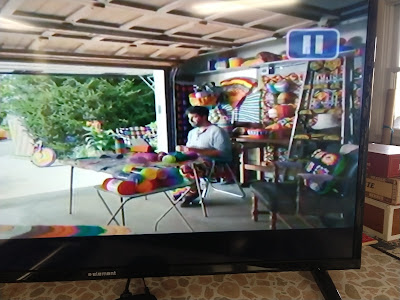

We also see a whole bunch of his finished work, including covers for his car and a very large object -- a camper van with a boat on top? -- that is inexplicably parked in the middle of his neighbor's lawn.
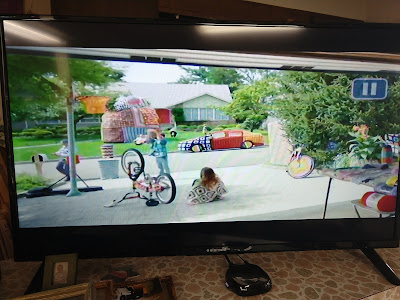
Alex says, "Well, I don't see why you should have to.  Let's set you up with a side gig savings goal on the US Bank mobile app.  This way you can turn it into your main hustle before you know it!"

Cody is thrilled.  "You're my hero, Alex!"  (Is this an acknowledgement that the mobile app is so hard to use that he couldn't set up his side gig savings goal by himself??)

Alex grins wildly and asks, "What are you working on now?"

He holds up a crocheted round about the size of a potholder.  "Pool cover."

Alex keeps grinning.  "That's fun!"

"Oh, I made my wife a bathing suit!"

"Did she like it?"

"She did not.  See what I made for Max.  Max!!  Look at him!  He loves it!"  Max, we see, is the dog, wearing a crocheted poncho and hat.
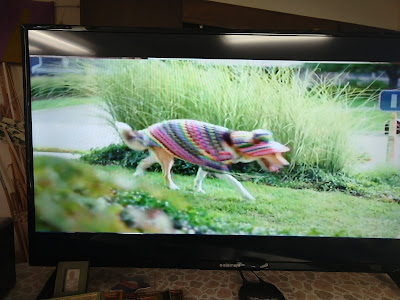
Now the voice-over intones, "The confidence to make your dream a reality.  USBank.  We'll get there together."

I don't know about you, but I found this commercial about as unappealing as Mrs. Cody apparently found her bathing suit.  

I can just see the ad guys lounging about in a conference room.  "Let's have somebody who wants to quit their job and go into business for themself and we can help them save money to do it."  They brainstorm somebody who wants to open a restaurant or a tattoo parlor, to become a wedding photographer, to start a landscaping service.  Nothing sounds really appealing, so one of them says, "Let's do something light-hearted and funny!!  Let's come up with a business that's really silly."  

Maybe a woman who wants to make jewelry or bake cupcakes.  "What's funny about that?" somebody asks and they all agree.  "That's something that women do all the time.  It's not funny.  If a guy did it, maybe that would be funny."   They think of all kinds of frivolous things that would be hilarious if a guy did it.  Now they're yukking it up.  After many sidesplitting suggestions, some of them even appropriate for family viewing, they finally come up with the most ridiculous career choice that a guy could possibly have -- crocheting!!

And of course, the way they portray crocheting, it IS ridiculous that anybody could ever turn dog ponchos and RV covers into a "main hustle."  Especially a guy.  

I could see how a woman (or a man) crocheting something beautiful could be a plausible example of an idea that could conceivably be turned into a business.  But the ad guys wanted the cheap laugh, and you can always get one by making fun of people who do handwork.  And what's funnier than silly women doing crocheting, but a DUDE doing it!!!    

This commercial is supposed to make people want to do business with USBank???  As a USBank customer for more than three decades, it made me want to take my money somewhere else.

Sunday, March 21, 2021

More about baby afghans

After I posted photos of two babies with their baby afghans, Carolyn left a comment and asked "Do you ever share the stitch for these afghans?"

I certainly do, Carolyn, and I love to spread the word because this stitch is easy, fast and functional.  Easy, because it only involves single crochet and slip stitch.  Fast, because it goes twice as fast as single crochet and uses a large hook.  Functional, because it incorporates a lot of air space into what looks like a solid surface, and thus makes a warm yet light blanket.  And because of all that air, you don't have to worry that the baby will suffocate even if the afghan gets over his face.  I have used this stitch for practically all the afghans I have made in the last 30 years, and that's a lot of afghans.  I never see any need to improve upon success.

I don't know the name of this stitch, although it probably had one when I first learned it.  After you make a foundation of chain stitch, you turn and come back by making one single crochet into the chain, two stitches back, then a slip stitch, then skipping a chain before inserting your hook into the second chain stitch.  In effect, you're making a series of empty squares as you come back across the width of the afghan.

When you get to the end of that first row, make two slip stitches, turn the work around and do the same thing coming back -- a single crochet into the single crochet in the row beneath, a slip stitch, skip a stitch and insert the hook into the top of the single crochet in the row beneath.  

Make a single crochet


Make a slip stitch


Skip one stitch and insert into the next stitch


Always stitch into the little Vs (single crochet in row below)
Sometimes I use a single strand of yarn, as in Baby Eleanor's afghan, and sometimes I hold two strands together for a fatter, warmer fabric, as in Baby Julian's.  That's what I'm doing in these photos, where you can see up close what a fat, firm, sturdy fabric is being made.

I often use one strand of white and one of a solid color, as in Baby Julian's, and you can get a particularly nice effect with two strands of variegated yarn, especially if you use different colorways.

I use big hooks, Boye brand only, size N with two strands of yarn, or maybe K with one strand.  I use worsted weight, even for babies, because it's tough enough to hold up in the washing machine and it works up quickly.  Baby or sport yarns are thinner and you would need to use a much smaller hook and thus make lots more stitches.  But I will use thinner yarns sometimes as the second strand with a worsted weight main yarn, as in the photos here.

One last piece of advice: make your foundation chain quite loose, so loose it looks kind of sloppy as you start to work.  For some reason this pattern stitch takes up more of the slack in your foundation chain than happens with other stitches I've used.  If you don't leave plenty of slack to begin with, your afghan may end up one or two inches shorter along the bottom edge than it is the rest of the way, as if a cord got pulled tight to gather the edge in.  Not fatal, but not beautiful.  Ask me how I know.


Thursday, March 18, 2021

Baby afghans -- complete with babies

For years I've been crocheting baby afghans by the dozens, the perfect handwork to pick up in the TV room or while visiting with company, or to take along to meetings.  Mindless enough to not interfere with conversation or concentration, small enough to work on your lap, yet as the hours go by you crank out a lot of product!  I have a pile of baby afghans at the ready to give away, and in the last couple of months handed out three of them.

One was to somebody on the neighborhood email list who was collecting stuff for a new mother whose apartment had burned.  I left the afghan in a bag on my front porch and she picked it up, to go to the nameless baby.  I felt good about the gift, and got a nice thank-you, but it's always better with actual proof that the baby likes his present!  

One went to a woman in my drawing/critique group, which hasn't met since lockdown, but she sent out an email when her first grandchild was born on Valentine's Day,  So of course she needed an afghan for Baby Julian.  (The afghan is folded in half in the photo, so plenty big to cover him up when he grows.)


The other went to a friend who came over for a drink on the deck in one of the unexpectedly warm afternoons in December.  (It wasn't all that warm, but we wore jackets and pretended.)  He mentioned that his niece was expecting a little girl soon.  I went into the TV room, rooted through the pile of finished afghans, and found nothing pink, but decided she could start life as a feminist and be bold.

And I just got a photo from the proud grand-uncle, of Baby Eleanor with her afghan.


Sunday, February 16, 2020

A good deed


I struck up a conversation with a friend at a party Friday night and she told me how she goes to the Greyhound bus station several mornings a week to see if any asylum seekers are on their way from Texas to New York or Chicago.  Yes, there are still a few people being admitted to the U.S. with asylum claims, and put on buses to go somewhere and wait for their hearing date.  And a network of saints on earth has spring up to help these unfortunate migrants on their journey, much as the Underground Railroad helped an earlier generation of migrants.

The buses come up from Texas and stop in Memphis, but since that stop occurs at 4 a.m., nobody meets the bus and there's nobody to call ahead and tell the Louisville people what to expect.  So my friend or somebody from her network is there every day to see if anyone needs help.  Some days there are no seekers on the bus, some days there are three or four.  The morning of our conversation, my friend met a young couple and their 2-month-old baby.

The buses stop here for 40 minutes, time for the greeters give out water and sandwiches (there is no food service at the Louisville bus station, or anywhere in its neighborhood).  They try to have warm gloves and caps on hand, since most of the migrants are not equipped for cold weather.  If more help is needed, somebody will pass the word to the network in Cincinnati; the couple with the baby didn't have coats but probably the good people two hours up the road were able to find some.

I asked my friend if they have a lot of babies come through, because I happen to own a lot of new baby afghans that I would like to give away.  I like to crochet while watching TV or talking with visitors, and a couple of years ago I went on an orgy of using up piles and piles of yarn that were occupying drawers and boxes and bags in every corner of the house.  She said that would be wonderful, because it's often cold on the bus.

So yesterday I hauled out my bags and tubs of afghans -- and realized that in my usual slapdash construction approach, they all had thread ends hanging out where I had started, stopped, or changed yarn in the middle. 

I spent two hours watching a movie on TV and weaving thread ends in with a big-eye needle, and got five afghans ready to deliver at a meeting this afternoon.  I think there are eight more in the TV room waiting to be finished, and I hope I can do that before too long.

This made me feel really good.  Yes, this project clears out at least one cubic yard of stuff that I am thrilled to divest.  But it also allows me to demonstrate in a very small way that although our government may be cruel and hostile to the tired and poor people at our borders, many of us ordinary citizens welcome them through the golden door.

Monday, September 2, 2019

Fiberart International 4 -- knitting and crochet


There were several intriguing knitted and crocheted pieces at Fiberart International, which was on display all summer in Pittsburgh.


Adrienne Sloane, Marking Time (details below)

This piece is knitted over wire, which is bent to make the script.  I liked the strong graphic quality of the "lines".  (Wished they had put the gallery tag somewhere other than smack in the middle of the pencil-drawn hash marks on the wall!)


Nicole Benner, Comfort/Confine II

Crocheted with metallic yarn and displayed over a mannequin, although in the past it has been worn by a person as performance art.  Can't you just imagine what it would be like to wear a garment like this?  Would you feel slinky and flashy as all get-out, or imprisoned, or both?


Marianne Moore, Financial Ruin (detail below)

A real knockout, knitted out of shredded US currency.  I had to wonder -- did she first have to glue a bazillion six-inch shreds into long yarns?  Sounds like a labor of love.


Rachel Hefferan, Woven/Crochet Transition (details below)


Here's a piece that starts off as weaving and ends up as crochet.  A clever idea, but since the transition between the two techniques seems to be the subject of the work -- see the title -- I wished that she had started crocheting on some of those long warp threads to more seamlessly join the two parts instead of just draping them on top.


Carol Milne, You Can Leave Your Hat On, Doll

And this one gets the originality award: "lead crystal knitted glass hat on mold-blown glass head."  I wish I knew more about glass to understand how this got made -- probably not with asbestos gloves holding knitting needles in the furnace.

Friday, July 5, 2019

More yarn leftovers!


Several years ago, I think, I embarked on an endless project along with my friend Debby.  We resolved to knit (Debby) and crochet (me) strips that would stretch for a mile.  (Read how we got started.)  As time passed, I would be more or less enthusiastic about the project.  Sometimes I would whip out a bunch in a week, other times I might go for months without progress.

I had resolved to use only leftovers rather than buy new yarn, so I was at the mercy of whatever might show up in grab bag or whatever someone might give me.  And frankly I had hit a dry spell recently.  During the cold weather months this winter I was working on baby afghans, from entire skeins of yarn, rather than the mile-o'-handwork.

Last fall a friend who teaches refugee women how to sew told me that her ladies also do knitting, and I asked her if they were going to just throw away the leftover bits anyway, could I have them?  And last month she dropped off a huge bag full -- almost five feet tall.


This should keep me crocheting all summer.


Wednesday, April 10, 2019

Remembering Enid -- the show!


Last week I got off on a tangent telling you about Enid Yandell, an excellent sculptor from Louisville who had a hard way to go a century ago because of her gender.  Now I'll get back to the show that got me onto this subject in the first place.  Several women sculptors in the region have banded together in a group called "Enid" and to commemorate Enid's 150th birthday, they have a small show at 21C Museum Hotel in Louisville.

My dear friend and art pal Bette Levy had two large pieces in the show, both of them dramatic combinations of ancient farm equipment and new crocheted pieces to complement them.

Bette Levy, Scythe (detail below)

Bette finds doily patterns in old needlework books, executes them huge (this one is probably five feet across) and then stiffens them so they retain their shape when mounted on the wall. 


Bette Levy, Infinity (detail below)

Here the rusty metal pieces are tines from an old hay rake, which would have been pulled behind a tractor.


I sometimes find long curator explanations at museums to be pretentious and artspeaky, but the remarks about Bette's work struck me as worth reading.  The sign said:

"Farm and domestic labor are the focus of Levy's series that combines doilies crocheted in historic patterns with aged farm tools, previously used to reap sustenance from the land, but long since abandoned for larger, mechanized production.  The scale of the crocheted doilies is enlarged to visually challenge the dominance of the tools, subverting the traditional gender division of labor and power, creating a more balanced pairing."

The exhibit continues at 21C Museum Hotel, 700 West Main Street in Louisville, through October.  If you've never visited a 21C, you should -- a combination of hotel, restaurant and world-class gallery, welcoming walk-in visitors as well as paying guests.


Friday, January 12, 2018

Tension headaches


Our fiber art group just scored two huge garbage bags full of old doilies and tablecloths in a variety of techniques -- crochet, tatting, hairpin lace, cutwork, bobbin lace, embroidery and who knows what else.  As we sorted through, contemplating what we'll do with them, I noted how some were obviously made at less-than-expert level craft.

And I thought, as I have so often in the past, that in every single fiber art, the key to mastery is control of tension.

Check out this cute little crocheted doily, made in granny squares.  The white is tighter than the pink, hence the 3-D effect.

When I first learned to crochet, taught by my mother-in-law, I made a fairly large afghan.  I was proud of how neatly it was done, flat and even -- until I finished and tried to fold it up.  Oops -- one end was a good six inches longer than the other!

What had happened, of course, was that as I got more comfortable with the yarn and the stitch, I eased up on the tension and the finished fabric got more expansive.

I have taught many beginners how to crochet, sew and embroider, and have watched myself try to learn knitting, weaving, felting, macrame and many other techniques.  In 99% of the cases beginners' work is too tight.  We clench up on the needle or hook or whatever tool we're using, we pull too hard on the thread or the yarn, we hang on too tight to the underlying material.  We grab that quilt in a death grip and resist the pull of the sewing machine; we wrap the french knot so firmly that we can barely pull the needle through; we tug the weft through the weaving so hard that the selvages bow inward. 

(Weavers may correct me on that last remark -- I think some beginners err in the other direction, leaving the weft too loose so the selvages are uneven and loopy.  But that's the other 1% of tension headaches.)

The problem usually disappears with practice; we relax, we learn to let the yarn flow easily, we develop muscle memory so all the stitches have the same tightness throughout the whole work.  In knitting parlance, we automatically maintain the right gauge without having to stop and measure all the time. 

That's not to say we can stitch in oblivion.  It's still good to stop every now and then, lay the work out flat, check how it's coming along.  Note whether your afghan is still the same width as when you started.  Check that the second sock is the same size as the first one.  Make sure your seams are smooth, not drawn up in a ruffle.  Look at the back of your work and see that the threads are well-behaved, not forming tangles and knots. 

It's not just the sewist that can have tension problems -- the machine can too.  In my experience, Bernina sewing machines, which I love, adore and have used exclusively for almost 30 years, have one achilles heel, and that's tension control.  I have had to learn tricks to keep them from spoiling my work: avoiding threads that the machine doesn't like, making sure the bobbin thread matches the top thread so if it's pulled up too far, it will be less visible. 

All these issues are part of mastering the craft of our art.


Thursday, July 13, 2017

Cleaning up the slut dolls


Being the kind of grandmother who doesn't buy toys for the kids, I had been blissfully ignorant of slut dolls -- the modern-day Barbies that present their own warped vision of women, except even worse.  I was too old to play with Barbies as a kid but have certainly read reams of commentary about their figures, their wardrobes, their roles in society, mostly agreeing that Barbie is no friend to feminists.  Now that bad vibe has morphed into slut dolls, those that look like hookers on the stroll, complete with collagen-fat lips, too much eye makeup, stilettos and waistband-length skirts.


But my friend Denise has discovered a way to repurpose slut dolls into lovely little girls with no makeup, appropriate clothing and a nice, innocent look, and giving them to her 7-year-old granddaughter.  It all started when she happened upon the work of an Australian artist and mom, Sonia Singh, who has created a little empire of Tree Change Dolls.  Apparently you can buy them on eBay, but Denise was drawn to the directions for DIY.

It's simple -- rescue doll from thrift store, remove the painted face with acetone, then paint on age-appropriate features.  Strip off the hookerwear and make better clothes.  Cut and restyle hair as needed.  Slice down the feet.


Here's a before-and-after pair.  Denise enlisted our friend Bette to crochet a sweater for this new look doll, who also got a haircut and a lovely new hat.  Fortunately she already owned a pair of full-length jeans, even if the sequins are a bit flashy. New shoes or boots are still to come.

Denise has several dolls in process, a worthy endeavor for any artistic grandmother.


Thursday, July 6, 2017

Grandchildren and fiber art 2


We have this new grandchild, two months old today, who lives only two miles up the road, and we get to see her quite frequently.  The only problem is that almost every time we see her she's asleep.

Her parents will call us and say "She just woke up, and we just fed her, and she's all bouncy and wide awake, how about if we bring her over right now?"  But when they arrive, fifteen minutes later, she's back asleep.  We'll take turns holding her, poking her cheek and wiggling her arm and even putting a cold glass against her tummy, but she just dreams on.  It's gotten to be a big joke in the family.

So here's the doting grandma, tired of wake-up games.  Some day the kid will be running around this very living room talking a lot and leaving her toys underfoot.  For now, give me my crocheting and a glass of wine.


Friday, June 30, 2017

Mile-o'-handwork 3 -- the installation


The wall of the gallery that the mile-o'-handwork had to occupy is a strange one: it's pierced by two windows that connect the back room show gallery to the front room sales gallery.  The show committee arranged five of my cakes and three much larger ones of Debby's at the base of the wall, and unrolled enough to make several vertical drapes up and down in front of the windows and on the wall.


I was happy to see the strips on display, but not happy with the overall effect.  I keep thinking I wandered into the janitor's closet and found a bunch of mops, buckets and vacuum cleaners standing there, with their hoses and handles inexplicably reaching up to the ceiling.  I think I'll embargo this project until I get a whole lot more work made, and when it does come out again in public I think I'll keep way more of the cakes rolled up and a lot fewer strips stretched out across space.  So all in all, a valuable experiment, and lots of ideas for the future!

By the way, here's a close-up of Debby's knitted strips.


And here's a close-up of my crochet.

I'll show you some of the other work in the show next week.  Unfortunately the show comes down today so it's too late for me to urge you to drop in.  Had I not been out of town I would have gotten there earlier in the run.


Thursday, June 29, 2017

Mile-o'-handwork 2 -- how to display it


When Debby and I first talked about the mile-o'-handwork we thought it would be a nifty idea to stretch our strips out across the Big Four Bridge, a pedestrian bridge across the Ohio River that we are fond of walking on.  The length of the bridge walk is one mile, so that would make a perfect installation.  This idea lasted for a while until I realized that I liked the look of my rolled-up cakes more than I liked the look of the crochet extended.  And besides, if I stretched the work out on the bridge it would get dirty.

So my thinking was that I would like to display the work -- if that ever became a possibility -- mostly rolled up, with just enough of the strips unrolled so people could see what the cakes were made of.  This thought process was academic, as I had no possible venues for display, and besides, I would like this hypothetical installation to be much bigger.  So I kept crocheting.

Meanwhile Debby was knitting, and one day she had an inspiration, which was to use her long strips to make writing on the ground.  When we were at our art retreat this spring she wrote out her favorite catchphrase from the Wizard of Oz on the back lawn.

Two very different ideas for what to do with the project, which showed no signs of ever getting finished.

But then the proposition!

Our local fiber and textile art group was having a juried show in a small gallery.  Because of the size of the gallery, there was a size limit: 24 inches wide.  Perhaps because of the size limit, or some other twist of the rules, we didn't get a whole lot of entries, and of course the entries that were selected were pretty small.

The show committee went from worrying that we would overflow the gallery to worrying that we wouldn't be able to fill it adequately.  And somebody had an idea: why not have a small display of the mile-o'-handwork!  Everybody in the group knew about our project, because both Debby and I had been working on it during meetings for years.

So I delivered one box of cakes to the gallery early this month with the directions "do whatever you think is best."  And finally this week I got out to see the installation (not a moment too soon, because the show closes tomorrow).  I'll show it to you tomorrow.


Wednesday, June 28, 2017

Mile-o'-handwork 1 -- genesis


Several years ago my art-and-walking pal Debby Levine, who is a master knitter, had a brilliant idea -- she would make a mile of knitting.  We talked about this idea over a period of weeks as we walked.  The more we kicked the tires, the more we realized how big a task that would be.  She revised her plans to make the knitting narrower, but it was still daunting. Then in a moment of temporary insanity I said to her "You make a half mile of knitting and I'll make a half mile of crochet."

I thought this would be a good way to use up those bits and pieces of yarn left over from afghans, and for a while that was going great, until I used up all my bits and pieces.  Then I started grabbing all the yarns from grab bag and crocheting them.  My crochet is about four inches wide, most happy when I'm working with low-rent acrylic yarn.  I roll the finished strip into a jellyroll until it gets wide enough to fit into a banker's box.

My grandson thinks these bundles look like cakes, so that's what I call them.  At any given moment I have several going, one in a bag in the car to take with me to meetings or other public events, one in the studio, a couple on the sofa where I watch TV, one in the living room to work on if company comes.

I tried to resolve that I would never buy any yarn for this project but simply use leftovers.  But about a year ago I got desperate for raw materials and bent my principles enough to go to the Good Garbage Store's going-out-of-business sale, where I got about 50 skeins of yarn for about 35 cents each.

I have five or six boxes so far, five cakes to a box.  A couple of years ago I took everything I had finished over to the house of a friend with a really long room, and we unrolled and measured all the cakes.  It seemed that I was maybe 20% of the way to my half mile, which didn't seem like all that much progress for all the time I was putting in.  But I am not discouraged.  I will keep crocheting, and I trust that the Lord will provide yarn like manna in the wilderness.  And someday I will display the work.


Friday, August 19, 2016

Love will find a way


My son sent me an email the other morning -- "Do you have fiberfill?"

What on earth could this be about?  He said it was for a secret project and he would come over and show me.

He pulled this out of his bag:

It  was about five inches long and four inches across.  This required further explanation.

The occasion was his first anniversary, and after some discussion with his wife about what she would like him to do for her, she tossed out an off-hand remark -- "what I really want is a crocheted Oddish but you'd never be able to do that."  (She has been bribing herself with Pokemon Go to walk 20 miles a week, and the Oddish is her favorite character.)

My son being the kind of guy he is, filed away that remark and said to himself, "that couldn't be too hard."  So he found directions on the internet, bought some yarn and a crochet hook and went to work.  As you can see, there were a few glitches in this first segment, including that protuberance on the right-hand end which we think was supposed to be a flat base.

Fortunately he lives only two miles away so he could come over for consultation several times.  His purchased crochet hook went MIA and he had to come by for a replacement.  We stuffed the segments and figured out how to sew them together.  We found the perfect hemispherical red eyes in my button box and embroidered a blue smile.


The directions had said to put a stitch marker at the beginning of the row.  I was pleased to see his improvised device, straight out of the Lego box:

Here's the surprised recipient with her new toy.  I bet next year she will think carefully before she says what she really wants for her anniversary.


Friday, March 16, 2012

Lace invasion

What could be more fun on a beautiful spring day than to go to your favorite museum and apply doilies to trees?  I was invited to participate in this "lace invasion" by my fiber art friend Bette Levy, whose show opens this evening at the Carnegie Center for Art and History in New Albany IN.  Bette's work includes a lot of crocheting, and the bright idea was had to do a crocheted installation on the lawn and steps of the museum.

Bette and some others had worked ahead, crocheting between doilies to make large expanses of lacy coverings, so that all they had to do was wrap the expanses around the tree and close up the back side.  On my tree we were more improvisational, simply applying the doilies to the tree with push pins and then crocheting cords between them.

Because our tree was small and had several branches at working level, we were able to work up quite an intricate network of cords and doilies.


By contrast, the people with the largest tree just made a single big wrap.

People also put doilies over the architecture.

There were unexpected obstacles to working in situ: where to put your hands and your thread! When there's a branch in the way you have to be able to adapt your stance.  Here's me in action, trying to make my wrists bend in ways my grandmothers never taught me.  (thanks to Suzi Z for the last two photos)