Showing posts with label pandemic. Show all posts

Tuesday, January 25, 2022

The pandemic quilt is finished!

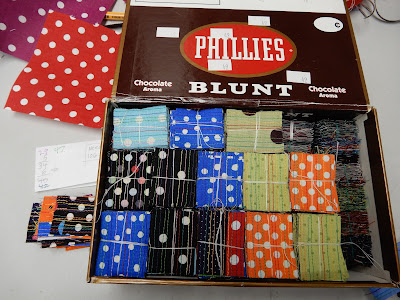
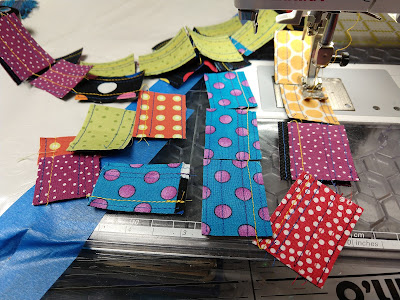
 A year ago I started working on a new project: memorializing the 2,662 coronavirus deaths in Kentucky in 2020.  I went to my stash of polka dot fabrics, the floating circles calling to mind the mysterious virus particles floating around in our air.  I made 2,660 tiny postage stamp quilts, each measuring approximately 1 3/4" by 1 1/4".  I counted them over and over as I bundled and packed them into cigar boxes, putting them away until I got around to stitching the whole thing into a huge grid.

I worked on other projects for the rest of the year, but brought the postage stamps back to be stitched together in November.  That turned out to be bad timing, because I had barely begun the process of sorting, counting and stitching than I realized I had to put them away and work on my annual Christmas ornaments.  

After the New Year I hauled the project out again, determined to finish.  To my dismay I realized that somewhere along the way, 70 bits had gone AWOL.  I know I counted them at least ten times along the way, but they were not there when it was time to get serious.  I looked on the floor.  I looked under things on my work table.  I looked on the shelves where the project had been stowed during the holidays.  No bits.  I cussed, I fretted.  Finally I sewed 70 new bits (thus ensuring that someday in the near future I will find the missing ones...) and finished the quilt.

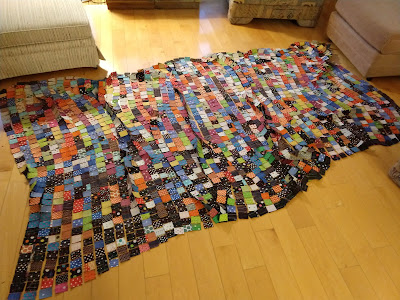
Last night I triumphantly hauled the quilt up from the studio and spread it out on the living room floor to show my husband.  And could hardly  believe how huge the damn thing is!!!

What you see in the picture is not the full expanse -- many of the columns are folded back on top of others.  I realize that the full width, if the columns are pulled flat, will be something like ten feet.  That's a lot of quilt; I may have to buy a new hanging rod, because the brass rods I usually use for postage stamp quilts aren't that wide. 

Now the only step remaining is to sew loops across the top of the quilt, so it can be hung from the rod.  And to disassemble the work surface that I constructed for this project, an old vinyl tablecloth spread across my entire sewing machine surround so the bits didn't get caught in any tiny gaps between surfaces.  

Then I think I'm done with the sewing machine for a while.  Back to hand stitching.  I have lots of ideas that I need to get going on!

Thursday, August 26, 2021

Afghanistan memorial

I have never been one for working on just one project at a time.  Some of my art friends find focus by finishing up one thing before starting on the next, but that's way too controlled for me.  I like to have several things going at once, picking up whichever one is closest to hand without walking up or down the stairs, whichever one is most conducive to stitching while talking with family and friends, whichever one fits my mood of the moment.

I've posted several times about my coronavirus memorials, marking each death in Kentucky with a french knot onto a roll of vintage bandage gauze.  I finished the 2020 memorial a few weeks ago (2,662 dead) and almost immediately started on a 2021 version (7,575 dead and counting as of this week).  I've finished January (1,083 dead) and am almost done with February (892 dead).  But the small scale of the knots got to be tiring, and I yearned for something bigger, faster, and involving the sewing machine.

So for the last few days I have been working on a new project, a memorial for the U.S. military dead in Afghanistan.  Longtime readers and pals will know that I did a similar piece in 2008 counting the U.S. military dead in Iraq, which traveled extensively with Quilt National '09 and is now owned by the International Quilt Museum in Lincoln NE.  It had a flag for each death, referencing the flag-covered coffins that came home from that war.

Memorial Day, 2008, 86 x 100"

This one will be similar in format -- a single little quilted rectangle for each of the dead, held together with stitching in space -- but different in materials and concept.  

Memorial Day, detail
The brother of one of my dear friends and art pals was a career Navy man, serving as Chief Surgeon for the group of ships supporting the Theodore Roosevelt in the Persian Gulf during the Iraq war, and then on the ground in Afghanistan at the hospital in Kandahar.  After he retired a few years ago, he decided to divest his old uniforms, and through his sister, they came to me for purposes of art.

At first I wasn't sure what to do with them but with the impending end of our Afghanistan adventure I thought that war needed a memorial as well for the troops who served and died.  Cutting up the camouflage uniforms will give me the fronts of the small quiltlets for this memorial; the backs will be made from a large variety of fabrics, to remind us that every one of those uniformed dead was an individual, a person with hopes and dreams too soon cut off.

The death count is suprisingly inexact, (perhaps because so many of our military and support activities were outsourced to contractors and it's hard to tell who's military and who isn't)  and there will probably be a few more in the coming days and weeks as we attempt to make a final exit, but it's somewhere in the vicinity of 2,400.  A lot fewer than in Iraq (4,431 dead since 2003; there were 4.083 when I made my Memorial Day quilt in 2008).

This compulsion to count the dead probably sounds morbid and obsessive.  I don't think I'm particularly preoccupied with death, certainly not in my daily life, where I have been blessed not to be closely touched by the coronavirus or the war, and where I've lost only one close family member in the last decade.  But the historian and journalist in me always wants to find out the facts and write them down, and the soldier's daughter in me always wants to remember how war is not glory, it's hell. 

I'll write more about this project soon, because working with the uniforms has proven to be quite a surprise.


Thursday, August 19, 2021

Plague diary -- reading

Reading has always been one of the most important parts of my life; I can't recall any time since age 3 that I haven't had a book nearby, if not actually in hand.  In fact, "bring a book" has always been my personal motto.  Although my home is filled with books, many of them unread, I really love library books.  And in the last year or so, I realize that I REALLY love library e-books.

When the public libraries were closed and staff furloughed for several months during lockdown, I had a momentary panic until I saw that the e-book collection was still going strong, with new titles added every day.  I read a lot during lockdown, almost all of it digitally.

When e-books first started to catch on, in 2006 or 2007, I often announced that I would not like them.  I said that I loved the feel of the physical codex, the turning of pages, the recollection of where on the page I had seen a name or reference.  Reading on a device seemed far less serious and pleasant than reading "real books."  But that changed when my sons gave me a Kindle for Mother's Day in 2014, just as we were heading off for a vacation to Britain and Norway.  I was hooked immediately, especially at the thought of not having to shlep a dozen books along on a three-week trip.

Since then my e-book habit has kept me in reading matter around the globe.  Because we refuse to pay the exorbitant internet fees on cruise ships, a shore visit would begin with finding the nearest wi-fi so I could get some new books.  Sometimes that was at a hot spot on the dock (where you would always find a bunch of crew members calling home), sometimes a nearby bar, where I could simultaneously download content and drink beer.

But at sea or ashore, I realize how much I like reading on a device.  It's easier to use at the table, where I do a lot of reading -- prop it in a little easel and it's perfectly on display.  You can read in bed after the lights go out.  


Best of all, you can search in the book to find out who in hell Geoffrey is, when he appears in the narrative after 200 pages of absence, or what exactly Geoffrey said when he was first interviewed by the police.  You don't need a bookmark, or worry that your bookmark will fall out.  You can mark any passages you like, even make rude marginal notes, without a pencil!


Since I started daily calligraphy two and a half years ago, I have written a passage from every book I read.  It's the first time in my life I've kept track of what I read, and I think just keeping the list has added to the reading experience.  If you want a recommendation, I have really enjoyed "The Premonition" by Michael Lewis, and "Nightmare Scenario" by Yasmeen Abutaleb and Damian Palette -- both about the pandemic and how the government dropped the ball on managing the outbreak.  Depressing reading, yes, but informative and thought-provoking.  Or if current events just have you spitting expletives, try "Nine Nasty Words" by John McWhorter, a linguist's take on the naughtiest taboo words in the English language.  Not for those who clutch their pearls upon hearing "darn it."

What have you been reading lately?  Anything about your reading choices or reading habits different now than it was before pandemic?  

Saturday, August 14, 2021

Plague diary -- just when you thought it was safe...

I can tell you exactly when I decided that it was time to get worried again.  It was on the morning of July 23, during my sister's visit.  We went to two different art supply stores that day, and in each one the employees were masked.  We had not brought our masks along, but we agreed that if we had, we would be wearing them.  It just seemed that caution was in the air again, at a suddenly higher level than we had detected for months.

We didn't go cold turkey; we went out to eat that night (but were happy to be seated in a corner of an uncrowded room, far from other people) but we skipped the opening reception for the show by my fiber and textile art group the next day (and were happy we did, after we heard that the small room had been packed with maskless visitors).  And this week I ate inside (but was happy that we were seated right by the door, with nobody at the adjoining table).  I've been wearing a mask in the few stores I've been in, and today noted that at least half of the customers in the three stores I visited were also masked.   

We're feeling particularly paranoid because the four-year-old started school this week.  She was supposed to go last year, but her parents held her out and now she is totally excited about this new adventure.  The kids are all wearing masks, but of course they're unvaccinated, in the midst of the delta variant firestorm.  Apparently it will be months before the FDA gets around to perusing the data, and waiting for additional data, and maybe even requiring some more data before the little ones can get protection.  

daily calligraphy from Monday


Early in the pandemic we took comfort in the fact that children seemed to be less likely to contract covid, and far less likely to suffer severe illness or die.  Now that has changed.  As of last week, 131 children under 5 have died, and 292 between 5 and 18 have died.  Yes, I want the FDA to be careful before releasing drugs whose safety and efficacy are in doubt.  But there's also a risk to doing nothing.  And I tend to think we're now in a situation where the risk of perhaps dropping the heavy fire extinguisher on your foot is far less than the risk of letting the building burn down.

I also have to wonder why, if it's OK for parents to flout medical advice and keep their kids unvaccinated (whether for covid or measles or any other potentially fatal disease) it isn't OK for parents to flout medical advice and give their four-year-olds a dose of covid vaccine.  Are parents the ultimate authority over their children's medical treatment or aren't they?  If yes, then give the shots to any child who can walk or be carried into the place with Mom or Dad.  If no, then require every child between 12 and 18 to be vaccinated.  But when we want to have it both ways, we lose and covid wins.


Friday, August 6, 2021

Pandemic knots

Earlier this year I did a project of memorializing each of the 2,662 people in Kentucky who died of coronavirus in 2020. I stitched 2,662 french knots onto a roll of vintage gauze bandage, distributed by month, starting in March with only 15 deaths and ending with 754 in December.


I finished the project about two weeks ago and had already decided that I needed to continue into this year, since the virus has done the same.  

I learned some things from my 2020 memorial.  First is to be more careful in counting!  In the first project I tended to get carried away, stitching while watching TV without really noticing how many knots I had made.  I ended up having to cut out dozens of knots where I overshot the mark -- and that hurt.  Fortunately the gauze was forgiving, and I was able to erase the needle holes with a scratch of fingernail or needle end.  But it was stupid to do it that way.

This time I'm going to plan ahead a bit and gauge the relative density of the knots in a given month by comparing to the 2020 piece.  For instance, January 2021, which I'm working on right now, has to have a third more knots in the same space as December 2020.

This is a meditative project.  When I posted a shot of the new stitching on instagram earlier this week, a friend left a comment: "I imagine you have a very profound realization of exactly how many deaths the "number" represents.  So easy to see a number and move on."

I replied: "You're right -- that's exactly what I think about when making these marker pieces.  I guess this is the sixth death marker that I have embarked upon (one is half done) and this genre, if you want to call it that, has great meaning for me."

Meanwhile, if more people would just get the damn vaccine, there would be a lot fewer knots in my future.

Thursday, March 18, 2021

Baby afghans -- complete with babies

For years I've been crocheting baby afghans by the dozens, the perfect handwork to pick up in the TV room or while visiting with company, or to take along to meetings.  Mindless enough to not interfere with conversation or concentration, small enough to work on your lap, yet as the hours go by you crank out a lot of product!  I have a pile of baby afghans at the ready to give away, and in the last couple of months handed out three of them.

One was to somebody on the neighborhood email list who was collecting stuff for a new mother whose apartment had burned.  I left the afghan in a bag on my front porch and she picked it up, to go to the nameless baby.  I felt good about the gift, and got a nice thank-you, but it's always better with actual proof that the baby likes his present!  

One went to a woman in my drawing/critique group, which hasn't met since lockdown, but she sent out an email when her first grandchild was born on Valentine's Day,  So of course she needed an afghan for Baby Julian.  (The afghan is folded in half in the photo, so plenty big to cover him up when he grows.)


The other went to a friend who came over for a drink on the deck in one of the unexpectedly warm afternoons in December.  (It wasn't all that warm, but we wore jackets and pretended.)  He mentioned that his niece was expecting a little girl soon.  I went into the TV room, rooted through the pile of finished afghans, and found nothing pink, but decided she could start life as a feminist and be bold.

And I just got a photo from the proud grand-uncle, of Baby Eleanor with her afghan.


Thursday, March 4, 2021

A year of work

More than a year ago I saw photos in the newspaper of people lining up to vote in the New Hampshire primary, the first election of what was obviously going to be a big election year.  Since I am an election junkie, and absolutely love everything about voting, I had the idea to cut out the pictures and use them in a big artist book.  Soon the rules for this project became clear: I would collect every photo of people voting in 2020 that was published in either the New York Times or the Courier-Journal, the two papers that we receive every day.  

Eventually I realized that sometimes voting pictures were back-to-back on the same piece of paper, in which case I would try to choose the better photo.  Once when the NYT published a whole Sunday magazine worth of pictures of people voting and counting ballots, I was lucky to get a second copy of the magazine from a friend so I could use both sides of the pages.

Several months later I decided I better start assembling the actual book.  The pictures were piling up, and I wasn't sure how to display them.  Simply pasting them into a scrapbook seemed kind of lame -- a book, yes, but not an artist book.  And it looked like there were going to be a LOT of pictures, so how big a scrapbook to buy?  And in the midst of pandemic, I didn't even want to go to the store.

Then an inspiration.  When I retired 20 years ago I brought home with me a lot of obsolete office supplies that I knew would just be thrown out when I left.  One of these was a big stack of continuous feed printer paper (you show your age if you remember when printers had sprockets on either side to pull the paper through, and after printing you had to tear off the side strips and separate the pages).  And I decided not to use glue stick to put the pictures into the "book," but sew them in.  

Time passed and every now and then through the summer I would spend a few hours sewing pictures into the book.  It seemed to be an appropriate activity for pandemic lockdown -- every day something new to add to the pile, no end in sight.  I fine-tuned the definition of what would go in the book a few times -- people voting, of course.  People standing in line to vote, yes.  People waving campaign signs outside the polls, no.  As pandemic made many states expand their mail voting, I expanded my definition to include people mailing ballots, people collecting ballots from mailboxes, post office trays of ballots being sorted or delivered.

I had envisioned that the project would end on November 4 or 5, but that didn't happen -- every day were more pictures of people counting ballots.  Earlier in the year I had decided that counting ballots was fair game for the book, and there were plenty of those as November wore on.  But people protesting the ballot counting, no.  Then there were lots of photos of electors voting on December 14.

And even then, the election wasn't over!!  I debated with myself and decided that the Georgia Senate runoff elections were part of the 2020 voting, so I cut out those pictures as well.

And finally yesterday afternoon I sewed the last photo into the book!  Here my husband is looking through the book.  You can see the red thread that sews everything in, with hanging ends where I had to start and stop.


PS two hours later I found a newspaper on my pile from a couple of days ago with a photo of people voting, accompanying a story about the Supreme Court taking up a voting rights case.  Sure enough, they were voting in the 2020 election, which meant that picture should technically be in the book.  And yet my last page was so pretty, so carefully chosen -- I didn't want to make a new last page with a quite ordinary picture. Should I go back and try to find a place to sew it in, on an earlier page, or should I forget about it, since the book was already finished when I found it?  I will think about that for a while.  

Friday, February 26, 2021

Phase 1 finished!!

I have made 2,662 postage-stamp-size quilts, their polka dots signifying coronaviruses floating around in the air around us, each one marking the death of one Kentuckian to the disease in 2020.  That was the easy part.  Now it's time to sew them together into a big grid.


But first, arithmetic.  

I'm not one for a whole lot of planning before I start a project.  Some people may find security in sketching, measuring, samples, templates, junior "etudes" before embarking on the real thing.  I find those things unnecessary, time-wasting and anxiety-provoking.  I like to get on with it, and let the actual materials tell me how they want to behave, what they want to become, even as we work together.

I did make an attempt to pre-plan this project.  I thought I would make my postage stamps 1 1/2 inch wide and 1 1/4 inch tall.  So I cut my fabrics into 5 inch strips, planning to eventually slice them into four strips the right height, and then cut the strips into 1 1/2 inch pieces.  I made a couple hundred at those dimensions before I realized that they looked too square, and I wanted my bits to be more obviously rectangular.  Can't tell you why, they just looked too puny.  

Thought about this for a while, and then decided what the heck, let's change the size.  A few hundred smaller ones would surely not be apparently among a sea of larger ones, and if they were, so what?  People aren't all the same, why should their metaphorical embodiments have to be?  So most of the tiny quilts are 1 3/4 inches wide.  

But even if you can get away with changing the arithmetic in midstream while making the components, there comes a time in construction where you have to actually commit to a certain number.  Namely, how many columns of postage stamps to make, and how many stamps to sew into each column.  

Because I had upsized my bits, the full finished size got bigger too, and suddenly I was worried about it being too wide for my good brass rod that I always use to hang big postage stamp quilts.  I think I'll end up with about 2 inches per column, with the bits pushed pretty close together.  So I'm leaning toward 41 columns of 64 bits each, plus one extra column of 38.  Or something like that.  


I don't have to decide until I sit down to sew, and that can't happen until I clean off my sewing table and transform it into a huge, smooth, obstacle-free surface with no cracks or corners to impede the movement of the stitched grid.  A few days to think -- and then maybe I'll just flip a coin.

Sunday, February 14, 2021

More counting -- oops!!

I've been watching TV for several hours a day all during the impeachment trial, sometimes in my studio while sewing "postage stamps" for a coronavirus memorial, sometimes in the TV room with my husband while sewing french knots for another coronavirus memorial.  (Both will have the same total: 2,662, to mark the death toll in Kentucky during 2020.)

For the postage stamps, counting is easy, because I tie the little bits into bundles of 25 and can easily tell how many I have made.  Coincidentally, one full shoebox of bundles is exactly half of what I need, and I'm well into the second box.

But counting the french knots is a little more difficult.  Well, truth be told, a lot more difficult.  The 2,662 knots have to go into the proper month.  I sewed and sewed and sewed on December, which needed 754, and after a while I stopped and counted.  This involves taking a photo and checking off each knot with a mark in my Paint program.

I needed 86 more knots, and it was tricky to keep track.  I would make five knots, counting out loud, then make hash marks.  As careful as I tried to be, once or twice I lost count and had to go back and reconstruct, from the back of the work, exactly how many knots had occurred since I started the new thread.

After I finished December, I did March (the easiest month -- only 15) and then set in on the other months.  I worked on November for a while (423 needed) and then thought I'd better stop and count.  I moved on to April, which needed 225, and made some, stopped when I thought I was getting close, and moved on to some other months.    

After a particularly furious day of french knots yesterday, I decided I'd better count and see where I stood.

November was pretty close -- less than 100 still needed.  I would have been happier if it were closer, but I should be able to count as I sew, especially if I won't be stopping to shout at the TV.  October is only halfway there, 171 knots done, 140 to go.  That's going to be more tedious to count; maybe I'll just sew for a while, take a new photo and start the count all over again.

But April.  

Imagine my chagrin when I counted April and found that I had overshot the target by 56!  Now I will have to cut out 20 percent of what I did.  I hope the fabric will be forgiving and not show ugly holes.  Boy, do I feel dumb.


Wednesday, February 10, 2021

Counting knots

The impeachment trial has already proven to be a most conducive environment for hand stitching.  While watching yesterday I made a whole lot of french knots on my memorial bandage, so many that when I went to count them this morning I realize I'm almost done with the largest month in the project: 668 out of 754 needed for December.  The last 86 will require me to count as I stitch -- which will be fine until I get distracted and have to yell out at something outrageous said in the Senate.  I'll have to be careful!

And now it's time to decide how I will separate the months on this "calendar" scroll.  Probably with a line of machine stitching?  

Meanwhile, on to November, with "only" 423 deaths to mark.

Monday, February 8, 2021

Back to the pandemic memorial sewing

The last time I wrote about my coronavirus memorial quilt at the end of January, I had 23 bundles of 25 postage stamp-size little quilts, on the way to 2,662 pieces -- the number of deaths in Kentucky in 2020.  With a few days off to sew Valentine hearts, I've been making good progress and now have 53 bundles -- halfway there!!  (I decided it was less daunting, and simpler, to count bundles rather than pieces.  It seems way less difficult to make 106 bundles than to make 2,662 bits.)

Meanwhile I decided that I needed a new hand stitching project, so I'm doing a second 2,662 memorial, this one in french knots sewed onto a vintage roll of six-inch wide bandage muslin.  

This piece is going to be organized by month, showing how the pandemic started slow, plateaued for most of the year, and then hit the fan in the post-Thanksgiving surge.

You know how I feel about planning -- the less the better.  I like to work out problems while stitching, not before.  I really have no idea how much space it's going to take to make 754 french knots, so I'm just sewing away.  Pretty soon I'm going to have to start counting, at least to estimate how many inches of bandage to give to December.  Then I'll work backward and allocate the same space to each of the other months.  

I think what I'll do is take a photo and pop it into my Paint program, then mark off each knot that has been counted with a click of my paintbrush, ten knots per color.  Like this:

That's 110 knots counted, so I think I have about 500 made so far.  Looks like I can do 8 inches per month.  I actually have enough bandage on the roll for 12 inches per month, so I don't have to worry about running out of space.

Wednesday, January 27, 2021

Progress report -- coronavirus memorial

 I haven't decided yet what to call my memorial quilt, but I have made significant progress in the last few days.  To keep track, I'm bundling the little postage stamp bits into packages of 25.  

As of yesterday: 575 and change, on the way to 2,662.

For the back layer, I'm using a strange polypropylene fabric that people buy to tack on the bottom of upholstered furniture, among other uses.  It doesn't fray or ravel, so the only stray threads along the edges of my little bits will be those from the top fabric.  It's only $3 a yard, and comes in a lot of colors, but I'm using black, this being a memorial and all.  The only drawback to this fabric is that it melts into a horrible mess if you so much as touch your iron to it.  Ask me how I know.

after barely touching the iron


I'm cutting my fabrics into five-inch widths and putting in enough rows of stitching to hold the layers together before I slice them into 1 1/4-inch strips.  


Then I put in enough additional stitching to quilt the whole thing together, leaving one channel for my eventual line of stitching to hold the bits together horizontally.


Finally, I slice the strips into 1 1/2-inch bits.  I confess that after I did this meticulous planning and made a few hundred bits, I decided they would look better a touch wider.  So now I'm cutting them almost 1 3/4 inches wide.  I don't think the disparity is going to be a problem if the 300 smaller ones are subsumed into an expanse of 2,300 larger ones.  Probably even I won't notice the difference!

Friday, January 22, 2021

More deaths to count

Although I don't think I'm at all obsessed with death, I seem to have a recurring desire to mark and count the deaths associated with various national tragedies.  My first such effort was called Kentucky Graveyard (Iraq) and showed flag-draped coffins for all the Kentucky military who died in Iraq in the first year after our invasion.  My second was called Memorial Day and had a flag for each of the U.S. military who died in Iraq through Memorial Day 2008.


Kentucky Graveyard (Iraq) 


Memorial Day (detail)

I've been thinking for a long time about a similar project to count the dead from the coronavirus pandemic.  I've seen stories about artists who have put little flags out on lawns to count the dead, those who sew together small fabric bits, and those who make hash marks on fabric or canvas.  I thought of two different projects, and today I got started on the first of them.

It's along the lines of my Memorial Day quilt, actually a grid of thousands of tiny quilts the size of postage stamps.  Memorial Day had 4,084 little bits, and that was a pretty big project that took three months of fulltime studio work.  But the Kentucky coronavirus death count was 2,662 through the end of 2020, and 2,600 little bits seems manageable and yet big enough to make an impact. 

Fortunately, when the idea came to mind I had exactly what I needed already in the studio: a big stash of polka-dotted fabrics, which can easily signal either little germs floating about in the air, or the pox marking the afflicted.  In fact, I had used a lot of dots in a quilt made several years ago, called Epidemic.  (That quilt had a lot of holes in the grid, signifying people lost to the disease.)  I took all of this as a sign to make another epidemic quilt.


I've learned so much about how to construct these "postage stamp" quilts after making more than 15,000 little bits over the years.  This time I think the construction is going to go faster and more efficiently than I've ever managed before.  (I'll tell you more about that as the project progresses.)


I got 164 stamps sewed this afternoon, ready to be stitched into the big grid.  Only 2,498 to go...  


Thursday, November 26, 2020

Plague diary -- thankful in so many ways

Things are getting worse with coronavirus these days, our daily tally of new cases on a steep upward curve, hospitals again filling up and businesses being shut down.  Now the public health people are worried about family gatherings, fearing that Thanksgiving will become a bonanza of superspreader events.  I'm worried, of course, and my sons have organizing a fancy Thanksgiving dinner that will be prepared in our three kitchens, split into portions and delivered to the other houses.  (I'm doing mashed potatoes and cranberry-orange relish.)  

And yet, in so many ways, pandemic life has been good.  No, I can't see the grandchildren as much as I would like, although we sometimes get together for walks.  And no, we can't eat out as much as we would like.  The occasional carry-out is good, but it's usually easier just to cook at home.  

why is one person dressed for winter, one for fall and one for summer?? it's a weird family


But there's a good side.  As others have also noticed, we haven't had a cold all year, because who would we have caught one from?  We've both needed emergency medical intervention, one including an ER trip and overnight hospitalization, the other with four visits worth of dental work, and didn't pick up a single germ.  And lockdown has provided lots of time that I'm trying to make good use of.  I've read many, many books.  I've been making lots of art, and even some progress on cleaning the studio. 

As we contemplate the dire winter ahead and wonder how long it will be before we can receive a vaccine, when the economy will ever recover, whether a whole generation of children will be blighted by their interrupted education, my husband and I have nevertheless thought hard and often about how fortunate we are.  

Fortunate to be retired, so that we don't have to worry about getting sick at work or chained to a zoom screen all day or having our employer go out of business.  Fortunate to have our sons close by, even if we have to be careful about seeing them.  Fortunate that we have plenty of room to be housebound without claustrophobia, and each have our own TV, out of earshot of the other one, and that we each have things that interest us and tasks that we love to do.  Fortunate to have each other, so there's always someone to talk to about matters big and small and to help you up when you fall, literally or figuratively.  And so very fortunate to anticipate a grownup in the White House very soon.

I wish a thankful Thanksgiving to you all, and hope that we'll all be together as internet pals for a long time.

Friday, November 20, 2020

Plague diary -- security theater

I don't know what it's like in your neighborhood, but here the coronavirus is getting closer and scarier every day.  Our governor has put in new lockdown orders, a couple of friends and relatives are awaiting the results of covid tests, and this morning a contact tracer from our local health department called to say a visitor to PYRO Gallery on Saturday just tested positive.

The person taking the gallery shift this afternoon said she would make a point of wiping down all the doorknobs, light switches, furniture and fixtures.  I had a disconnect when I read her message.  A few hours earlier I had read in the New York Times that the public health people now have concluded that there is "little to no evidence that contaminated surfaces can spread the virus."  

In other words, all the ostentatious deep cleaning, all the guys in hazmat suits spraying down airports, all the washing of cans and bottles from the grocery, all the three-day quarantining of mail, probably didn't accomplish much in the way of keeping us safe.  

How does this happen -- the conventional wisdom from March turns out to be mostly wrong in November?  I think there are two elements in play.

First is that in March we knew so little about the coronavirus and how it operates, so we seized upon the few things we could pin down and measure.  Somebody in a lab somewhere determined that a virus particle could live on a surface for days, so it seemed like a no-brainer to splash bleach on all the surfaces you could think of.  Couldn't hurt, right?  And then when later scientific experiments and observations realized that the real danger comes from the airborne particles from sneezing, coughing, singing, yelling and otherwise breathing hard, it's hard to make people forget the terrified response that used to seem like a good idea.

But second, wiping down surfaces quickly became security theater.  You know, like making everybody take their shoes off to get through airport security, even though there never has been another shoe bomber since that one nut job was caught in 2001, even in all the countries of the world where you don't have to take off your shoes.  

It's one thing when those in power deliberately use security theater to put on a show of concern and action, even while they're doing very little about the real dangers.  I'd put taking-off-shoes in that category.  And I'd put some of the hazmat disinfection efforts by businesses in that category as well, as if wiping down the doorknob or the assembly line makes up for failure to have employees keep proper distance, failure to enforce mask wear, or failure to test and trace infections among workers or customers.

But what's really unfortunate is when we use security theater against ourselves.  When we spend lots of time and money on Clorox wipes and think our families are safe because we scrubbed the sink twice since breakfast.  Or the flip side -- when we persuade ourselves that masks don't stop the virus, that it's only security theater; when we persuade ourselves that a big Thanksgiving dinner is OK because we're only inviting our family members, and canceling festivities is only security theater; when we persuade ourselves that God won't let us get sick when we go to church, and online or at-home worship is only security theater.

I know it's hard to keep up with the changing dos and don'ts of the pandemic.  In March they were telling us to scrub the canned tuna but don't bother to wear a mask.  In November they're telling us to wear a mask everywhere but don't bother with the bleach.  It takes time and energy to keep up with the changing advice, and people who don't trust scientists may not follow it anyway.

So as a result, here we are today -- 57 million people sick around the globe, 1.3 million dead, more sick and dead in the United States than in any other country.  I say there's a particular place in hell for those who mislead us into doing the wrong things, or who urge us to do whatever we want, as if there were no pandemic at all. 

Wear your masks, people!  But probably don't bother with the Clorox.  


Sunday, November 8, 2020

Plague diary -- ordering online

One of the huge economic changes of the pandemic has been a shift to ordering online instead of going to the store in person, and people who follow this sort of thing for a living expect that we'll never go back to the olden ways.  Not that remote shopping wasn't a big deal even before the coronavirus, but it has skyrocketed this year.  Just one statistic: Amazon Prime Day sales were up 45% over last year.  

I know there's a generational gap in here somewhere; my children are totally comfortable with buying things sight unseen, whereas my husband and I hardly ever think to do so unless we've first tried brick-and-mortar.  I like to feel the goods, try on the shoes, find the reddest pepper.  But even I am getting more willing to get with the 21st century.  Especially when it comes with free shipping.   

But there's a big downside, namely all the damn packaging.

Here's a box that arrived last week (after we encountered empty shelves at the local big box).


You might expect it to be chock full of big things...


...but no, here's what was inside.  And that's not the worst of it -- when you get down to the actual products, here's all it was:


So will we run out of landfills before we all succumb to coronavirus?


Sunday, November 1, 2020

Plague diary -- election day

So many things are different this plague year, especially the election.  And many of the changes are for the better.  In Kentucky, for the first time we've been having early voting for weeks, including on weekends and late into the evening, and mail-in ballots for anyone who has reason to avoid going in person.  Thankfully, we've been spared the meanness of lawsuits trying to block any forms of alternative voting that have plagued so many other states.

But whether it occurs in a school gymnasium, a church basement, somebody's garage or your own dining room table, it all comes down to the ballot.  We Americans have a chance again this week to exercise the ultimate right of citizenship -- no, not the right to bear arms or the right to low taxes or the right to drink maskless in a bar any damn time you want -- the right to vote.

I was looking through some of my files of found poetry and came upon this one made two years ago.  I think it's still relevant, maybe more now than ever.  If you haven't done so already, vote.  The future awaits your choice.


Thursday, July 30, 2020

Up against the wall!


PYRO Gallery is preparing for our first show since we closed abruptly in early March.  It seemed like the perfect opportunity to unveil my new postage stamp quilt, which is not only new and big but timely, because it's about coronavirus.  (I wrote about this quilt in April when I first started working on it.)


And so this afternoon my wonderful, tall and handy son helped me install it on the tallest wall in the gallery.


The lights haven't been adjusted yet so this isn't a very good photo, but you can see 169 little postage stamp bits socially distanced from one another.  (Some are more vigilant and compliant than others, just like actual humans.)

To make it hang properly, the columns needed to be weighted, and I wondered how to do that.  Then I found a whole bag full of rusty washers shaped like coronaviruses!

The show will run from August 6 through 29, at 1006 E. Washington St. in Louisville.  The gallery will be open from noon to 3 pm on Fridays and Saturdays, and the entire show will be up on the PYRO website for virtual visitors.

Monday, July 27, 2020

Masks for Australia


After I wrote in April about making masks for friends, family and supporters of PYRO Gallery, my sister-in-law in Australia asked whether I could make some for them.  I said of course, whipped out four beautiful masks, packed them up and took them to the post office.

I regularly send stuff to two foreign countries: Australia and Germany.  I've dabbled in other carriers but my go-to is the post office.  I love the post office; I love the stamps, and the ubiquity of the service, and the daily delivery; I love getting and sending real mail to and from real people.  I've read the history and learned how the post office, serving all the 13 colonies, was the major institution to hold the disparate settlements together before independence.  For many years I sent a postcard to my mother every day and found joy and comfort in the ritual of the mail.  I am appalled at the president's attempts to cripple or kill the post office.  So I'm a big fan.  Hold that thought as I tell you the rest of the story.

Time passed and I realized, weeks later, that I hadn't received a thank-you note for the masks.  I found the receipt somewhere in the pile of stuff on my desk, and checked the tracking number.  Here's what I learned:

May 1 -- mailed
May 2 -- arrived at Louisville Distribution Center
May 5 -- left Louisville Distribution Center
May 5 -- arrived at Chicago Network Distribution Center
May 5 -- arrived at Chicago International Distribution Center
May 6 -- arrived at Chicago International Distribution Center  (yes, I know it arrived the day before but now apparently again)
May 6 -- left Chicago International Distribution Center 
May 10 -- in transit to next facility
May 21 -- processed through Chicago International Distribution Center 
June 8 -- arrived Chicago (where I thought it had been for the last month...)
June 9 -- departed O’Hare

Now, I like Chicago as much as anybody, and I would personally be happy traipsing around the place for a month, returning periodically to my base of operations to change clothes and regroup, but I didn't think that mail did that sort of thing.  Guess I was wrong.  

After its month in Chicago, the package set off for the Southern Hemisphere.  By boat?  By carrier pigeon?  It arrived on June 20.  Must not have been by boat, because when we took a cargo ship across the Pacific it took 14 days from Los Angeles to New Zealand, and this was only 11 days.  So probably an airplane, albeit a mighty slow one.  And then it took another 11 days to get to my brother's house 100 miles west of Sydney.  No details on whether its week in Sydney was like its month in Chicago.

The tracker recorded that on July 1, "Addressee not available -- scheduled for another delivery attempt today."  Which apparently never occurred, nor did the carrier leave a note in the box.  After I checked the tracker again my brother went to their local post office and collected the masks on July 8.

When I looked at the USPS website just now, I found pages of alerts from dozens and dozens of countries warning of delays and suspensions in mail delivery.  Australia's, for instance, said "Customers should expect delivery delays."  No kidding.  If you're planning to send anything overseas you might want to send an e-card instead. 

During May and June I was feeling like a chump -- why had I even bothered to make and send masks to a country that had pretty much whipped coronavirus before my package got there.  But guess what, this month they're having a resurgence.  The state of Victoria, where my nephew attends university, is in heightened quarantine.  My nephew, deciding to come home for a while, managed to get on a plane hours before Victoria closed its borders.  And a few days ago a new outbreak in New South Wales, where my family lives, has everyone on alert.  So maybe the masks will come in handy after all.