Showing posts with label postage quilts. Show all posts

Monday, July 10, 2023

Someone else's trash becomes my treasure

Last year my good friend moved to Atlanta, and realized that she owned a whole lot of stuff that she didn't want to take with her.  So she held an open house of sorts, in which friends were encouraged to take home anything in two big upstairs rooms.  I of course could not resist, and found all sorts of treasures, including but hardly limited to a guillotine blade paper cutter and a 1950 edition of Webster's New International Dictionary.  I've been using the paper cutter for myriad projects, and cutting up the dictionary for art.

But today I want to talk about a special find: a huge box full of the ribbons and medals that my friend's daughter won in a long and successful swimming career, spanning many years from childhood through high school.  The minute I saw them I knew they were perfect fodder to be turned into "postage stamps" for a grid quilt.

The ribbons were two inches wide, with woven selvages, already a bit stiff with some kind of sizing, but I backed them with nonwoven polypropylene for a little more substance.  As soon as the backing was sewed to the ribbons, I sliced them into squares with a pinked-edge rotary blade, and then continued with many more rows of stitching in different colors.  There was no fraying or raveling (a big improvement over previous postage stamp projects) and the gold letters and pictures sparkle when the light hits them right.  

I watched a great deal of trash TV last August while mindlessly feeding hundreds and hundreds of squares through the sewing machine, and eventually counted and bagged all the finished squares and stashed them away in a big shoebox.


I pulled the shoebox out again in April and started sewing the squares together into a grid.  Having learned from experience that the larger the quilt, the more tedious it is to sew it together, I decided to make three separate panels and hang them as a tryptych.  It was so easy to put these smaller panels together that I zipped through the final assembly stage in less than a week.

And now the finished quilt -- "Competition" -- is hanging in the 20th Anniversary Show at PYRO Gallery.  I think it looks great, and it was probably the most painless major piece that I have ever made!  


Tuesday, January 25, 2022

The pandemic quilt is finished!

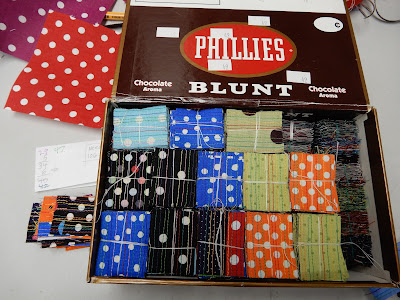
 A year ago I started working on a new project: memorializing the 2,662 coronavirus deaths in Kentucky in 2020.  I went to my stash of polka dot fabrics, the floating circles calling to mind the mysterious virus particles floating around in our air.  I made 2,660 tiny postage stamp quilts, each measuring approximately 1 3/4" by 1 1/4".  I counted them over and over as I bundled and packed them into cigar boxes, putting them away until I got around to stitching the whole thing into a huge grid.

I worked on other projects for the rest of the year, but brought the postage stamps back to be stitched together in November.  That turned out to be bad timing, because I had barely begun the process of sorting, counting and stitching than I realized I had to put them away and work on my annual Christmas ornaments.  

After the New Year I hauled the project out again, determined to finish.  To my dismay I realized that somewhere along the way, 70 bits had gone AWOL.  I know I counted them at least ten times along the way, but they were not there when it was time to get serious.  I looked on the floor.  I looked under things on my work table.  I looked on the shelves where the project had been stowed during the holidays.  No bits.  I cussed, I fretted.  Finally I sewed 70 new bits (thus ensuring that someday in the near future I will find the missing ones...) and finished the quilt.

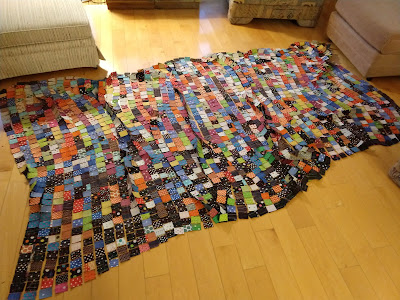
Last night I triumphantly hauled the quilt up from the studio and spread it out on the living room floor to show my husband.  And could hardly  believe how huge the damn thing is!!!

What you see in the picture is not the full expanse -- many of the columns are folded back on top of others.  I realize that the full width, if the columns are pulled flat, will be something like ten feet.  That's a lot of quilt; I may have to buy a new hanging rod, because the brass rods I usually use for postage stamp quilts aren't that wide. 

Now the only step remaining is to sew loops across the top of the quilt, so it can be hung from the rod.  And to disassemble the work surface that I constructed for this project, an old vinyl tablecloth spread across my entire sewing machine surround so the bits didn't get caught in any tiny gaps between surfaces.  

Then I think I'm done with the sewing machine for a while.  Back to hand stitching.  I have lots of ideas that I need to get going on!

Sunday, September 19, 2021

Lots of comments

There were lots of comments on my two latest posts, and rather than just leave a reply comment of my own, where probably nobody would see it, I'll take this post to reply to everybody. (That's one feature that I like in Instagram: if you comment on a post, and subsequently somebody -- the original author, or another reader -- replies or likes it, the system will tell you, even if your comment was made long ago.) 

I wrote about all the reading that I've been doing since lockdown, and how I have come to like e-books better than paper.  Shasta Matova commented:  "There is a time for both, so I don't try to make a choi8ce, but I too like ebooks especially when the library is closed.  Besides the benefits you mentioned, they remember where you left off and give you definitions for words I don't know."  

Idaho Beauty wrote:  "There are times when (e-book) is the only way I can get a book through my library but I don't enjoy it nearly like I do holding an actual book and turning the pages by hand rather than by swiping (and I do hate that sound that is sometimes added to mimic the sound of an actual page turning)."    

Idaho, I too would go crazy with that kind of sound effect.  I always keep the sound turned off on any kind of device, turn it on only if I want to hear something.  I'm sure there's a way you can adjust the preferences in your ebook to deep-six that feature.  It took me several months before I figured out that I could stop the system from showing me passages that other readers had highlighted!  First off, I don't care what other people choose to read and remember, and second, I was really cheesed at how stupid most of the highlighted passages were.

I also wrote about my newest quilt project, a memorial marker for all the U.S. military dead in Afghanistan since 2001, as well as memorials to those dead from covid.  Robbie commented: "I applaud you for all your effort on these projects!  Hope they can all be displayed and appreciated by so many."  Norma Schlager wrote: "I especially like that you are using uniform material on one side and other fabrics on the back.  Can't wait to see how this one turns out."  Martha Ginn wrote:  "Very appropriately dark, drab and sad -- an apt description of this conflict."


Cindy wrote: "I find your work a lovely tribute to those who are gone.  Not morbid in the least."

Irene MacWilliam wrote:  "I think my mind works somewhat like yours.  I am living in N Ireland and wanted to do a piece in memory of all those who had died in our 'troubles' conflict between 1969-1994... This piece has just been bought by our museum which has a collection to do with The Troubles.  I do a lot of work to do with conflict and how it affects families."   Irene, good for you!  I think that one of the most important jobs for artists is to witness to the stupid and destructive things that people do to one another.

Jenny wrote:  "Lest we forget: Afghan casualties from Western intervention amount to around 240,000 whilst Iraqis account for around 200,000...  a companion quilt perhaps?"  Jenny, you're right, war tends to be far harder on the civilian population who just happen to be standing there in the way than it is on the actual soldiers.  It has always been thus, but with modern weapons the killing power of each soldier is vastly greater than it was in past wars.  I can't imagine how one might go about marking that number of deaths; once you get into five figures the total has outgrown any technique that I might use.


Since I last posted, I've finished all the little bits for the Afghanistan memorial -- 2,461 is the number I'm going with. 

Thanks to you all for reading, and for commenting.  It's always good to hear from those at the other end of the cyber-talk!

Thursday, August 26, 2021

Afghanistan memorial

I have never been one for working on just one project at a time.  Some of my art friends find focus by finishing up one thing before starting on the next, but that's way too controlled for me.  I like to have several things going at once, picking up whichever one is closest to hand without walking up or down the stairs, whichever one is most conducive to stitching while talking with family and friends, whichever one fits my mood of the moment.

I've posted several times about my coronavirus memorials, marking each death in Kentucky with a french knot onto a roll of vintage bandage gauze.  I finished the 2020 memorial a few weeks ago (2,662 dead) and almost immediately started on a 2021 version (7,575 dead and counting as of this week).  I've finished January (1,083 dead) and am almost done with February (892 dead).  But the small scale of the knots got to be tiring, and I yearned for something bigger, faster, and involving the sewing machine.

So for the last few days I have been working on a new project, a memorial for the U.S. military dead in Afghanistan.  Longtime readers and pals will know that I did a similar piece in 2008 counting the U.S. military dead in Iraq, which traveled extensively with Quilt National '09 and is now owned by the International Quilt Museum in Lincoln NE.  It had a flag for each death, referencing the flag-covered coffins that came home from that war.

Memorial Day, 2008, 86 x 100"

This one will be similar in format -- a single little quilted rectangle for each of the dead, held together with stitching in space -- but different in materials and concept.  

Memorial Day, detail
The brother of one of my dear friends and art pals was a career Navy man, serving as Chief Surgeon for the group of ships supporting the Theodore Roosevelt in the Persian Gulf during the Iraq war, and then on the ground in Afghanistan at the hospital in Kandahar.  After he retired a few years ago, he decided to divest his old uniforms, and through his sister, they came to me for purposes of art.

At first I wasn't sure what to do with them but with the impending end of our Afghanistan adventure I thought that war needed a memorial as well for the troops who served and died.  Cutting up the camouflage uniforms will give me the fronts of the small quiltlets for this memorial; the backs will be made from a large variety of fabrics, to remind us that every one of those uniformed dead was an individual, a person with hopes and dreams too soon cut off.

The death count is suprisingly inexact, (perhaps because so many of our military and support activities were outsourced to contractors and it's hard to tell who's military and who isn't)  and there will probably be a few more in the coming days and weeks as we attempt to make a final exit, but it's somewhere in the vicinity of 2,400.  A lot fewer than in Iraq (4,431 dead since 2003; there were 4.083 when I made my Memorial Day quilt in 2008).

This compulsion to count the dead probably sounds morbid and obsessive.  I don't think I'm particularly preoccupied with death, certainly not in my daily life, where I have been blessed not to be closely touched by the coronavirus or the war, and where I've lost only one close family member in the last decade.  But the historian and journalist in me always wants to find out the facts and write them down, and the soldier's daughter in me always wants to remember how war is not glory, it's hell. 

I'll write more about this project soon, because working with the uniforms has proven to be quite a surprise.


Friday, February 26, 2021

Phase 1 finished!!

I have made 2,662 postage-stamp-size quilts, their polka dots signifying coronaviruses floating around in the air around us, each one marking the death of one Kentuckian to the disease in 2020.  That was the easy part.  Now it's time to sew them together into a big grid.


But first, arithmetic.  

I'm not one for a whole lot of planning before I start a project.  Some people may find security in sketching, measuring, samples, templates, junior "etudes" before embarking on the real thing.  I find those things unnecessary, time-wasting and anxiety-provoking.  I like to get on with it, and let the actual materials tell me how they want to behave, what they want to become, even as we work together.

I did make an attempt to pre-plan this project.  I thought I would make my postage stamps 1 1/2 inch wide and 1 1/4 inch tall.  So I cut my fabrics into 5 inch strips, planning to eventually slice them into four strips the right height, and then cut the strips into 1 1/2 inch pieces.  I made a couple hundred at those dimensions before I realized that they looked too square, and I wanted my bits to be more obviously rectangular.  Can't tell you why, they just looked too puny.  

Thought about this for a while, and then decided what the heck, let's change the size.  A few hundred smaller ones would surely not be apparently among a sea of larger ones, and if they were, so what?  People aren't all the same, why should their metaphorical embodiments have to be?  So most of the tiny quilts are 1 3/4 inches wide.  

But even if you can get away with changing the arithmetic in midstream while making the components, there comes a time in construction where you have to actually commit to a certain number.  Namely, how many columns of postage stamps to make, and how many stamps to sew into each column.  

Because I had upsized my bits, the full finished size got bigger too, and suddenly I was worried about it being too wide for my good brass rod that I always use to hang big postage stamp quilts.  I think I'll end up with about 2 inches per column, with the bits pushed pretty close together.  So I'm leaning toward 41 columns of 64 bits each, plus one extra column of 38.  Or something like that.  


I don't have to decide until I sit down to sew, and that can't happen until I clean off my sewing table and transform it into a huge, smooth, obstacle-free surface with no cracks or corners to impede the movement of the stitched grid.  A few days to think -- and then maybe I'll just flip a coin.

Monday, February 8, 2021

Back to the pandemic memorial sewing

The last time I wrote about my coronavirus memorial quilt at the end of January, I had 23 bundles of 25 postage stamp-size little quilts, on the way to 2,662 pieces -- the number of deaths in Kentucky in 2020.  With a few days off to sew Valentine hearts, I've been making good progress and now have 53 bundles -- halfway there!!  (I decided it was less daunting, and simpler, to count bundles rather than pieces.  It seems way less difficult to make 106 bundles than to make 2,662 bits.)

Meanwhile I decided that I needed a new hand stitching project, so I'm doing a second 2,662 memorial, this one in french knots sewed onto a vintage roll of six-inch wide bandage muslin.  

This piece is going to be organized by month, showing how the pandemic started slow, plateaued for most of the year, and then hit the fan in the post-Thanksgiving surge.

You know how I feel about planning -- the less the better.  I like to work out problems while stitching, not before.  I really have no idea how much space it's going to take to make 754 french knots, so I'm just sewing away.  Pretty soon I'm going to have to start counting, at least to estimate how many inches of bandage to give to December.  Then I'll work backward and allocate the same space to each of the other months.  

I think what I'll do is take a photo and pop it into my Paint program, then mark off each knot that has been counted with a click of my paintbrush, ten knots per color.  Like this:

That's 110 knots counted, so I think I have about 500 made so far.  Looks like I can do 8 inches per month.  I actually have enough bandage on the roll for 12 inches per month, so I don't have to worry about running out of space.

Thursday, January 28, 2021

Because you asked...

 After I posted yesterday about the coronavirus memorial quilt, Cozygirl left a comment and asked: "Will you handstitch the piecing together or use a machine?"

Answer: machine all the way!  

Several years ago I wrote a blog post about how I sew big postage stamp quilts together.  I still use the same method, and indeed the same little ziplock bags with numbers on them.  (On both sides, because you never know which side will be up at any given moment.)  

The quilt you see in these old photos is called "Epidemic" -- you can see the polka dots in it too, just like the new one.  I think some of the fabrics left over from that quilt will also show up in the one I'm making now.

Wednesday, January 27, 2021

Progress report -- coronavirus memorial

 I haven't decided yet what to call my memorial quilt, but I have made significant progress in the last few days.  To keep track, I'm bundling the little postage stamp bits into packages of 25.  

As of yesterday: 575 and change, on the way to 2,662.

For the back layer, I'm using a strange polypropylene fabric that people buy to tack on the bottom of upholstered furniture, among other uses.  It doesn't fray or ravel, so the only stray threads along the edges of my little bits will be those from the top fabric.  It's only $3 a yard, and comes in a lot of colors, but I'm using black, this being a memorial and all.  The only drawback to this fabric is that it melts into a horrible mess if you so much as touch your iron to it.  Ask me how I know.

after barely touching the iron


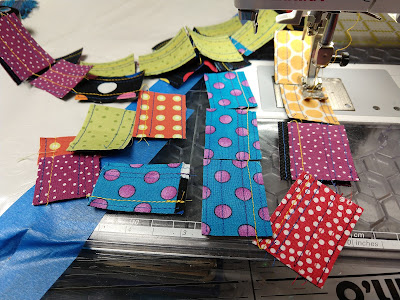
I'm cutting my fabrics into five-inch widths and putting in enough rows of stitching to hold the layers together before I slice them into 1 1/4-inch strips.  


Then I put in enough additional stitching to quilt the whole thing together, leaving one channel for my eventual line of stitching to hold the bits together horizontally.


Finally, I slice the strips into 1 1/2-inch bits.  I confess that after I did this meticulous planning and made a few hundred bits, I decided they would look better a touch wider.  So now I'm cutting them almost 1 3/4 inches wide.  I don't think the disparity is going to be a problem if the 300 smaller ones are subsumed into an expanse of 2,300 larger ones.  Probably even I won't notice the difference!

Friday, January 22, 2021

More deaths to count

Although I don't think I'm at all obsessed with death, I seem to have a recurring desire to mark and count the deaths associated with various national tragedies.  My first such effort was called Kentucky Graveyard (Iraq) and showed flag-draped coffins for all the Kentucky military who died in Iraq in the first year after our invasion.  My second was called Memorial Day and had a flag for each of the U.S. military who died in Iraq through Memorial Day 2008.


Kentucky Graveyard (Iraq) 


Memorial Day (detail)

I've been thinking for a long time about a similar project to count the dead from the coronavirus pandemic.  I've seen stories about artists who have put little flags out on lawns to count the dead, those who sew together small fabric bits, and those who make hash marks on fabric or canvas.  I thought of two different projects, and today I got started on the first of them.

It's along the lines of my Memorial Day quilt, actually a grid of thousands of tiny quilts the size of postage stamps.  Memorial Day had 4,084 little bits, and that was a pretty big project that took three months of fulltime studio work.  But the Kentucky coronavirus death count was 2,662 through the end of 2020, and 2,600 little bits seems manageable and yet big enough to make an impact. 

Fortunately, when the idea came to mind I had exactly what I needed already in the studio: a big stash of polka-dotted fabrics, which can easily signal either little germs floating about in the air, or the pox marking the afflicted.  In fact, I had used a lot of dots in a quilt made several years ago, called Epidemic.  (That quilt had a lot of holes in the grid, signifying people lost to the disease.)  I took all of this as a sign to make another epidemic quilt.


I've learned so much about how to construct these "postage stamp" quilts after making more than 15,000 little bits over the years.  This time I think the construction is going to go faster and more efficiently than I've ever managed before.  (I'll tell you more about that as the project progresses.)


I got 164 stamps sewed this afternoon, ready to be stitched into the big grid.  Only 2,498 to go...  


Sunday, October 18, 2020

A message from Alison 1

Recently I struck up an email conversation with Alison Schwabe, an internet pal who lives in Uruguay, whose blog I read.  She announced that she got into Quilt National 21 and lamented the fact that this time around she probably won't be able to go to the opening festivities next spring, as she had for all the previous QNs she was in.  I sent her congratulations and mentioned that I couldn't remember which of those celebrations she and I both attended -- the only time we have met in person, to the best of my recollection.

Alison wrote back and said "I think we might have both been at QN09 where your wonderful piece Memorial Day was hung so impressively there in prime position near the entry! ...I imagine it is in a collection now?"

Funny she should mention it, because just this month Memorial Day went off to its permanent home, at the International Quilt Museum at the University of Nebraska in Lincoln.  IQM is attempting to acquire as many as possible of the big prizewinners from all previous Quilt National shows, thanks to a grant from the Robert and Ardis James Foundation, and my quilt qualified because it won the Quilts Japan Prize at QN09.

It was a bittersweet task to pack up Memorial Day and send it away forever.  Yes, it will be seen by many, many more people, and be taken care of in much more archival fashion than it has been for the last nine years, packed in a box under my guest room bed.  But mothers always worry a bit when their babies grow up and leave home.

Here's a peek of it, still beautifully wrapped in a sheet from when I last had it out in public, and as it went away to Nebraska.  (Because the quilt consists of 4,083 tiny bits, hanging by threads, it's extremely difficult to fold it properly.  When I sent it off to QN I had three friends and a very large table to help me.  When I took it off the wall almost four years ago, my son and I struggled for a long time on the floor to get it refolded.)

Alison said she looked up Memorial Day in her QN catalog, "and remember being amazed that each of those tiny patches is a suggestion of a US flag, of red/white striped fabric with a tiny little piece of navy fabric in the top LH corner of each.  You had several different red/white striped fabrics, and I think each piece was double sided?  I didn't remember that the final row was incomplete... and I can't even wrap my mind about how you made that!"

She's right, each of the thousands of flags is a little quilt, made with red/white stripes on the front, plain green denim on the back, and a lot of stitching.  I had found a bunch of different R/W striped fabrics, and a bunch of different navy fabrics with little white stars or dots or random speck patterns to simulate the union of the flag.  And I had also bought a yard of an old Nancy Crow fabric with actual tiny flags to accurate scale (and made my homemade flags in the same size).  

The final column of the quilt was incomplete because the quilt marks the number of US troops who died in Iraq.  The count starts at our invasion in March 2003 and ends on Memorial Day 2008 -- 4,083.  All the columns had 70 flags except the last one, with only 23.

How I made that -- yes, it's hard to imagine the process.  It took me several "postage stamp" quilts to work out a process, and if you're interested, here's how I do it.  But after you've figured that out, it's just a case of sewing, sewing, sewing, sewing.  As I was trying to finish this quilt in the summer of 2008, I realized one day that my right knee was extremely unhappy.  Who knew that the sewing machine foot pedal was enough work to cause repetitive stress injury?  I finished the quilt with my left foot on the pedal (surprisingly difficult) and the knee rested up to normal, so a happy ending.

Thanks, Alison, for prompting my walk down memory lane -- and congratulations on your QN triumph!   

Thursday, July 30, 2020

Up against the wall!


PYRO Gallery is preparing for our first show since we closed abruptly in early March.  It seemed like the perfect opportunity to unveil my new postage stamp quilt, which is not only new and big but timely, because it's about coronavirus.  (I wrote about this quilt in April when I first started working on it.)


And so this afternoon my wonderful, tall and handy son helped me install it on the tallest wall in the gallery.


The lights haven't been adjusted yet so this isn't a very good photo, but you can see 169 little postage stamp bits socially distanced from one another.  (Some are more vigilant and compliant than others, just like actual humans.)

To make it hang properly, the columns needed to be weighted, and I wondered how to do that.  Then I found a whole bag full of rusty washers shaped like coronaviruses!

The show will run from August 6 through 29, at 1006 E. Washington St. in Louisville.  The gallery will be open from noon to 3 pm on Fridays and Saturdays, and the entire show will be up on the PYRO website for virtual visitors.

Saturday, April 4, 2020

Return to my sew-off squares


As you may know, I am a fan of what I call "sew-off squares" -- little bits of fabric that you use when machine-sewing sewing large projects to avoid having to cut your threads.  If you ever do any machine sewing, you should develop this habit!  Read about it here.  I often make such little squares deliberately for a certain quilt, sewing dozens or hundreds or thousands of them into airy grids, but I also make lots of them with no particular design in mind as a byproduct of sewing and quilting.  Some time ago I gathered several hundred of them and packed them neatly into a box on the shelf, but a week ago I decided I needed to return to them, and dumped everything out on the sewing table.  What you see here is less than half of what I started out with, because I have been using them!

Vickie asked me last week how I make the sew-offs, so I looked through my pile for examples to show you.  They range in size from as small as an inch to as large as two inches, which is why I also call them "postage stamps."

Some are sewed carefully with tiny grids, stitching lines neatly parallel and perpendicular.

Others are sewed more randomly on diagonals.

Some are stitched so densely that you can barely see the underlying fabric.


Since opening Pandora's box, I have done a lot of sorting.  I made some tiny grids as presents for other people:


I chose others that will eventually  be mounted for display.  These two sets will be on boards that I salvaged from a group project years ago, clamped resist for indigo dyeing.  You can still see a few of the circles from the C-clamps.


Mostly I have been using the sew-offs for a big project.  I usually make these "postage stamp" quilts with the grid quite closely packed, like this:


But obviously in these times of social distancing they need to stand farther apart!  So instead of leaving maybe a quarter-inch between the bits as I sew them into a grid, I'm spacing them about seven inches apart.


What you see here are several columns of bits, each one sewed onto a spine of fishing line.  When I get to the next step in the assembly, they will be spaced about seven inches apart horizontally as well.


Thursday, February 6, 2020

After a decade of putting stuff aside......


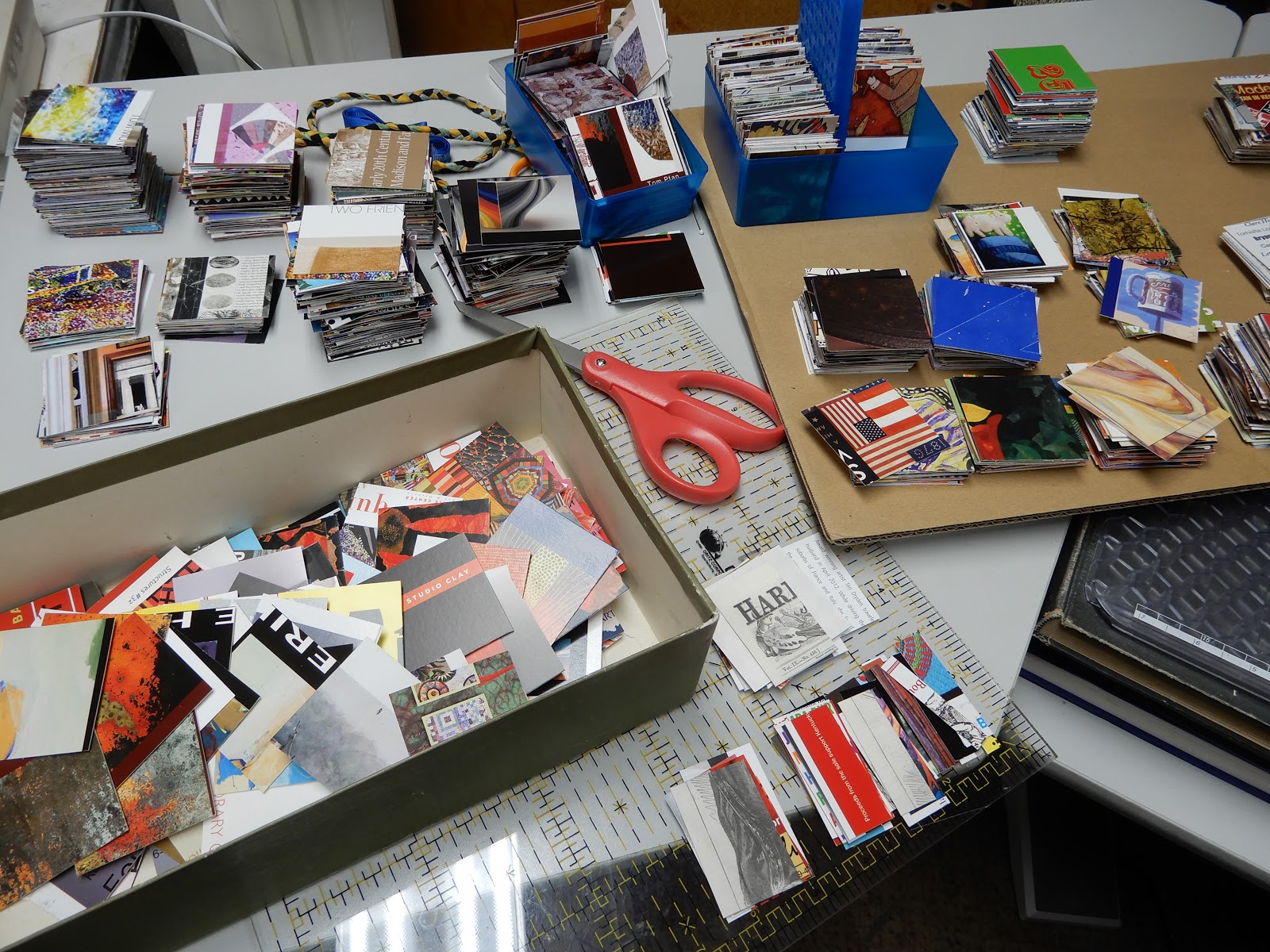
More so in the past than now, art galleries and museums were in the habit of sending out lots of postcards to announce new shows and exhibits.  I was on the mailing list for several places, and maybe ten years ago I started to save all the cards.  Carefully stashed them in nicely labeled boxes and thought that someday I would make art with them.

At the last meeting of my art group, the monthly prompt was "postage stamps."  After a great evening of looking at mail and stamp projects of many different sorts, I was reminded of my old idea of using those art show cards.

Kathleen Loomis, Memorial Day, 2008, Quilts Japan Prize in Quilt National 09


I have made lots of what I call "postage stamp quilts" in which tiny quilts, about the size of stamps, are machine-sewed together into an open grid.  I've also made a couple from paper, which has the advantage of not requiring the time-consuming quilting before you get to sewing the pieces together.

Fortunately the postcards were right there on the shelf, in pleasant contrast to other art materials that I know I own but can't find without serious searching.

After several days of cutting, I got to the sorting stage:

I had first thought to just sew everything together into one huge grid, but then realized that first, one huge grid would be harder to sew, harder to hang and less appealing to purchase.  And second, that the bits of card had many different kinds of imagery and I could find smaller theme groupings that would be more interesting.

So here is the start of a grid of hard-edged graphics, mostly orange and blue:

And here's a finished grid of little landscape scenes:

Sorry for the glare -- it's impossible to take a decent photo because the glossy card stock is so reflective.  Fortunately these pieces don't need to be photographed for jurors -- they can go straight to the wall for my show this summer.

Saturday, December 7, 2019

Last week on Art With a Needle


Seems like I didn't do anything all week except work for PYRO Gallery.  I did a shift of gallery-sitting on Sunday, went in on Wednesday morning to hang my work, made the gallery tags for everything in the new show, printed them out and helped affix then to the wall on Thursday morning, went back Friday noon with a few more tags that for some reason hadn't been finished in time, came back at 5 to help set out the food for the reception, talked with dozens of people during the reception, made a few wall tags for new work that replaced things sold at the reception, and then back again to work a shift this afternoon.

It was an exhilarating week, because we had a very successful opening, but I am looking forward to not setting foot in the gallery for the foreseeable future.

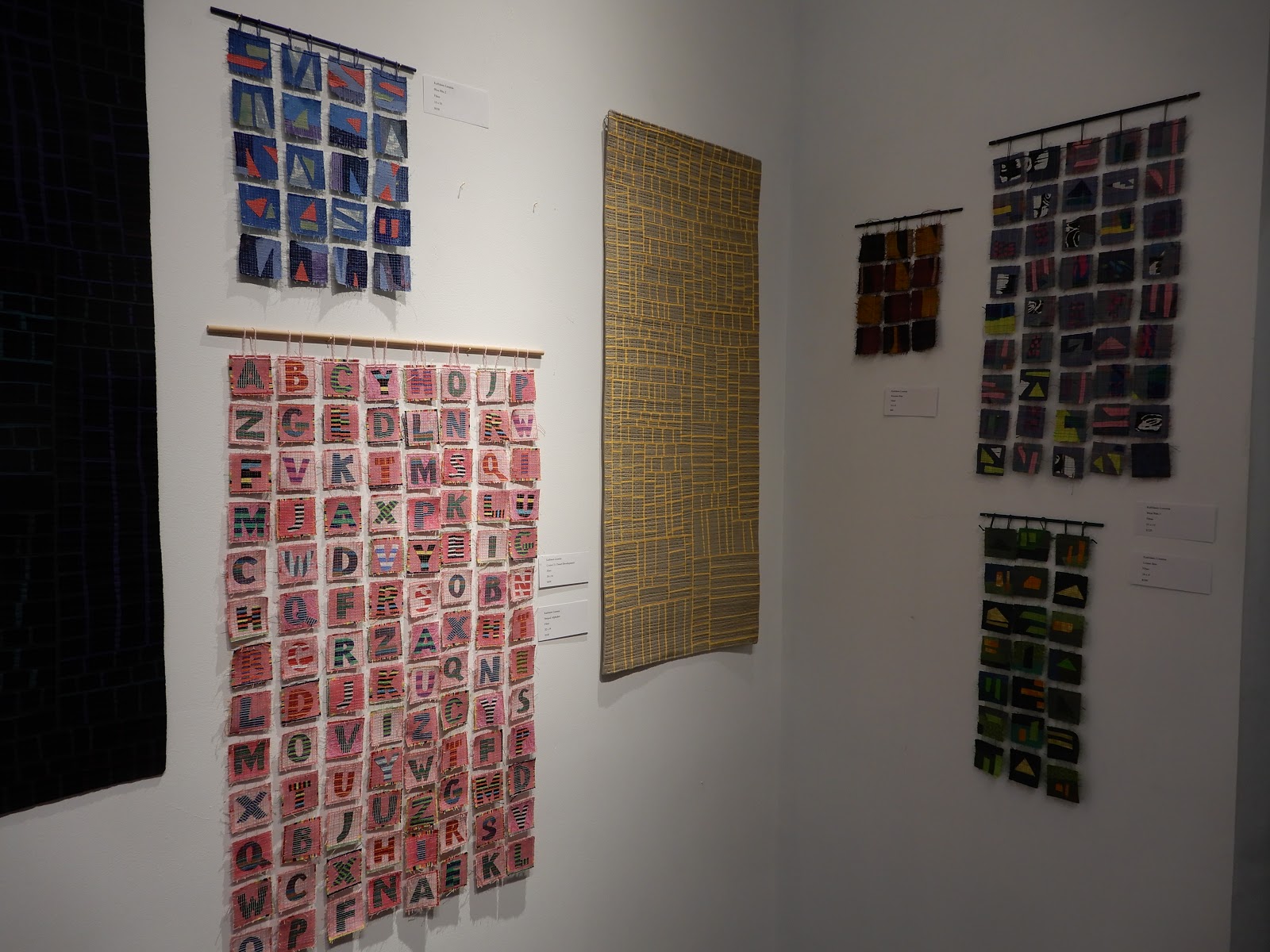
Three of my pieces sold last night, all of them the little postage stamp hangings.  This morning I rooted around in my boxes and found one more postage stamp piece that I hadn't taken in, and found another one pinned to my design wall, which with 15 minutes work was ready to be hung.  So I hung the two new pieces in the holes left by the sold work.

six postage stamp hangings, before the opening reception

minus three, plus two, this afternoon

A comment on the blog this week from Rose, who noted my mention of my broken ankle and told me about HER broken ankle last year.  I had it so much easier than she did, and so much easier than a lot of other people I have talked to who broke ankles or other pedal bones.  I am so fortunate -- it could have been so much worse.  I guess we're getting to the age range where it's so much more common to fall, and to suffer consequences.  I wish for all my friends and readers a great new year, free of broken bones and other misfortunes.

Here's my favorite miniature of the week: