This morning somebody on a quilt/art email list wanted to know whether anybody was collecting quilts to send to Haiti. I couldn’t help but groan – here we go again!
Every time there's a disaster the knee-jerk reaction of many folks is to send stuff. Remember after Katrina people were loading trucks with bottled water and the old T-shirts straight off their own backs and god knows what all kinds of other stuff for New Orleans? We might also recall how most of those shipments did not reach actual victims, or at least not until much, much later. (Part of that was due to government incompetence, but part was due to the very nature of ad hoc relief.)
Quilters seem to take this knee-jerk reaction to another level -- sending not just stuff, but handmade stuff.
I think that in planning our response to disasters we need to make distinctions between things that are needed and things that are emotionally pleasing. Immediate needs are far better satisfied by relief organizations that can buy in bulk and have established distribution channels.
Just run down a fast mental checklist – Do they need warm bedding in Haiti (it’s a tropical climate)? If so, do they need quilts, as opposed to fleece blankets or other warmer, more durable coverings? If so, do thousands of people have a nice (but not too nice) quilt sitting around that they would be willing to put in the mail today? If so, can you imagine a more inefficient form of getting the quilts to actual people? Relief agencies who can buy blankets by the container-load can certainly provide ten or a hundred times more blankets for the money than we can individually, and get them there overnight.
In the later aftermath of disaster sometimes people benefit from the emotional payoffs of handmade stuff. For instance, it may be nice for a bereaved/bereft person to get warm vibes from a connection to the individual who made a quilt. It may be even nicer for a bereft person to get an individual gift that incorporates the victim's own story -- as, for instance, the souvenir quilts made of clothing from 9/11 victims, or Operation Kid Comfort, which makes quilts for children depicting their soldier-parents in Iraq or Afghanistan.
But more frequently, I suspect, the lovingly handmade and donated quilt is appreciated no more, and maybe less, than the mass-produced fleece blanket. I also suspect the major benefits of such gifts go to the givers, not the recipients.
I am too young to remember World War 2 but I have read how the famous collection drives where people donated their bacon fat and other household wastes "to the war effort" were actually shams -- they didn't need the bacon fat but the shared sacrifice and enhanced patriotism of such activities were good for people and good for the country. That's fine -- I think shared sacrifice is something the US needs a lot more of these days -- but don't you feel kind of lied-to and patronized by such approaches?
Anyhow, if you want to feel all warm and fuzzy right this minute, send money to an organization with a good reputation for disaster relief, a low percentage of donations diverted to overhead, and a presence on the ground in Haiti. I did that this morning via Lutheran World Relief and I feel fuzzier than if I went down to my studio to make a quilt.
Thursday, January 14, 2010


Wednesday, January 13, 2010
The Viola Arnold Memorial Postcard Project
After my mother died I decided to continue sending daily postcards in her memory. Each of her 11 closest relatives (2 children, 3 children-in-law, five grandchildren, one great-grandchild) got a month of postcards. My sister, who had been Mom’s daily caregiver, got two months of cards. At the end of each month, I asked the recipient to send a postcard to a friend in memory of Mom.
While Mom was happy to receive random cards and messages, I thought I needed a little more intellectual rigor in what I sent to other family members – after all, who but a mother could sustain interest over a period of years in what her darling fixed for dinner? So I decided to have a theme every month.
January’s theme was “Art By People I Know.” February’s was “The World (Book) of the 70s.” I have a set of World Books bought in the 70s when my kids were little -- and what is so obsolete as a 30-year-old hard-copy encyclopedia? I decided I was willing to cannibalize it for art, and found 28 articles on old technology, current events that had yet to be upended by history, and downright dumb things, like the lavishly illustrated and totally imaginary depiction of interplanetary space travel, which would be happening any day now, or so the World Book said.
March was called “Room and Board,” a collection of old cards from hotels, motels and restaurants.
In April, however, I fastened on a new approach, which took vigorous root and, I think it’s safe to say, changed my life as an artist. That approach was to start carrying my camera on my daily walks, in search of photos for the monthly theme. April’s theme was “Pathetic Landscaping,” and it turned out to be easier than one might hope to find 30 really striking examples! Those cards went to my brother-in-law, an avid gardener whose own landscaping is the antithesis of pathetic.
So what was so life-changing about this perfectly ordinary concept? I learned that my style of photography is not to search for beauty or grandeur – it’s to look for and document small themes and ironies in ordinary surroundings. Four weeks of keeping an eye out for pathetic landscaping, for instance, made me notice how many people in one part of town chose the same lawn ornament.


Monday, January 11, 2010
The six-year postcard project
On January 3, 2003, I had a good idea. I would do a “performance art” project in which I would send my mother a postcard every day for the year. Wasn’t it a bit late to start a daily art project on January 3, you might ask? Well, yes, except when you make up projects you get to make up the rules. I had been in Virginia to see my mother for the holidays and had just gotten home, so my rules were that I didn’t have to send a card on a day that I had seen her in person.
The project turned out to be a big hit both with Mom and with me. I enjoyed finding cards that I thought she would like, and she liked getting a lot of mail! The cards didn’t say anything really memorable –one from an uneventful day might report on the weather, what was happening in the garden, and what we had for dinner. But it was a way to keep in touch, and the cards were permanent; Mom could go through them as often as she wanted, reread the messages and look at the photos.
When it got close to Christmas Mom started dropping hints that she was sure going to miss the postcards when the year was over, and it became apparent to me that my one-year performance art project was going to be a lifetime endeavor. I sent her a card every day I didn’t see her for almost six years, until she died in December 2008.
At the beginning of the project I thought maybe I would make fancy cards, along the lines of the fabric postcards that some fiber artists send. But it didn’t take long for that idea to hit the skids. For one thing, it took too long to make. For another, it cost more to send anything thicker than card weight, or with loose embellishments. And most important: Mom really liked plain old commercial tourist picture postcards the best. She and my father had traveled widely in the day, and many of the cards showed places she had been.
Sometimes I would cut out an interesting photo or clipping from the newspaper and paste it to the card. Often I sent cards from art exhibits. After I got a small photo printer for a birthday present, I could print out my own pictures onto 4 x 6 index cards, the perfect size for mailing. I bought postcards voraciously whenever we traveled, and haunted flea markets, particularly one in Floyd VA where I could buy vintage cards for 25 cents (cheaper than I could get a lot of new postcards). Best of all, many of my friends helped feed my postcard habit, sending me cards from their collections or purchased on their own vacations.
Sometimes we had themes, like a week of birds or a week of flowers. Once we had a full month of cards from New Zealand; several times I cut up old Christmas cards to postcard size and sent them in December.
When Mom died I discovered that not only did I miss her terribly but I missed sending the postcard every day. There were only a couple of weeks left in the year but that was long enough for me to realize that I wasn’t ready to give up the performance art project. So on January 1, 2009 I started the Viola Arnold Memorial Postcard Project, which lasted a year. While the original postcard project was totally loose, the Memorial Project had more structure. I’ll write about that in a subsequent message.
Mom kept all the cards over the years. At the start of the project I made her a couple of fabric boxes in which to keep the cards, but they were soon outgrown. I have all the cards now but haven’t been able to go through them yet. Eventually I should be able to reconstruct six years of my own life in excruciatingly boring detail!

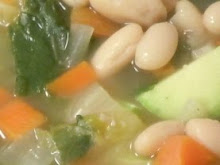
This was a particularly beautiful bowl of soup that made a nice postcard.
The project turned out to be a big hit both with Mom and with me. I enjoyed finding cards that I thought she would like, and she liked getting a lot of mail! The cards didn’t say anything really memorable –one from an uneventful day might report on the weather, what was happening in the garden, and what we had for dinner. But it was a way to keep in touch, and the cards were permanent; Mom could go through them as often as she wanted, reread the messages and look at the photos.
When it got close to Christmas Mom started dropping hints that she was sure going to miss the postcards when the year was over, and it became apparent to me that my one-year performance art project was going to be a lifetime endeavor. I sent her a card every day I didn’t see her for almost six years, until she died in December 2008.
At the beginning of the project I thought maybe I would make fancy cards, along the lines of the fabric postcards that some fiber artists send. But it didn’t take long for that idea to hit the skids. For one thing, it took too long to make. For another, it cost more to send anything thicker than card weight, or with loose embellishments. And most important: Mom really liked plain old commercial tourist picture postcards the best. She and my father had traveled widely in the day, and many of the cards showed places she had been.
Sometimes I would cut out an interesting photo or clipping from the newspaper and paste it to the card. Often I sent cards from art exhibits. After I got a small photo printer for a birthday present, I could print out my own pictures onto 4 x 6 index cards, the perfect size for mailing. I bought postcards voraciously whenever we traveled, and haunted flea markets, particularly one in Floyd VA where I could buy vintage cards for 25 cents (cheaper than I could get a lot of new postcards). Best of all, many of my friends helped feed my postcard habit, sending me cards from their collections or purchased on their own vacations.
Sometimes we had themes, like a week of birds or a week of flowers. Once we had a full month of cards from New Zealand; several times I cut up old Christmas cards to postcard size and sent them in December.
When Mom died I discovered that not only did I miss her terribly but I missed sending the postcard every day. There were only a couple of weeks left in the year but that was long enough for me to realize that I wasn’t ready to give up the performance art project. So on January 1, 2009 I started the Viola Arnold Memorial Postcard Project, which lasted a year. While the original postcard project was totally loose, the Memorial Project had more structure. I’ll write about that in a subsequent message.
Mom kept all the cards over the years. At the start of the project I made her a couple of fabric boxes in which to keep the cards, but they were soon outgrown. I have all the cards now but haven’t been able to go through them yet. Eventually I should be able to reconstruct six years of my own life in excruciatingly boring detail!

This was a particularly beautiful bowl of soup that made a nice postcard.
Sunday, January 10, 2010
Great and not-so-great minds....
So the new issue of Art in America came and the cover reminded me of -- me!

Here's Lattice Picture by Josef Albers.

Here's a detail of Postage 2: The Great Lawn by me. And at the right are details of two similar pieces by me.
A few comparisons come to mind.
-- his is made from glass, iron and copper wire; mine are made from fabric and thread
-- each of his little bits is a little over one inch square; each of mine is somewhere in the vicinity of 1 1/4 x 1 3/4 inch
-- his little bits are arrayed against a solid black background in a black frame; mine hang from rods, either against the wall or in the middle of the room
-- his has 110 little bits; mine have a lot more (about 1300 in The Great Lawn, the smallest; just over 4000 in Memorial Day, the largest)
-- he's famous; I'm not
-- he's dead; so far I'm not.


A few comparisons come to mind.
-- his is made from glass, iron and copper wire; mine are made from fabric and thread
-- each of his little bits is a little over one inch square; each of mine is somewhere in the vicinity of 1 1/4 x 1 3/4 inch
-- his little bits are arrayed against a solid black background in a black frame; mine hang from rods, either against the wall or in the middle of the room
-- his has 110 little bits; mine have a lot more (about 1300 in The Great Lawn, the smallest; just over 4000 in Memorial Day, the largest)
-- he's famous; I'm not
-- he's dead; so far I'm not.
Friday, January 8, 2010
Art-A-Day
I've always been drawn to what a good friend of mine calls "art-a-day" -- the commitment by an artist to do something every day for a period of time. Sometimes that results in work meant for the artist's eyes only, such as the many variations on sketchbooks or journals. Sometimes it results in finished art, as the daily work ends up assembled into a package or exhibit.
I've done daily art several times in the past, and I'll post about those projects soon. But my immediate purpose is to go public with my project for 2010, a photograph every day. I considered setting rules such as a theme or subject for the photos, but decided to leave it open-ended for now. Maybe as the year progresses and the photos accumulate, they'll make themes for themselves.
Here's my first week of photos.


January 3 -- a bitterly cold day, with the construction workers intelligently spending the afternoon indoors

January 4 -- real estate still in the toilet


January 7 -- snowbound pumpkin
Subscribe to:
Posts (Atom)