Friday, October 30, 2015
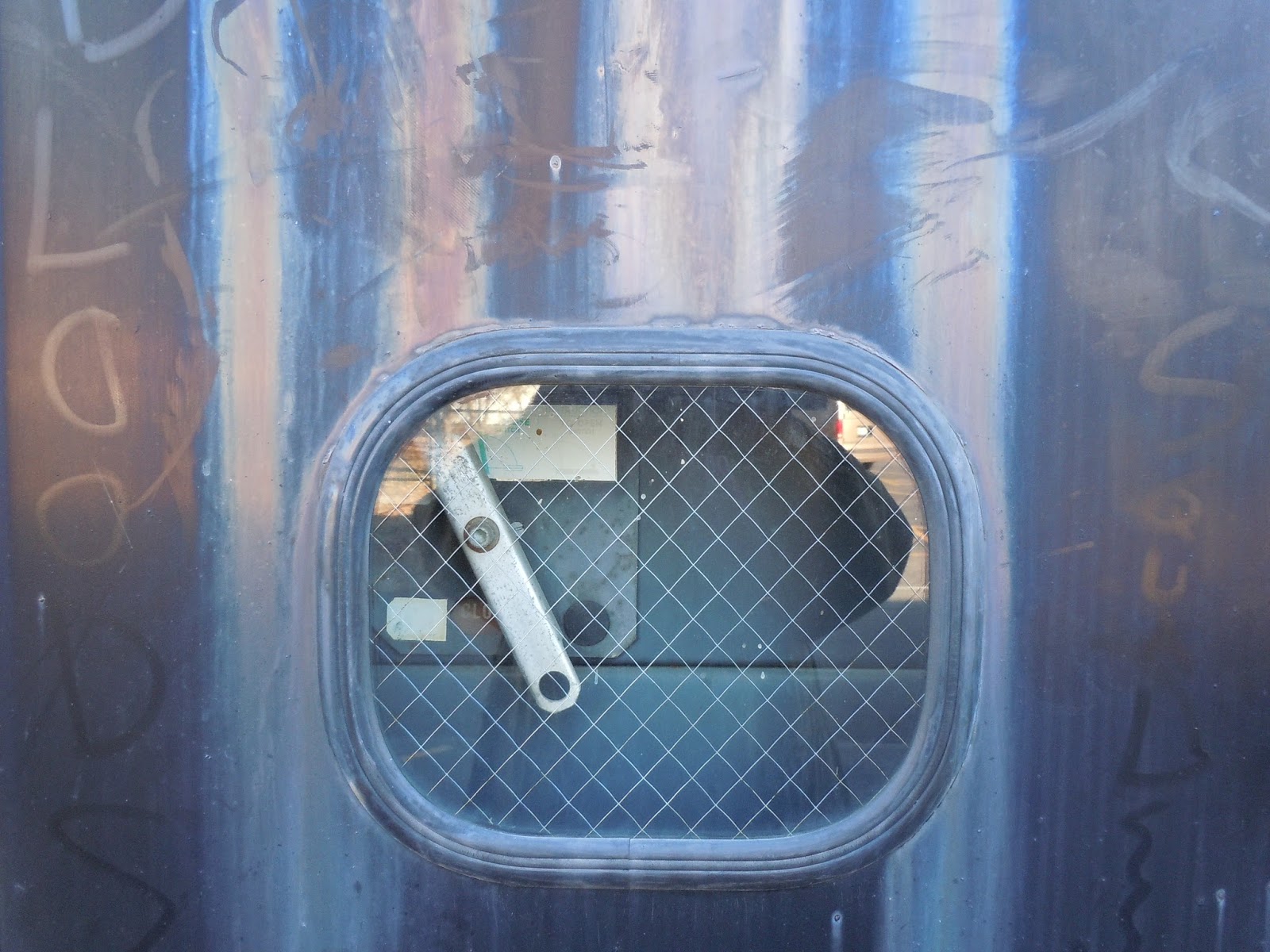
Sign of the week
On the train platform, Yokohama:
In case you can't read it (the English part, that is):
Women Only
Boys of primary-school age and below, handicapped men, and men who are helping handicapped persons may also ride in women-only cars.
All trains arriving at Tokyo between 7:30 and 9:30 (weekday)
Wednesday, October 28, 2015
Divestiture 3
Ten years ago I took a workshop from Nancy Crow in which we were supposed to make a vertical composition 4 feet by 8 feet in black and white, contrasting areas of small, complicated piecing with areas of larger, more serene expanses. I begged permission to make mine horizontally instead of vertically, as I have problems on ladders, and came up with the idea of a semicircle, which of course would fit perfectly into a 1x2 area.
Black Planet, in progress
I liked my black and white composition but never got it completed in the two days allotted, let alone sewed together.
Then we were supposed to replicate the composition but add neutral colors to the B&W. I got this far in the workshop and never returned to either of the pieces when I got home. My design walls at home are nowhere near as expansive as at the Crow Barn, and I got distracted by finishing up my alphabet series for a solo show later that year.
Brown Planet, in progress
(Brown Planet, still pinned to its design wall backing from the Barn, subsequently got passed along to my internet pal Norma Schlager, who finished it and entered it in Houston, where it won a prize.)
When I returned to the Crow Barn the following year I also returned to the exploding planet motif. My first try was a disappointment. I had wanted to get it sewed together, in contrast to the two previous Planets, and didn't take enough time. I liked the colors but thought the composition was too crude and didn't like the way the circle was cropped at the right.
Blue Planet, in progress
I took that one down and started a second one.
second Blue Planet, in progress
This one I worked on at home and finally finished in 2011. I wasn't thrilled with the composition (probably should have stopped piecing four inches down) but it was a workmanlike effort and I thought it might just be appropriate for some second-tier show.
Blue Planet, in progress five years later
The bigger problem was that it didn't match any of my other work. Right after I began the two blue planets, I started working with my fine lines technique, which has occupied me for the last eight years. As the fine line series progressed, I became more and more reluctant to show work that was not related, especially since I had no immediate plans to continue with the exploding semicircle motif. So Blue Planet sat on the bed for years all by its lonesome.
When my fiber art group took on its community service project to provide art for our local Child Advocacy Center, I thought maybe Blue Planet had found its destiny. And here it is, in the lobby at the reception last night.
It's hard to see in this photo, but there's a bend in the wall and the quilt fits perfectly on that panel with about three inches on each side.
Several people asked me if I had made the quilt for the space. I said no, but maybe that was the wrong answer.
Tuesday, October 27, 2015
Divestiture 2
I wrote earlier about my fiber and textile group's community service project to make art for a local children's agency. I went through my piles of old quilts and found several to donate. Here's a pair of quilts that I made to illustrate a concept.
I never did anything more with the concept, until today, so this post can be both a show-and-tell and a project lesson.
At the time I had recently acquired a huge pile of solid strips, which got to me in a convoluted way. Many years ago Caryl Bryer Fallert (now Fallert-Gentry) taught two week-long workshops at Quilt Surface Design Symposium. Week one dealt with strip piecing, and all students had been asked to bring in a bunch of strips to contribute to a communal pile. They apparently brought in way more than they were able to sew, because when week two rolled around and my workshop occurred, there was still a big pile of strips on the table.
Caryl said we were all welcome to use the strips, and I did -- in fact, it sent me down the road on a long series that I should write about sometime. On Friday afternoon Caryl announced that she wasn't taking those #@%&* strips home with her, so if anybody wanted some, take them! You know me well enough to know that I did, and I worked with them for several years. Probably still have some stashed away somewhere in my studio.
So back to the project lesson. Start by making five log cabin squares, all the same size. I didn't own a digital camera at the time and therefore wasn't obsessively documenting process steps, so you'll have to take this part on faith. My five log cabins had alternating logs of black and bright colors, with logs of varying widths.
Stack the blocks up in a pile and slice across them at an angle. Carefully separate the two piles by an inch or so, keeping everything in the same orientation. Take the top piece on one of the piles and move it to the bottom of the same pile. You now have five top halves and five bottom halves, but if you take the top pair off, they don't match one another. Sew the pairs together. Now you have five blocks, each with a fracture seam in the middle.
Press the blocks, shuffle them and stack them up again, with all the seams going vertically. Slice across the pile on an angle, crossing the first seams. Again, separate the two piles, move the top piece on one of the piles to the bottom, and sew the new pairs together. You now have five blocks with two fractures in the middle.
Each block looks like this:
But since I had made five blocks, I got this little quilt plus a bigger quilt out of the project.
As I look at the pictures, I don't understand how I managed to get those different angles on the cuts. There should have been only two slices in the entire project, so all the angles should have been the same.
Maybe I did the slicing in two separate batches. Guess I'll have to deconstruct the photos and figure out what happened. And if I ever want to teach this technique I'll have to make a new sample with simpler planning. But not today.
Labels:
good causes,
machine piecing,
quilts,
tutorial
Monday, October 26, 2015
Me vs. the system -- who won??
I am one pissed-off artist as I write this post. I just spent a half hour attempting to enter a juried show using the CaFE system, which I have used before but will never use again if I can help it.
CaFE is one of those "helpful" systems that wants to make life oh so easy for you but ends up making it nearly impossible to accomplish what you want to do. Like autocorrect and autofill, which so frequently refuse to accept the word you type in and substitute something else, CaFE thinks it knows what you want to do, and damn if it will let you override its plan.
Theoretically the helpful system should have been a breeze, because I was going to enter the same things that I had put in a previous show. There they were in "My Portfolio" and when I checked the two images, they popped themselves up into place. Or I guess they did -- I had been asked some questions about "Entry 1" and "Entry 2," but I could never figure out which of the two pieces got dubbed 1 and which got dubbed 2.
After I had entered the previous show I had second thoughts about the price I had put on the works, and now decided I'd better go back and see if I wanted to revise the number. But CaFE wouldn't let me go to that part of the system -- even to see it, let alone edit it. I spent ten minutes clicking from one link to another trying to access where I had previously entered info about the pieces, but without success. The only thing I could see when I clicked "review your entry" was one photo of each piece -- no dimensions, no price, no date of completion.
Finally I got tired of clicking and figured I'd just pay the damn money and be done with it. But the system now told me that one of the images I had selected was committed to another show and could not be submitted. Decided to log out of the system, not yet having given them my credit card or completed the transaction, and log on again, hoping it might let me start from scratch. No such luck. I thought about it for a bit, tried to gauge how much I really wanted to be in this show, and decided it was time for a stand on principle, namely that I refused to be jacked around any more by a computer system.
Unspooled, 2015, not entered in the Mid-States Craft Exhibition, Evansville Museum of Art, Evansville IN
I've recently heard some other horror stories about CaFE from a friend who was involved in organizing a show and got to see the output. The system wants images that are 1920 pixels on the longest side, but "helpfully" is willing to resize the images for you if you upload something larger. Except that my friend swears the helpful system sometimes produces distorted images because it doesn't know how to get the resizing right.
I plan to let the museum know why I didn't enter the show. I have used lots of online entry systems but haven't kept track of which ones have the features I love or hate. I know that some systems work way better than others, and it seems that the simpler the system, the better it works. I for one would much rather upload my images twice than have the system take them hostage in May and not give me control over them in October.
Show organizers, beware the bells and whistles of systems like CaFE that pretend to be "helpful" but are just obstinate. Artists have better things to do than jump through 27 hoops to enter your show.
Sunday, October 25, 2015
Photo suite 200 -- still taking pictures
When I started this series of photo suites on January 1, 2012, I showed a bunch of pictures of me taking pictures. Now that I'm up to #200 in the series, it seemed appropriate to show you that I'm still taking pictures. And wearing the same hat.
Thursday, October 22, 2015
Divestiture 1
My local fiber and textile art group does a community service project every year or so in which we make art for some worthwhile agency to decorate its premises. We have work hanging in a cancer hospital, a forest/nature preserve, a substance abuse treatment center, a hospice and a children's home. This year we're working with an agency that helps abused children with medical and psychological care and with a facility where children can be interviewed by one person on videotape and then not have to testify and be cross-examined in a courtroom.
The agency has just moved to a new home, with lots of long, long walls totally devoid of artwork. In fact, their recent accreditation hinged on the promise that we were going to provide plenty of art. In addition to making the place look more friendly, the staff will use the artwork as a fast way to build rapport with children as they are escorted to the treatment and interview rooms, and to quickly gauge their verbal and emotional states in advance of the actual encounter.
Many of our members did artwork onto canvases, which were provided in two sizes, but anybody with larger works to donate was welcome to do so. I took the opportunity to go through my piles and piles of old quilts and was able to come up with a baker's dozen that I was willing to part with.
First, I found a stack of little quilts from 2001 and 2002 that don't say anything and don't go with one another, even though they're all exactly the same size, 15 1/2 inches finished. I seem to recall that the plan was to make a sort of sampler quilt, in which they would be individually quilted, but then sashed together. I was using bits and pieces from scrap bags, leftovers and wherever, so there was no coherence. Fortunately I abandoned the idea of putting them together, and put bindings and sleeves on each one. Whereupon they have sat in a box for more than a decade doing nothing. I think they'll look fine in the children's facility.
Here are two based on Margaret Miller's great quilt recipe, "Strips That Sizzle."
Here are two where I was experimenting with strip piecing, then cutting the strips sets on the diagonal and re-piecing.
More strip-piecing-then-cutting-again, and leftovers from a baby quilt.
Here are two very traditional patterns. One block is about as long as I can work with a traditional pattern before getting bored and mixing it up somehow.
I'll show you more of my donations in a subsequent post.
Subscribe to:
Posts (Atom)